How to stop floor mats sliding
This is the one page in this section that is about safety rather than money. A mat that migrates forward can reach the pedals.
Heads up: the buy links on this page are affiliate links. If you buy through one, we earn a commission at no extra cost to you. It does not change what we recommend or the order we rank things in - here is how we keep those separate.
Why this page exists.
A floor mat that slides forward can interfere with the accelerator or brake pedal. Pedal entrapment by unsecured or stacked floor mats is a recognized safety hazard that NHTSA publishes guidance on and that has driven vehicle recalls. This is not a comfort issue.
Rule one: never stack mats
Do not put a new mat on top of the factory mat, ever, for any reason.
Stacked mats are the single most common cause of the failure above. The top mat is not held by anything, it sits on a smooth surface that lets it slide freely, and the combined thickness reduces pedal clearance before anything has even moved.
Take the factory mat out. Put the new one in its place, anchored to the same hooks. If you want the factory mat back in April, it stores in the garage until then.
The four methods that work
1. The factory floor hooks (best)
Most cars built in the last fifteen years have retention posts or hooks in the driver’s footwell, precisely because of the recall history. Vehicle-specific mats have matching holes or grommets.
Look for a round post or a twist-lock fitting in the carpet, usually toward the front of the footwell. If your mat has a grommet and your car has a post, use them — this is the method the car was designed around and nothing else is as secure.
2. Aftermarket anchor kits
If the car has no hooks, retention kits are inexpensive and fit through the carpet with a backing plate underneath. They install in about ten minutes with a screwdriver, and they turn a universal mat into an anchored one.
Fit them at the front of the mat, not the rear. The direction of travel you are preventing is forward, toward the pedals.
3. Hook-and-loop carpet fasteners
Self-adhesive hook-side discs stick to the underside of the mat, and the hooks grip the loops of the carpet directly. No tools, no holes, and they work well on cut-pile carpet.
They are less positive than a post, and the adhesive can let go in a hot car in summer, so check them when you refit mats each season.
4. Nibbed backing, as a supplement only
Most all-weather mats have a nibbed or spiked underside that grips carpet. It is a real effect and it is not sufficient on its own, because it relies on the mat lying flat — and a mat that has curled in the cold has lifted its nibs off the carpet.
Skip this
Two methods to avoid
Double-sided tape. It fails in the cold as the adhesive stiffens, it fails in the heat as it softens, and it leaves residue in the carpet. It also gives you no warning: it holds until the day it does not.
Anti-slip rug pads. The rubber mesh sold for rugs adds a layer between the mat and the carpet that is itself free to move. It reduces mat-on-carpet sliding by introducing pad-on-carpet sliding, and it traps moisture against the carpet.
The sixty-second check
Do this every time you fit or refit anything in a footwell. Engine off, in the driveway.
- Press the accelerator to the floor. It should reach the stop with no contact against the mat.
- Press the brake fully. Same test, and this one matters more.
- Move your foot from brake to accelerator and back several times. Nothing should catch on a mat edge.
- Push the mat forward with your hand as hard as you can. It should not reach the pedals.
- Look at the mat edge nearest the pedals. If it is close enough to reach them when moved, it needs trimming or a different mat.
Then repeat the check in a month. Mats bed in, anchors settle, and the cold changes how the material sits.
If your mat is curling, anchoring will not fix it
A mat that has gone stiff and curled at the corners has lifted itself off both the carpet and its own retention, and no amount of hooking it down keeps a rigid curled sheet flat.
That is a mat at the end of its life, and it is the characteristic failure of cheap compounds after a few freeze cycles. Replace it — the budget options are here and the tier above them is here.
What to buy, given all that
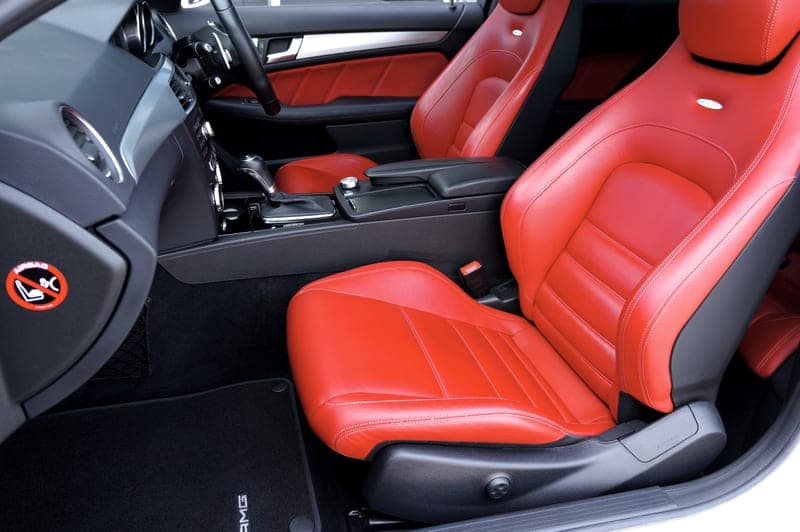
WeatherTech
WeatherTech All-Weather Floor Mats
Roughly $60-$100 a row
The same maker's flat mat rather than its walled liner, at roughly half the money. It has a deep channel pattern that holds a useful amount of water, and for most people in most winters that is genuinely enough.
Skip it if: You track slush in by the bucket. A flat mat overflows at the edges where a walled liner does not.
#ad We hold no verified live price for this product, so we show none. How this site is funded.
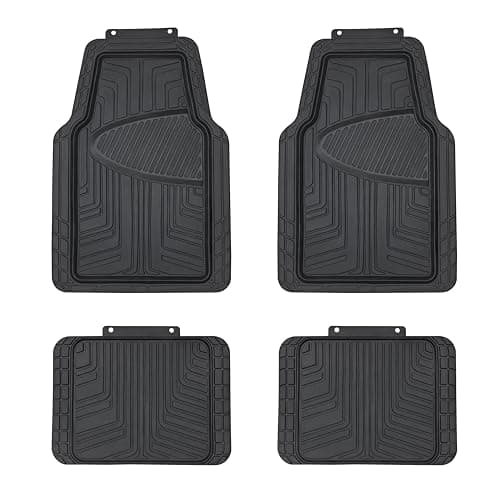
Amazon Basics
Amazon Basics 4-Piece All-Season Floor Mats
Roughly $20-$30 a set
The cheapest way to get something washable under all four sets of boots. It is a flat trim-to-fit mat, so it holds less water than a molded liner and it will never fit like one - but the salt ends up on the mat instead of the carpet, which is the entire job.
Skip it if: You want the driver's footwell done properly. A universal mat trimmed with scissors does not engage the factory retention posts, and that is the one footwell where it matters.
#ad Price as of October 18, 2026, from Amazon. Prices change. How this site is funded.
How this was ranked
Every site in this category says it tested twenty of these. We have not tested any, and we say so. What we did instead: built the candidate set from what Amazon actually stocks, compiled the published specifications from each manufacturer’s own pages, did the arithmetic on running cost and on what the thing prevents, and read owner reviews for failure patterns rather than star averages. Every number on this page has a link to where it was published, so you can check the work.
- Units we claim to have tested
- 0
- Sponsored placements
- 0
- Free products accepted
- 0
Frequently asked
How do I keep my floor mats from sliding forward?
Anchor them to the vehicle’s factory floor hooks if it has them, or fit an aftermarket anchor kit if it does not. Hook-and-loop carpet fasteners work as an alternative. Never rely on the nibbed backing alone, and never stack a mat on top of the factory mat.
Is it safe to put a rubber mat over the factory floor mat?
No. Stacked mats are the most common cause of pedal interference: the top mat is unsecured, it slides freely on the smooth mat below, and the extra thickness reduces pedal clearance before anything moves. Remove the factory mat and fit the new one in its place.
Why does my car not have floor mat hooks?
Older vehicles often predate the retention designs that became standard after floor-mat pedal-entrapment recalls, and some base trims omit them. Aftermarket anchor kits are inexpensive, install in about ten minutes with a screwdriver, and fit through the carpet with a backing plate.
Do anti-slip pads work under car floor mats?
Not well. The rubber mesh sold for rugs adds a layer that is itself free to move, so you have replaced mat-on-carpet sliding with pad-on-carpet sliding, and it traps moisture against the carpet underneath. Use a mechanical anchor instead.