Maintainer, trickle charger, charger: three different things
These words are used interchangeably in shops and on packaging, and they should not be.
A trickle charger, in the original sense, delivers a small constant current and does not stop. Leave one connected indefinitely and it will overcharge the battery, boil off electrolyte and shorten its life. Some products still sold under that name behave exactly this way.
A maintainer (also sold as a “smart charger” or “battery tender”) monitors voltage, charges when the battery needs it, and drops to a float or standby state when it does not. That is what makes it safe to leave connected all winter, and it is the only category you should be considering for a parked vehicle.
A charger is sized to recover a flat battery quickly. Higher current, shorter connection, usually a different purchase. Modern smart chargers frequently do both jobs, which is where the terminology got muddled in the first place. The distinction, and why it matters, is here.
One naming trap worth stating plainly: “Battery Tender” is a brand name, not a product category. People searching for a battery tender are usually searching for a maintainer, and the two are not synonyms.
The specification that actually matters
Amperage is the number on the box, and it is not the number that decides this purchase. For maintaining a healthy battery, anything from 750 mA to 2 A is fine; the difference only shows if you are trying to recover a flat battery, where 1 A takes about twice as long as 2 A.
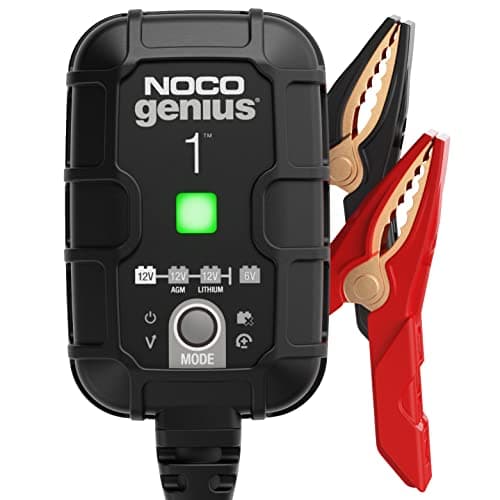
The specification that matters is the operating temperature range, because the device is going to spend the winter in an unheated garage. Only one maintainer in our group publishes one: NOCO rates the GENIUS1 from -4 F to 104 F. Battery Tender and Schumacher do not publish a figure for their equivalent units. We say so on their product entries rather than assuming they are fine, because an unpublished spec is not a passed spec.
The second thing to check is chemistry support. If your car has an AGM battery — common on anything with stop-start — or you are also maintaining a lithium powersports battery, the charger needs a mode for it. Charging AGM on a flooded-lead-acid profile shortens its life.
What it costs to leave one running
This is the arithmetic that makes the decision obvious, and nobody in this category publishes it.
NOCO publishes 15 W maximum consumption for the GENIUS1, and it draws far less than that once a battery is topped up. Take the worst case anyway: 15 W for eight hours is 0.12 kWh. At the U.S. average residential rate of 18.34 cents per kWh (EIA Electric Power Monthly, June 2026) that is about 2.2 cents a night, or roughly $2.64 across a 120-night winter. A replacement battery is commonly $150 to $250 fitted.
A jump starter is a different purchase, not a cheaper one
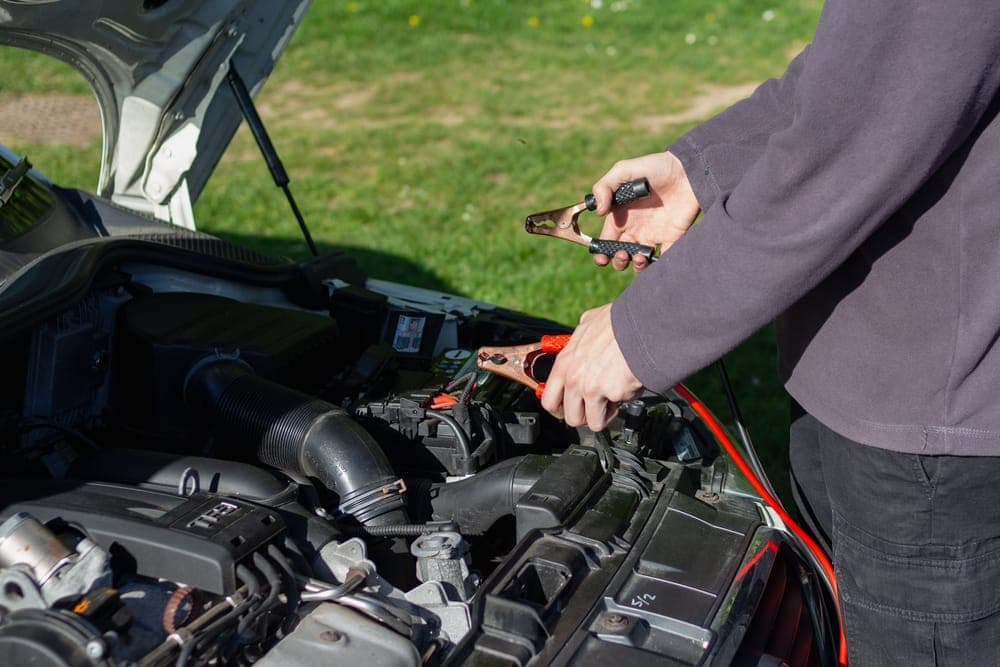
A lithium jump pack solves the emergency: the car is dead, nobody else is around, and you need to be somewhere. It is genuinely worth owning for that. What it does not do is address the cause, and using one repeatedly on the same car is a way of avoiding a conversation about a battery that needs replacing.
It also has its own cold-weather caveat: lithium capacity falls in the cold, so a jump pack left in a freezing trunk all winter may not have the charge you assumed when you need it. Charge it in autumn, keep it indoors, and check it mid-season. Which one you actually need is here.