Skip to content
Frost & Fender
Roundup

The best all-weather floor mats for winter

The extra money buys walls. Everything else between these products is a matter of degree, and for most people the walls are optional.

By Scooter M.Published September 1, 2026

Heads up: the buy links on this page are affiliate links. If you buy through one, we earn a commission at no extra cost to you. It does not change what we recommend or the order we rank things in - here is how we keep those separate.

The shortlist

Ranked, with the prices

Ranked on published manufacturer specifications and, where the numbers exist, the arithmetic on what each option costs and what it saves. Tap any row for the full write-up, including who should skip it.

#ProductBest forScorePrice
01A car footwell with a rubber all-weather mat in place - a stand-in for the WeatherTech All-Weather Floor Mats, not a photograph of this modelWeatherTech All-Weather Floor MatsThe sensible middle of this categoryBest all-round mat8.4Check price on Amazon
02A molded car floor liner with raised edges - a stand-in for the WeatherTech FloorLiner, not a photograph of this modelWeatherTech FloorLinerKeeping salt water off the carpet entirelyBest containment9.2Check price on Amazon
03A molded car floor liner with raised edges - a stand-in for the Husky Liners X-act Contour Floor Liners, not a photograph of this modelHusky Liners X-act Contour Floor LinersLiner-grade containment with a softer feel underfootBest liner underfoot8.9Check price on Amazon
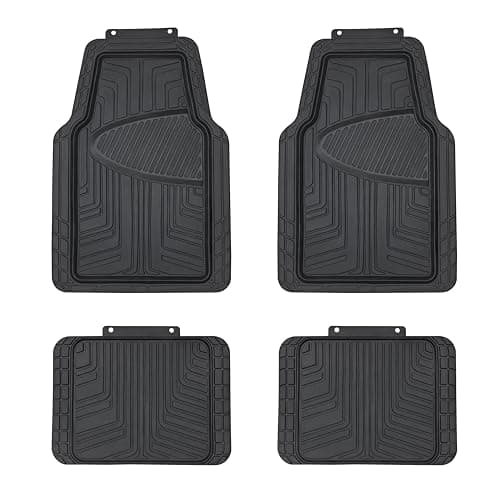
04A car footwell with a rubber all-weather mat in place - a stand-in for the Armor All 4-Piece Rubber Floor Mat Set, not a photograph of this modelArmor All 4-Piece Rubber Floor Mat SetThe lowest spend that still keeps salt off the carpetBest under $357.8Check price on Amazon

Scores are ours and editorial. They are never published as review or rating markup, because we have not tested these products - see how we pick.

Why this is a rust purchase, not a tidiness purchase

Wet carpet is unpleasant. That is not the reason to buy these.

Footwell carpet sits on closed-cell padding, and that padding sits on the floor pan. Salt solution tracked in on boots soaks through the carpet into the padding, where it has no route to evaporate and no airflow. It stays damp against painted sheet metal for the whole season, every season.

Floor-pan corrosion on cars that look immaculate from the outside very often started there, and it is discovered years later when someone lifts the carpet or when a seat mount fails an inspection.

The trade

A universal rubber set is about $25. Vehicle-specific flat mats are $60 to $100 a row. Walled liners are $110 to $200 a row.

Floor-pan repair is body-shop work: cutting out corroded metal, welding in a patch panel, sealing and repainting. It is measured in days and it is comfortably four figures on most vehicles.

Every price in the first paragraph is a rounding error against the second one. The real question is not whether to buy mats — it is which tier, and that is a genuine decision rather than an obvious one.

What the extra money buys

One thing, mostly: walls.

A flat mat holds water in the channels molded into its surface. A good one holds a genuinely useful amount — a wet day, a slushy commute, boots that were wiped before you got in.

A liner is a tray with sides that run up the footwell. Water in a tray stays in the tray, however much of it there is, until you lift it out and pour it away.

The failure a liner prevents is specific and worth understanding, because it is worse than having no mat at all: on a flat mat, a heavy load of slush eventually reaches the edge, runs off, and goes underneath, where it sits on the carpet with a rubber lid over it and takes days to dry. If you routinely bring in boots full of snow, that is your scenario. The full comparison is here.

The second thing: fit, and why it is a safety issue

Vehicle-specific mats are cut from a digital measurement of that exact footwell. Universal mats come with molded trim lines and a pair of scissors is your fitment process.

The visible difference is coverage — a trimmed universal mat leaves gaps at the edges, which is exactly where the water goes. The more important difference is retention. A mat that slides forward can foul the pedals, and pedal entrapment by a loose or stacked floor mat is a recognized safety hazard that NHTSA publishes guidance on.

Two rules follow, and neither is negotiable: every mat must be anchored to the vehicle’s floor hooks or an equivalent retention system, and you never stack a new mat on top of the factory one. How to anchor one properly is here.

Cold flexibility: the specification nobody publishes

The figure that actually matters in winter is the temperature at which the compound stiffens, and no manufacturer in this category publishes it. What you observe is the symptom: cheap rubber goes board-stiff below freezing, curls at the corners, and stops sitting flat — which defeats both the channeling and the retention at the same time.

We mark it as unpublished on every product entry rather than estimating, because the absence is itself useful when you are deciding whether to spend $25 or $150.

Skip this

Skip carpeted 'winter' mats entirely

A carpeted mat sold as a winter accessory is two layers of wet instead of one. It absorbs the salt solution rather than containing it, holds it against the mat underneath, and takes days to dry in a cold car.

If you want the look of carpet, use rubber through the winter and put the carpet mats back in April. That is what the people who sell both do with their own cars.

Which tier to actually buy
  • Tight budget: a universal rubber set, trimmed carefully and properly anchored. It catches most of the water that matters, and the realistic alternative to a cheap mat is no mat.
  • The sensible default: vehicle-specific flat mats. Correct shapes, real channel depth, roughly half the price of liners.
  • Heavy snow, or a car you intend to keep: walled liners. The only tier that contains a bootful of snow rather than redistributing it.
The write-ups

Every pick, in full

01 / Best all-round matA car footwell with a rubber all-weather mat in place - a stand-in for the WeatherTech All-Weather Floor Mats, not a photograph of this model

WeatherTech

8.4 / 10

Roughly $60-$100 a row

WeatherTech All-Weather Floor Mats

The same maker's flat mat rather than its walled liner, at roughly half the money. It has a deep channel pattern that holds a useful amount of water, and for most people in most winters that is genuinely enough.

Check price on Amazon

#ad We hold no verified live price for this product, so we show none. How this site is funded.

Published specifications for the WeatherTech All-Weather Floor Mats, with the source of each
SpecificationPublished valueWhere it is published
FitVehicle-specific flat matsWeatherTech All-Weather Floor Mats
ConstructionFlat mat with deep channeling, no raised side wallsWeatherTech All-Weather Floor Mats
RetentionAnti-skid backing and factory anchor compatibilityWeatherTech All-Weather Floor Mats

What it does well

  • Roughly half the price of the walled liner
  • Flat profile is easier to hose out and quicker to dry
  • Model-specific shapes rather than trim-to-fit

What it does not

  • No side walls, so a heavy load of slush can escape at the edges
  • Less coverage up the firewall than a liner
  • Still costs several times a universal rubber mat

Skip this one if

You track slush in by the bucket. A flat mat overflows at the edges where a walled liner does not.

How it scores, by criterion

Water containment7.5
Fit9.5
Ease of cleaning9.5
Cold flexibility8.0
Price6.5
02 / Best containmentA molded car floor liner with raised edges - a stand-in for the WeatherTech FloorLiner, not a photograph of this model

WeatherTech

9.2 / 10

Roughly $120-$200 a row

WeatherTech FloorLiner

A laser-measured, vehicle-specific liner with walls that run up the sides of the footwell. The walls are what you are paying for: they hold slush and salt solution where a flat mat lets it run off onto the carpet edges.

Check price on Amazon

#ad We hold no verified live price for this product, so we show none. How this site is funded.

Published specifications for the WeatherTech FloorLiner, with the source of each
SpecificationPublished valueWhere it is published
FitVehicle-specific, digitally measured per modelWeatherTech floor mats and liners
ConstructionRigid molded liner with raised perimeter wallsWeatherTech floor mats and liners
RetentionUses the vehicle's factory floor anchors where fittedWeatherTech floor mats and liners
CoverageFront, rear and cargo liners sold by rowWeatherTech floor mats and liners

The arithmetic

About $150 a row against a carpet that rusts the floor pan from the inside.

Salt solution soaking into footwell carpet keeps the padding underneath damp all winter. That is where floor-pan corrosion starts on cars that otherwise look clean, and floor-pan repair is body-shop work in the four figures. The mat is the cheap end of that trade.

What it does well

  • Raised walls contain meltwater instead of letting it run under the mat
  • Model-specific fit means no trimming and no sliding
  • Rigid enough to lift out full of slush without spilling it

What it does not

  • Expensive - this is the premium end of a cheap category
  • Rigid material is noisier underfoot than a soft mat
  • Overkill if your winter is three slushy weeks

Skip this one if

Your budget is the reason you are here. This is three to four times the price of a universal rubber mat that catches most of the same water.

How it scores, by criterion

Water containment10.0
Fit10.0
Ease of cleaning8.5
Cold flexibility7.0
Price4.5
03 / Best liner underfootA molded car floor liner with raised edges - a stand-in for the Husky Liners X-act Contour Floor Liners, not a photograph of this model

Husky Liners

8.9 / 10

Roughly $110-$180 a row

Husky Liners X-act Contour Floor Liners

The main rival to the WeatherTech liner, and softer underfoot. The trade is straightforward: a more pliable compound is quieter and warmer to stand on, and slightly less rigid when you lift a full liner out of the car.

Check price on Amazon

#ad We hold no verified live price for this product, so we show none. How this site is funded.

Published specifications for the Husky Liners X-act Contour Floor Liners, with the source of each
SpecificationPublished valueWhere it is published
FitVehicle-specific contoured linersHusky Liners published product information
ConstructionMolded liner with raised edgesHusky Liners published product information
MaterialProprietary rubberized compoundHusky Liners published product information

What it does well

  • Softer, warmer and quieter than a rigid liner
  • Raised edges contain meltwater
  • Model-specific fit with factory anchor points

What it does not

  • Flexes when carrying a full liner out of the car
  • Same premium price bracket as the rival
  • Fit coverage is thinner on older and rarer models

Skip this one if

You want the most rigid tray possible for lifting out full of slush.

How it scores, by criterion

Water containment9.0
Fit9.0
Ease of cleaning8.5
Cold flexibility9.0
Price5.0
04 / Best under $35A car footwell with a rubber all-weather mat in place - a stand-in for the Armor All 4-Piece Rubber Floor Mat Set, not a photograph of this model

Armor All

7.8 / 10

Roughly $20-$35 a set

Armor All 4-Piece Rubber Floor Mat Set

Universal trim-to-fit rubber for about the price of two coffees a month across a winter. It catches the water that matters. It does not fit as well as a molded mat, and you must actually anchor it, but the salt stays off the carpet.

Check price on Amazon

#ad We hold no verified live price for this product, so we show none. How this site is funded.

Published specifications for the Armor All 4-Piece Rubber Floor Mat Set, with the source of each
SpecificationPublished valueWhere it is published
FitUniversal, trim-to-fitArmor All published product information
ConstructionMolded rubber with channelingArmor All published product information
Set contentsTwo front and two rear matsArmor All published product information
Low-temperature flexibility ratingNot published by the manufacturerArmor All published product information

What it does well

  • Costs less than a tank of fuel and solves most of the problem
  • Trim lines molded in, so cutting to shape needs only scissors
  • Four mats rather than a single row

What it does not

  • Trim-to-fit means visible gaps at the edges
  • Needs anchoring or it slides
  • Cheap rubber stiffens in deep cold and can curl at the corners

Skip this one if

Your footwell has an unusual shape or your car lacks anchor hooks. An unanchored mat that slides under the pedals is a safety problem, not a bargain.

How it scores, by criterion

Water containment6.5
Fit5.5
Ease of cleaning9.0
Cold flexibility6.0
Price10.0

How this was ranked

Every site in this category says it tested twenty of these. We have not tested any, and we say so. What we did instead: built the candidate set from what Amazon actually stocks, compiled the published specifications from each manufacturer’s own pages, did the arithmetic on running cost and on what the thing prevents, and read owner reviews for failure patterns rather than star averages. Every number on this page has a link to where it was published, so you can check the work.

Units we claim to have tested
0
Sponsored placements
0
Free products accepted
0

The full method, including what we refuse to claim

Questions people actually ask

Frequently asked

Are all-weather floor mats worth it?

In a salted climate, yes, and the reason is corrosion rather than appearance: salt solution in footwell carpet keeps the padding damp against the floor pan all winter. The purchase is $25 to $200 against four-figure sheet-metal repair. The longer answer is here.

What is the difference between floor mats and floor liners?

Walls. A mat is flat and holds water in surface channels; a liner is a tray with raised sides that runs up the footwell. Under heavy slush a flat mat overflows at the edges and the water goes underneath, which is worse than no mat. Under normal winter use a good flat mat is sufficient.

Do cheap floor mats work as well as expensive ones?

For catching most of the water, yes, provided they are trimmed to fit and properly anchored. What you give up is edge coverage, wall containment under heavy load, and cold flexibility — cheap rubber stiffens and curls below freezing. A $25 anchored set beats no set by a very large margin.

Can floor mats damage my car?

An unanchored mat can, by sliding forward and fouling the pedals - pedal entrapment is a recognized hazard NHTSA publishes guidance on. Never stack a new mat on the factory mat, and always use the vehicle’s floor hooks or an equivalent retention system.

How do you clean all-weather floor mats?

Take them out, hose both sides, scrub the channels with a stiff brush and a mild detergent, rinse thoroughly and let them dry fully before refitting. Removing the salt is the whole point, so volume of water matters more than the cleaner. The method, including the white residue, is here.

Sources

Read next