Why a new weather seal does not solve this
People fit a fresh rubber bottom seal, watch the daylight disappear along the width of the door, and assume the rodent problem went with it. Then the droppings come back.
Two reasons. The first is that a bottom seal is designed to close a long, straight gap against a flat slab, and it does that well. What it cannot do is close the two triangular voids at the ends, where the seal meets the vertical track and the jamb. Those corners are the classic rodent route, and they are open on most doors even when the seal itself is new.
The second is material. Rubber and vinyl are chewable. A mouse that wants to be on the warm side of a door in January will work on a rubber seal, and a rat will go through it quickly.
So the fix has two halves: close the gap with the right weather part, and make the remaining points non-chewable.
How we judged these
1. Does it address the corners, the length, or the floor? These are three different problems and no single product solves all three.
2. Is the material chewable? Stainless steel is the standard answer for rodent exclusion, as a plate at the corners or as wool fill fabric stuffed into a gap, because rodents cannot gnaw through it. Rubber, vinyl and foam all fail this test.
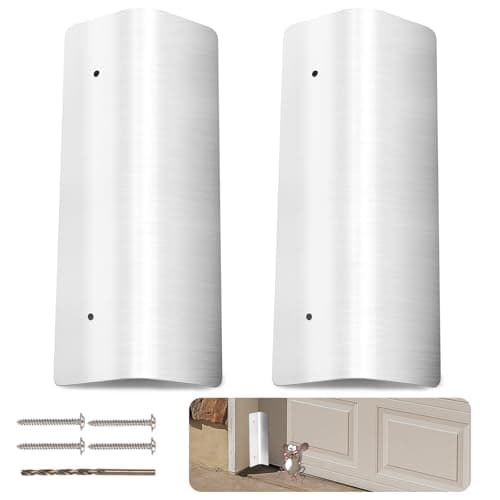
3. What does the maker publish about testing? In this category, almost nothing. The stainless guards sold for door corners are unbranded retail products with no manufacturer specification page and no independent testing behind them. We rank them on material and fitting method, and we say plainly that the test data is not there.
4. How does it attach? Adhesive-backed strips are quicker but lift off cold, dusty concrete; screwed-down plates mean drilling the frame but cannot peel away in February. We prefer the screwed version for a part that has to hold all winter.
Which part fixes which gap| The gap | The fix | Why the other parts do not do it |
|---|
| Corners where the seal meets the track | Stainless steel corner guard | A bottom seal is cut for the straight run and stops at the ends |
|---|
| Long gap under the door | New rubber or vinyl bottom seal | A corner guard covers the ends; it does not seal weather along a door's width |
|---|
| Dips in an uneven slab | Floor threshold bonded to the concrete | A bottom seal can only bridge so much before it distorts |
|---|
| Gaps around the side and top | Jamb weatherstrip | Different part, different plane - and often the forgotten one |
|---|
The gap sizes that matter
The reason this is hard is that the opening a mouse needs is much smaller than the one you would notice. Pest-exclusion practice works on the principle that anywhere a rodent can fit its skull it can follow, and for a house mouse that is a gap far narrower than a finger.
Practically, that means “you cannot see daylight” is the wrong test. Kneel inside the closed door in the dark with a flashlight outside it, or run your hand along the seal. Anywhere the seal is holding its shape but not touching the slab, and both corners, are the places to treat.
It also means the order matters. Fixing the corners while a two-inch dip in the slab is still open under the middle of the door is wasted effort. Which seal type suits your door and floor is the first decision, not the last.
What the rodents are actually after, and what they cost
A garage in winter offers a rodent three things: warmth, shelter from predators, and in most garages, food — birdseed, pet food, or a bag of something in a cardboard box.
The expensive part is not the mess. It is that a parked car is an attractive nesting site, and modern wiring insulation gives them something to chew. Wiring repairs on a car are diagnostic work before they are parts work, which is what makes them expensive relative to the cost of a seal.
Against that: a stainless corner shield and a bottom seal together are a two-figure purchase and an afternoon. This is the cheapest insurance in the garage, which is why it sits alongside the rest of the stored-car checklist.
Skip this
Skip the ultrasonic repellers, and be careful with poison
Ultrasonic plug-in repellers are sold everywhere for this job. We would not spend money on one: the mechanism is supposed to be sound that rodents avoid, and a garage is full of hard surfaces that block and reflect it. Exclusion is a physical problem and it wants a physical answer.
Poison bait has a different problem. It works, but a poisoned rodent dies somewhere it chose, which in a garage is often inside a wall, a vehicle's ventilation duct or under a workbench. It also creates a secondary-poisoning risk for anything that eats the rodent, including a neighborhood cat or an owl.
Seal first. Remove the food. Then, if you still have a resident population, deal with it with traps you can check rather than bait you cannot find.
The order to do this in
- Empty the obvious food. Birdseed, pet food and anything in cardboard goes into sealed bins. Exclusion on its own is much harder work if the reward is still inside.
- Fix the floor gap. If the slab is flat, a new bottom seal is enough. If it dips, a threshold bonded to the concrete is the part that bridges it.
- Then close the corners with stainless steel guards. The ones we rank are screwed to the frame, so this is a drill-and-screw job rather than a peel-and-stick one.
- Walk the perimeter. The service door, the gap where the siding meets the slab, and any conduit or hose penetration are all rodent doors. Stainless wool fill fabric is the same answer in each.
What we would buy
If your weather seal is sound: just the corner shields. It is the cheapest item here and it fixes the specific gap a bottom seal cannot.
If the seal is old or hardened: replace it first, then add the shields. A perished seal is both a weather problem and a chew point.
If the slab is uneven: the threshold is the honest answer, and it is the one part here that also stops water and leaves driving in. Installing either is a straightforward afternoon if the floor is clean and dry.