De-icer spray vs winter washer fluid
People treat these as two versions of the same product. They solve different problems, and only one of them prevents something dangerous.
Heads up: the buy links on this page are affiliate links. If you buy through one, we earn a commission at no extra cost to you. It does not change what we recommend or the order we rank things in - here is how we keep those separate.
The decision in one table
| Aerosol de-icer | Winter washer fluid | |
|---|---|---|
| What it is | A pressurized can you spray on ice | A liquid that goes in the washer reservoir |
| When you use it | Parked, before you drive | Moving, at any speed |
| The problem it solves | Ice on the glass right now, and frozen wiper blades | Salt and road film you cannot see through, and frozen jets |
| Cost | $5 to $9, lasts a handful of heavy mornings | $5 to $8 a gallon, lasts weeks |
| Cost per use | High | Very low |
| Prevents anything? | No - it reacts to ice that already formed | Yes - it stops the reservoir and jets freezing |
| Safety significance | Convenience | Real: no washers in winter is a visibility failure at speed |
Pick winter washer fluid if...
...you drive on treated roads at all. Which, in a freezing climate, is everyone.
Within about a mile of joining a salted road, a film of salt spray builds on the windshield. It is fine and even, so you do not notice it building — you notice it when you meet low sun or oncoming headlights, and the whole screen goes opaque. The only fix, at speed, is washers and wipers.
If the reservoir froze in October because it still had summer fluid in it, you have no fix. That is the failure. It is common, it is genuinely dangerous, and it costs six dollars to prevent.
Pick aerosol de-icer if...
...you park outside without a cover and you want a way to deal with frozen wipers and locks.
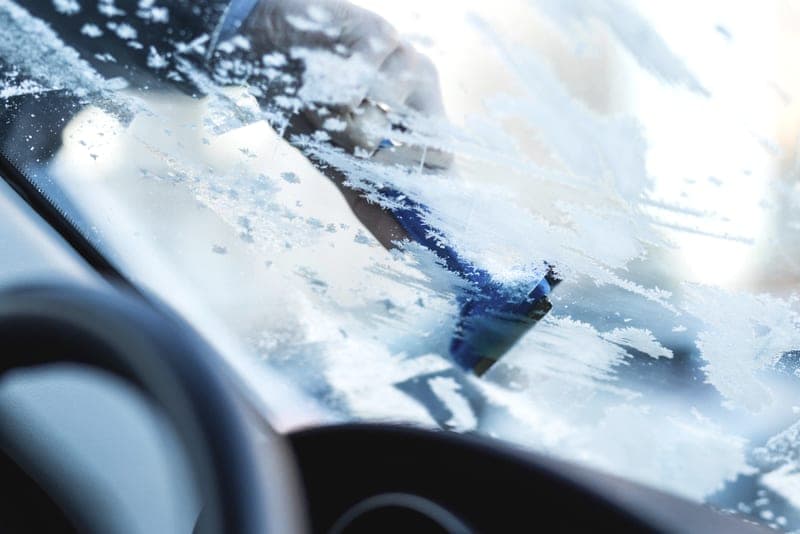
The unique capability is freeing a wiper blade bonded to the glass. A scraper cannot do that without risking the rubber, and switching the wipers on while they are frozen down is how blades tear and how wiper linkages get damaged. A few seconds of de-icer along the blade solves it.
It is also the answer for a frozen door lock or a door seal frozen to the frame — both common, both irritating, neither fixable with any other tool in the car.
The honest answer for most people: both, and neither is the main event
Together they are about $13, and they cover different failures. Get both.
But note what neither does. Neither prevents the ice. If you are reaching for de-icer every morning, the product you actually want is a windshield cover the night before, which turns a four-minute job into a twenty-second one and costs nothing per use.
The order of purchase we would actually follow: winter washer fluid first because it is the safety item, then the cover because it removes the daily work, then a can of de-icer for the wiper-and-lock cases that neither of the others addresses.
Two things people get wrong
Topping up rather than displacing. Adding winter fluid on top of a mostly full reservoir of summer fluid gives you a mixture with a freezing point you cannot predict and probably cannot rely on. Run it low first.
Assuming all winter fluid is equal. The temperature ratings printed on the jugs vary widely, and a fluid rated to 20 F is not much help at 5 F. Read the number on the container and match it to the coldest night you actually get, not the average. We have since put the published ratings side by side — the fluids ranked by the number on the jug runs from 0 F to −34 F, and two brands sell similar-looking jugs at opposite ends of that range.
What to buy, given all that
Rain-X
Rain-X De-Icer Windshield Washer Fluid
Roughly $5-$8 a gallon
The one winter product almost nobody buys deliberately and everybody should. Washer fluid rated for freezing temperatures stops the reservoir and the jets freezing solid, which is the failure that leaves you driving into low winter sun through a smeared windshield.
Skip it if: Nothing. If you drive in a freezing climate, put winter fluid in.
#ad We hold no verified live price for this product, so we show none. How this site is funded.
Prestone
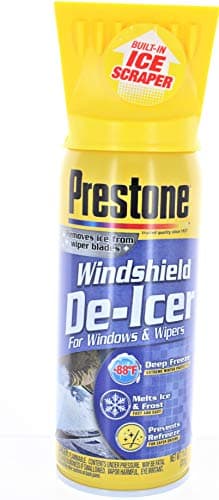
Prestone Windshield De-Icer
Roughly $5-$9 a can
A spray-on aerosol that melts a thin ice layer fast enough to get the wipers working. It is a de-icer, not a substitute for a scraper on a quarter-inch of glaze, and treating it as one is how a can gets emptied in a week.
Skip it if: You reliably get thick ice. Spray de-icer on heavy ice is expensive and slow; a cover the night before costs nothing per use.
#ad Price as of October 18, 2026, from Amazon. Prices change. How this site is funded.
How this was ranked
Every site in this category says it tested twenty of these. We have not tested any, and we say so. What we did instead: built the candidate set from what Amazon actually stocks, compiled the published specifications from each manufacturer’s own pages, did the arithmetic on running cost and on what the thing prevents, and read owner reviews for failure patterns rather than star averages. Every number on this page has a link to where it was published, so you can check the work.
- Units we claim to have tested
- 0
- Sponsored placements
- 0
- Free products accepted
- 0
Frequently asked
Can I put de-icer spray in my washer fluid reservoir?
No. Aerosol de-icer is a different formulation, sold pressurized, and it is not intended to pass through a washer pump and jets. Use a product sold as winter washer fluid, which is designed for the system.
What temperature does windshield washer fluid freeze at?
It depends entirely on the product, and the rating is printed on the container — which is why we do not quote a single figure. Summer fluid is mostly water and freezes near 32 F. Winter fluids are formulated to much lower temperatures, and the ratings differ substantially between products on the same shelf.
Is de-icer washer fluid the same as antifreeze?
No, and this is an important distinction. Engine antifreeze is ethylene or propylene glycol coolant for the cooling system and must never go in the washer reservoir. Winter washer fluid is a different formulation intended to be sprayed on glass. They are not interchangeable in either direction.
Do I need winter washer fluid if I have a garage?
Yes. The reservoir is only part of it — the lines and jets are outside the heated part of the car and they freeze while you drive, not just while you park. And the salt film that makes washers necessary comes from the road, not from where the car sleeps.