The answer first
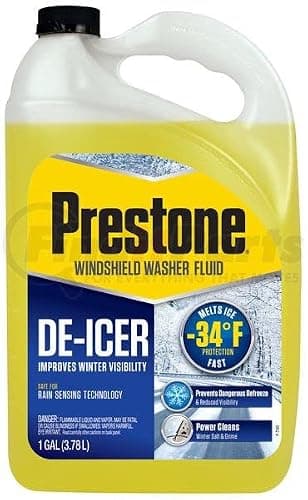
Buy the Prestone AS253. It publishes the lowest freeze protection you can get as a single gallon — “down to −34 F” (−37 C) — and the number on the label is the whole specification of this product.
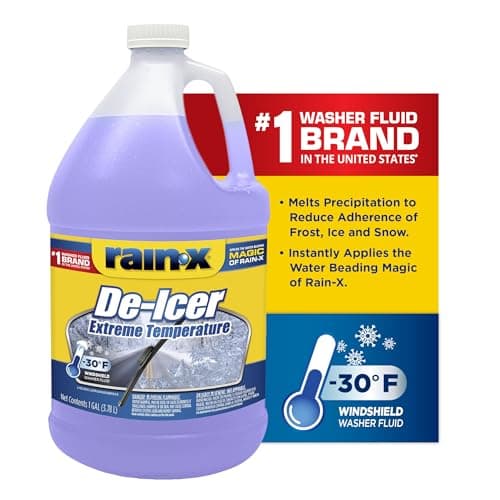
If you get through a lot of it, Rain-X’s −30 F Extreme Temperature De-Icer is published as “effective to −30 F” and adds its water-beading treatment to the glass with every wash, which is a real benefit driving into low winter sun. It is sold as a six-pack, so it is a season or nothing.
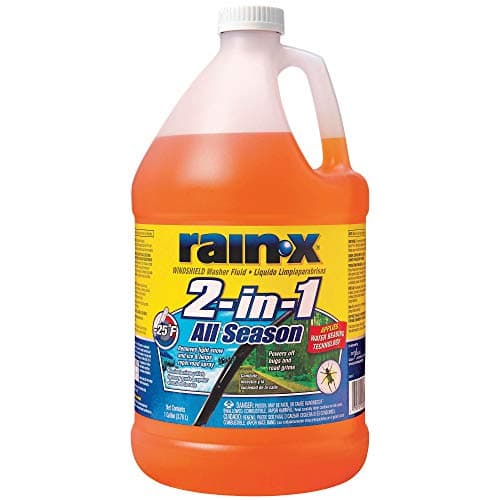
If you want the cheapest honest jug, the Rain-X 2-in-1 All Season at 128 fl oz is listed at (−25) and costs the least per gallon of the three.
And the trap, which catches more people than any of the above: Rain-X sells an “All Season” line published at 0 F and a “De-Icer” line published at −25 F and −30 F, in similar-looking jugs. Read the temperature, not the brand.
How we judged these
1. The published freeze protection temperature. This is the entire product. Everything else is a tie-breaker.
2. Whether the figure comes from the maker. A rating on a manufacturer’s product page is worth more than one that appears only in a retail listing title, and we say which is which for each pick.
3. Whether you can buy one jug. A fluid is heavy and cheap, which means online sellers prefer cases. A rating you can only buy six gallons of is a different purchase.
4. What else it does. Beading treatment and bug removal are genuine extras, in that order of winter usefulness.
The failure this product prevents
It is worth being clear about what you are buying, because people routinely treat washer fluid as the least important thing in the engine bay.
Summer washer fluid is mostly water. Put it through a winter and it freezes — first in the lines and the jets, then in the reservoir itself. Once the jets are frozen you have no means of clearing the salt-and-grit film that road spray lays onto your windshield, and that film is at its worst driving west at four in the afternoon in February.
That is the actual danger. Not a cracked reservoir, not a seized pump — being unable to see, at speed, with the wipers smearing a dry salt haze across the glass. A jug of fluid with the right number on it is the cheapest meaningful safety purchase on a winter car, and it costs less than a tank of gas.
Published freeze ratings across current winter fluids| Fluid | Published rating | Where the figure is published | Pack |
|---|
| Prestone De-Icer AS253 | Melts ice and frost "down to -34 F" (-37 C) | Prestone's own product information | Single 1 gal |
|---|
| Rain-X Extreme Temperature De-Icer | "Effective to -30 F" | Rain-X product page | 1 gal jugs, pack of 6 |
|---|
| Rain-X Heavy Duty De-Icer | "Effective to -25 F" | Rain-X product page | 1 gal jugs, pack of 6 |
|---|
| Rain-X 2-in-1 All Season, 128 fl oz | Listed as (-25) | Retail listing title, not a maker page for this item | Single 1 gal |
|---|
| Rain-X All Season | 0 F | Rain-X product page - a different product line | 1 gal jugs, pack of 6 |
|---|
| Prestone De-Icer AS250 | -27 F on retailer listings | Retailer listings; we did not find a Prestone page for this part number | Single 1 gal |
|---|
The labeling trap, spelled out
Two things in that table deserve to be said in words rather than left in a cell.
Rain-X runs two lines with overlapping names. The “All Season” fluid is published at 0 F. The “De-Icer” fluids are published at −25 F and −30 F. Zero Fahrenheit is a perfectly respectable number for a mild winter and completely inadequate for a cold one, and the jugs look alike on a shelf. The word you are looking for is the temperature.
Prestone runs two part numbers with different ratings. AS253 is published by Prestone at −34 F. AS250 appears on retailer listings at −27 F, and we could not find a Prestone page for that part number to confirm it either way. Both are sold as “Prestone De-Icer / Winter Windshield Washer Fluid”. If the rating matters to you, match the part number as well as the brand.
This is exactly the pattern our de-icer-versus-fluid comparison flagged when it said ratings vary between products and you should read the temperature on the jug. This page is that advice with the actual numbers attached.
Why the online price looks wrong, and what to do about it
Winter washer fluid is the one product on this site where the online price is routinely several times the shelf price, and the reason is physics rather than greed: a gallon of fluid weighs about eight and a half pounds and sells for a few dollars, so shipping dominates.
That produces two patterns. Single jugs online carry a large markup over a hardware store or a gas station. And the good ratings tend to appear as six-packs, where the shipping is spread across six gallons and the per-gallon price comes back to earth.
So the honest buying advice is: check the temperature on the jugs at the store first, because a $4 jug at the right rating beats everything on this page. Buy online when the store only stocks the mild stuff, or when you want a case to last the winter — which for most people is roughly what a winter takes.
That is ours, from the listed prices and the published pack sizes. It is also why we have ranked a single-jug product first rather than the colder case.
Doing the swap properly
Do not just top up. Pouring a gallon of −34 F fluid on top of half a reservoir of summer fluid gives you a diluted mixture with an unknown and much higher freeze point. Prestone and Rain-X both publish their fluids as not to be diluted, and a half-full reservoir of water is dilution.
Run it out first, in the fall. Use the washers until the reservoir is near empty — on a dusty day in October, with the car dirty, so you are not wasting it — then fill with winter fluid. If you want to be thorough, the reservoir drain or the pump hose will empty it properly.
Then cycle it through the lines. Run the washers for several seconds after filling so the new fluid reaches the jets, not just the tank. The jets and the thin lines in the hood are the first thing to freeze and the last thing a top-up reaches.
And check the jets while you are there. A blocked jet in December is usually a jet that was blocked in September and nobody noticed. A pin and a minute fixes it.
What the beading treatment is actually doing
Two of the three picks carry a hydrophobic treatment, and it is worth understanding because it is the only genuine feature difference in a category otherwise defined by one number.
Rain-X publishes that its de-icer fluid “instantly applies Rain-X technology to the windshield for greater driving visibility” and that “the washer fluid applies water beading technology to your windshield.” In practice that means every wash leaves a thin water-repellent film, so the next lot of road spray beads and sheets off rather than wetting the glass evenly.
In winter that is worth more than it is in summer, for a reason that has nothing to do with rain: the combination of low sun, a wet windshield and a salt haze is the worst visibility condition most drivers meet all year, and anything that gets water off the glass faster helps. It also reduces how long a film sits there to dry into a smear.
Rain-X does add a usage instruction worth knowing: “use in conjunction with your Rain-X windshield wipers.” Treat that as marketing rather than a requirement — the treatment works on glass regardless of whose blade sweeps it — but it does point at something real, which is that a worn blade will smear a treated windshield just as readily as an untreated one. Whether you need a dedicated winter blade is a separate question with a separate answer.
Match the part number, not just the brand
This is the single most useful habit in this category and it takes five seconds.
Prestone’s own information publishes AS253 at −34 F. Retailer listings for AS250 — sold under the same “Prestone De-Icer / Winter Windshield Washer Fluid” name — show −27 F, and we could not find a Prestone page for that part number to confirm it either way. Seven degrees is not nothing when you are choosing on one number.
The same applies to Rain-X’s two lines. The published ratings are 0 F for All Season, −25 F for Heavy Duty De-Icer and −30 F for Extreme Temperature De-Icer. Three products, one brand, a thirty-degree spread, and jugs that look alike on a shelf and nearly identical in a thumbnail.
So: find the temperature printed on the front of the jug, or the part number, and buy on that. If a listing does not show you either, it is not telling you the one thing you came to find out.
Skip this
Do not put aerosol de-icer, antifreeze or alcohol in the reservoir
Three substitutions people try, all bad.
Aerosol windshield de-icer is formulated to be sprayed onto glass, not pumped through a washer system. It is not packaged for the job, the propellant makes no sense in a reservoir, and the two products do different jobs.
Engine antifreeze is ethylene or propylene glycol and belongs nowhere near a washer system. It is bad for paint, bad for rubber and genuinely dangerous to animals that drink what drips onto a driveway.
Neat methanol or isopropyl alcohol cut with water is the home recipe, and the problem is what it does to the things it touches — wiper rubber, paint and plastic trim — plus it evaporates in the reservoir. A jug of formulated fluid is four dollars.
One genuine warning on the commercial products too: Rain-X publishes a California Proposition 65 warning for naphthalene on its De-Icer fluids. Wash your hands, keep it off paint you have just waxed, and do not store it where children or animals can reach it.
What we would buy
One jug, coldest rating, no fuss: the Prestone AS253 at a published −34 F. The lowest number here, from the maker’s own information, in a single gallon.
A hard winter and a case is fine: the Rain-X −30 F Extreme Temperature De-Icer. Six gallons is roughly a winter, the per-gallon price is the best of the three, and the beading treatment earns its keep every time the wipers run.
Mild winter, or a spare jug for the trunk: the Rain-X 2-in-1 All Season at (−25). Cheapest of the three, with the caveat that the cold figure appears on the listing rather than on a maker page for that exact item.
Whatever you buy, this is the first thing to do in the fall and it takes ten minutes. The full checklist puts it in order against everything else, and it sits near the top for a reason: nothing else on the list prevents a failure that happens at 60 mph.