The number on the box is not the number for your door
Every kit in this category is sold on one figure, and that figure describes a panel lying on a bench, not the door it ends up on. This is not a marketing complaint. It is a documented distinction, and the trade association for garage door manufacturers publishes it.
DASMA’s technical data sheet on the subject separates two things that sound interchangeable. A calculated R-value describes the door section only — material and thickness, worked out on paper. A tested U-factor comes from installing a complete door in a chamber and measuring the energy needed to hold the temperature across it. DASMA states plainly that the two results are not comparable to each other, because one is a slice of the door and the other is the whole assembly with its perimeter, its joints and its steel.
That matters here because an aftermarket kit only ever addresses the flat part of each panel. The ribs stay steel, the section joints stay section joints, and the gap around the outside of the door stays whatever it was this morning. So R-8 on the box is real, and the door it is fitted to is still not an R-8 door. Any page that tells you otherwise has not read the manufacturer’s own literature.
What insulating a door is actually worth per winter
Nobody in this category prints this, which is odd, because it is the only question a buyer has. Here it is with every input on the table so you can put your own numbers in.
A single-car door, one winter
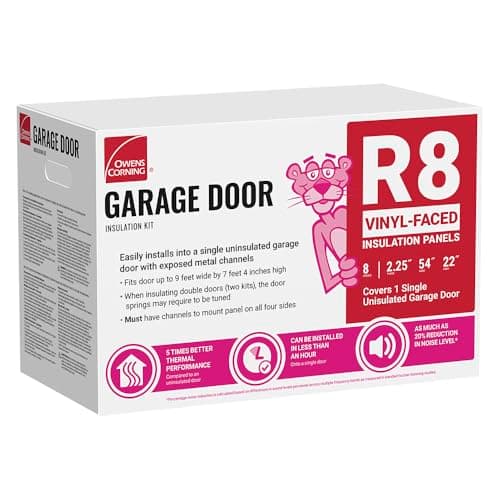
A 9 ft by 7 ft door is 63 square feet. Owens Corning publishes R-8 for its panel and separately claims five times the thermal performance of an uninsulated door, which implies the company treats a bare steel door as roughly R-1.6. Conduction is area, times temperature difference, divided by R.
Hold the garage 40 F above the outside air — 55 F inside against 15 F outside. Bare: 63 × 40 ÷ 1.6 = 1,575 Btu/h. Insulated: 63 × 40 ÷ 8 = 315 Btu/h. The 1,260 Btu/h you stop losing is 0.37 kW, which costs 6.8 cents an hour at the U.S. average residential rate of 18.34 cents per kWh (EIA, June 2026).
Two hours of heating a day across a 120-day winter is 240 hours, so the kit saves you about $16 a winter. Heat the space continuously through those same 120 days and it saves about $195. Against a kit somewhere between $70 and $145, that is either a six-winter payback or a single-season one, and nothing about the product decides which. Your thermostat does.
Read that arithmetic honestly and it tells you something a roundup is not supposed to say: if you do not heat the garage, an insulation kit will not save you money. There is no conduction bill to reduce. What you buy instead is a few degrees of moderation on a cold snap, a quieter door, and a garage that does not swing quite so far in July. Those are real, and they are worth $70 to plenty of people. They are just not savings, and we are not going to dress them up as savings.
Seal the door first. It is not close.
The site’s garage door seal roundup runs the same style of calculation on the gap under a door, and the answer there is about $123 a winter at the same two hours of heating a day that gets you $16 from an insulation kit. Same garage, same electricity price, roughly eight times the return, for about a quarter of the money.
The reason is that conduction and air exchange are different animals. Insulation slows heat moving through a solid panel. A gap lets warm air leave and cold air arrive, which no R-value touches. A door with a half-inch gap under it and R-8 panels on the inside is a door you have insulated around a hole. Seal, check for daylight along the jambs, and only then decide whether the conduction number is big enough to be worth another hundred dollars.
The three technologies, and what each one is for
Strip the branding away and there are three things sold as garage door insulation. They are not competing versions of the same product; they fail and succeed at different things.
Garage door insulation kit types compared on what each one publishes| Type | Published thermal figure | Weight added | What it is really for |
|---|
| Faced fiberglass batt | R-8, calculated, ASTM C177 (Owens Corning) | Moderate | The most resistance per dollar, on a door you heat behind |
|---|
| Rigid foam panel | R-4.8, panel only (retailer listing) | Highest of the three | A finished, wipeable inside face that stays flat for years |
|---|
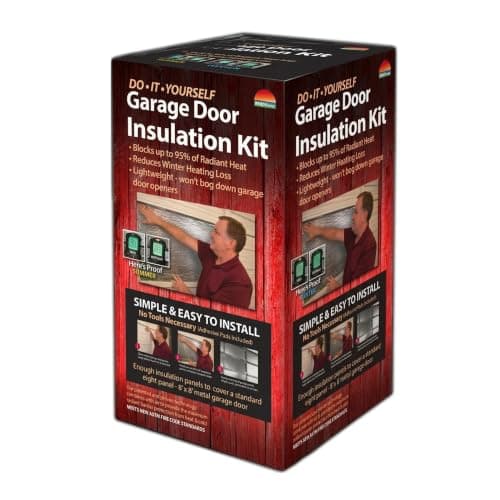
| Reflective bubble | None published | About 5 lb a kit | Radiant gain in summer, and doors where weight is the constraint |
|---|
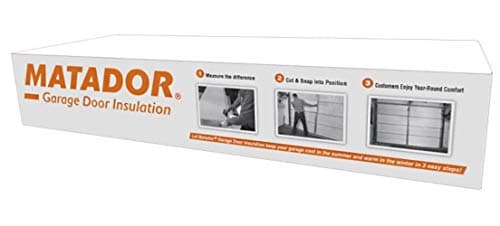
| Loose batts or foam board, cut yourself | Whatever the material states | Depends entirely on what you buy | Cheapest per square foot, worst at staying in the channel |
|---|
Note the third row. Reflective products are genuinely good at what they are designed for, which is reflecting radiant heat — a west-facing door baking in August is exactly their case. A still, cold January night is a conduction problem, and a thin foil-and-bubble laminate is not the tool for it. Buying one for winter performance because the package photograph shows snow is the most common mistake in this category.
Skip this
Skip any kit sold on a percentage instead of an R-value
You will see “blocks up to 95% of radiant heat” and “R-8 equivalent” on listings in this category. Neither is a thermal resistance figure and neither can be compared with R-8 or R-4.8. A percentage of radiant heat says nothing about conduction on a cold night, and “equivalent” is a word doing work that a test method should be doing. If a maker has measured the product, the number and the standard behind it will be on the page. Where a maker publishes nothing, we say so on the entry below rather than filling the gap in ourselves.
The weight question nobody puts on the box
A sectional garage door is counterweighted. The springs are wound to balance a specific door weight, and adding panels to all eight sections changes that weight. A light reflective kit is a few pounds and will almost certainly go unnoticed. A rigid foam kit across a double door is the heaviest thing in this article, and it is the one worth checking after.
The check takes a minute and costs nothing. Pull the emergency release so the opener is disconnected, raise the door to about waist height, and let go. A correctly balanced door stays roughly where you put it. A door that sinks or slams shut is now heavier than its springs expect, and it will work the opener harder every cycle until something gives.
If it fails that test, stop. Torsion springs store a great deal of energy and adjusting them is not a homeowner job — it is the one part of a garage door where the advice is genuinely to call somebody. The same warning appears in our seal installation guide, for the same reason.
How to choose, in the order the decisions actually arrive
One: does the kit cover your door? Every kit here is sized for one single-car door, up to about 9 ft wide. A 16 ft double door takes two kits, which doubles the cost and does not double the benefit, because the arithmetic above scales with area on both sides of the equation. Measure before you order, not after.
Two: is your door the kind these fit? These kits are designed for uninsulated steel doors with exposed channels on the inside face — the pressed ribs that form a frame around each flat panel. If your door is already insulated at the factory, or it is a flat wooden door with no channel to hold anything, a channel-fit kit has nothing to grip.
Three: what does the maker actually publish? This is the one we weight most heavily, and it is why the ranking below is the order it is. A published R-value with a test method attached can be compared. A published R-value with no method is worth less. No figure at all is not a disqualification — the reflective kit here has real uses — but it does mean nobody can tell you how it performs against the others, including us.
Four: how much weight are you adding? See above. If the answer to the balance test worries you, the lightest kit in the list is the one to buy, and its lower thermal performance is the price of not touching the springs.