When tire chains are required, and who is exempt
This is one of the few winter questions with an actual legal answer. Two states publish theirs clearly enough to plan around, and the pattern they set is the one most mountain states follow.
Heads up: the buy links on this page are affiliate links. If you buy through one, we earn a commission at no extra cost to you. It does not change what we recommend or the order we rank things in - here is how we keep those separate.
Chain requirements are declared, not implied
There is no general rule that chains become mandatory at some temperature or snow depth. What happens instead is that a state transportation department declares a control on a specific highway, at a specific time, and signs it. Until that happens, chains are optional. Once it happens, the requirement applies to the vehicles the declaration names, and the fact that your SUV feels fine is not a defense.
That means the useful skill is reading the level, not memorizing a season. Two states publish their systems clearly, and between them they cover most of what you will meet.
California: R1, R2 and R3
Caltrans uses three numbered requirement levels, and the difference between them is entirely about who is exempt.
| Level | What is required | Who is exempt |
|---|---|---|
| R1 | Chains are required | Autos and pickups with approved legal snow tires |
| R2 | Chains or traction devices required on all vehicles | Four-wheel and all-wheel drive vehicles with snow-tread tires on all four wheels |
| R3 | Chains or traction devices required on all vehicles | No exceptions |
Two things in that table are worth pausing on. At R2 the exemption requires snow-tread tires on all four wheels, not merely all-wheel drive — an AWD crossover on all-season tires is not exempt. And Caltrans publishes a minimum legal tread depth for mud and snow tires of 6/32 of an inch, so a worn winter tire stops counting as a winter tire at a defined point.
Caltrans also notes that R1 and R2 are the common conditions and that a highway is often closed before R3 is imposed. In practice, if you are reading an R3 sign, the decision in front of you is usually whether to travel at all.
Colorado: two laws, one after the other
Colorado publishes a two-stage system with different names and the same logic.
The Passenger Vehicle Traction Law is the first stage. CDOT publishes that every vehicle must have one of: all-wheel or four-wheel drive with mud and snow tires (the mountain-snowflake icon, or M+S, or M/S) and 3/16 inch of tread; all-wheel or four-wheel drive with winter tires to the same specification; all-wheel or four-wheel drive with a manufacturer’s all-weather rating and 3/16 inch of tread; or chains or an approved alternative traction device.
The Passenger Vehicle Chain Law is the second stage, published as the final safety measure before the highway is closed. At that point the drivetrain and tire exemptions stop applying: every vehicle must have chains or an approved alternative traction device.
What ignoring it costs, as published
Colorado publishes the numbers. Non-compliance is a $100 fine and a $33 surcharge. Non-compliance that results in the road being closed is a $500 fine and a $157 surcharge.
Set that against a set of chains, which is a one-time purchase in the low hundreds that then sits in the trunk for years. The second citation alone exceeds most chain sets, and that is before the tow, the delay, and the part of this that is not about money.
This site is normally in the business of arguing that a cheap purchase prevents an expensive one. Here the arithmetic is unusually direct, and it is published by the state rather than estimated by us.
The tread depth rule catches more people than the chain rule
Both states hang their exemptions on tread depth, and the two numbers are different: Caltrans publishes 6/32 in as the minimum legal tread for mud and snow tires, and CDOT publishes 3/16 in — which is 6/32 in expressed the other way. Same requirement, different notation, and it is worth noticing because a tire at the legal wear limit of 2/32 in is nowhere near it.
That is a large practical gap. A tire can be entirely legal to drive on and still fail the traction exemption, which means the driver who expected to be waved through gets stopped. Checking tread with a gauge in the fall costs nothing and tells you whether you are buying chains this year or not.
Skip this
Do not assume an alternative traction device is always accepted
Textile snow socks are excellent where chains will not fit, and both of the systems above contain language about “traction devices” and “approved alternative traction devices”. That word approved is doing real work: the acceptability of a specific alternative device is a jurisdiction question, and it can differ between states and between highways.
If a snow sock is your plan because chains genuinely do not fit your vehicle, check the current published status for the route you are driving before you rely on it, and carry the packaging. That is a weaker answer than we would like to give, and it is the accurate one.
How to actually plan around this
Check the route, not the weather. Controls are declared per highway. State DOT road-condition pages and their phone lines publish the current level, and it can change during the day you are driving.
Carry them before you need them. Chain controls are declared at the bottom of a pass, and the chain installers and roadside vendors at that point are not a reliable or cheap plan. The purchase decision is made in November, not at a checkpoint.
Buy for your tire, and fit them once at home. Chains are sized to the sidewall code, not the vehicle model. The size finder handles the lookup, and whether you need them at all is a separate and reasonable question if you never leave a plowed city.
Check your manual for clearance and axle. Especially on an SUV, where the wheel-well space is often tighter than the vehicle size suggests. The SUV-specific fitment problem is covered here.
One thing this page cannot do
It cannot be your legal reference. Chain control rules are published by each state, they are amended, and the level on a given highway changes by the hour. What is above is what California and Colorado publish, and it is accurate as a description of how these systems work — but before a trip, the number to trust is the one on the state’s own road information service that morning, and the sign at the side of the road.
What to buy, given all that
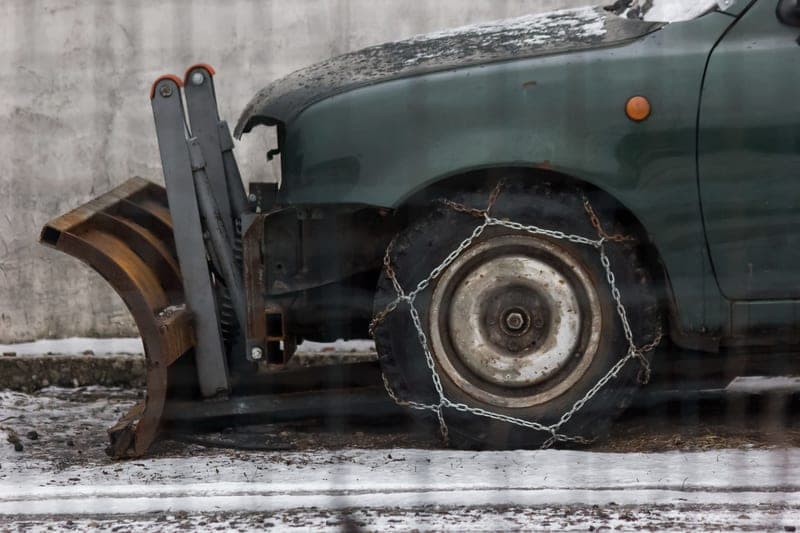
Peerless Chain
Peerless Auto-Trac Light Truck and SUV Tire Chains
In the same bracket as the passenger Auto-Trac set
The light-truck version of the self-tightening Auto-Trac, and the published clearance figure is why it belongs on an SUV page: 14 mm on the inside sidewall, which is a genuinely small number for a link chain and the reason it clears wheel wells that reject heavier sets.
Skip it if: Your owner's manual prohibits chains on that axle, or your tire size is not in the published fitment list. Neither is negotiable.
#ad We hold no verified live price for this product, so we show none. How this site is funded.
Security Chain Company
Security Chain Company Super Z6 Cable Chains
Roughly $70-$120 a pair
A low-clearance cable chain, which is the type most modern cars actually need. The clearance requirement is the entire buying decision here and most people never check it: many vehicles do not have room for a conventional link chain in the wheel well.
Skip it if: Your owner's manual prohibits chains on your vehicle, or specifies a clearance you do not have. Check the manual before you check the price.
#ad We hold no verified live price for this product, so we show none. How this site is funded.
AutoSock
AutoSock Textile Snow Sock
Roughly $80-$150 a pair
A textile cover that pulls over the tire. It fits vehicles with no clearance for chains, takes about a minute a wheel, and is the option that is accepted in some places where chains are not - which is worth checking before you buy either.
Skip it if: You need traction repeatedly over long distances. Textile wears fast on bare pavement.
#ad We hold no verified live price for this product, so we show none. How this site is funded.
How this was ranked
Every site in this category says it tested twenty of these. We have not tested any, and we say so. What we did instead: built the candidate set from what Amazon actually stocks, compiled the published specifications from each manufacturer’s own pages, did the arithmetic on running cost and on what the thing prevents, and read owner reviews for failure patterns rather than star averages. Every number on this page has a link to where it was published, so you can check the work.
- Units we claim to have tested
- 0
- Sponsored placements
- 0
- Free products accepted
- 0
Frequently asked
When are tire chains required in California?
When Caltrans declares a chain control on that highway, at one of three levels. R1 requires chains but exempts autos and pickups with approved legal snow tires. R2 requires chains or traction devices on all vehicles except four-wheel and all-wheel drive with snow-tread tires on all four wheels. R3 requires them on all vehicles with no exceptions, and roads are often closed before R3 is imposed.
Does all-wheel drive exempt me from a chain control?
Not on its own. Under Caltrans R2 the exemption is four-wheel or all-wheel drive with snow-tread tires on all four wheels. An AWD vehicle on all-season tires does not qualify. Under Colorado’s Traction Law, AWD or 4WD needs mud and snow or winter tires with 3/16 inch of tread. And once Colorado escalates to the Passenger Vehicle Chain Law, every vehicle needs chains or an approved alternative regardless of drivetrain.
What tread depth do my tires need to qualify?
Caltrans publishes a minimum legal tread depth for mud and snow tires of 6/32 of an inch. Colorado publishes 3/16 inch, which is the same depth written differently. Both are well above the 2/32 in legal wear limit, so a tire can be perfectly legal to drive on and still fail the traction exemption.
What is the fine for not having chains?
It varies by state. Colorado publishes $100 plus a $33 surcharge for non-compliance, rising to $500 plus a $157 surcharge if your non-compliance closes the road. Those published figures are a large part of the reason a set of chains in the trunk is a rational purchase for anyone who drives a mountain route.
Do snow socks count as chains in a chain control?
Sometimes, and you need to check for the state and route you are driving. Both systems above refer to “traction devices” and “approved alternative traction devices”, and whether a particular textile device is approved is a jurisdiction question rather than a product question. If it is your plan, verify it for the route in advance and carry the packaging.
Do I need chains if I only drive in town?
Probably not. Chain controls are declared on specific highways, overwhelmingly mountain routes, and a driver who stays on plowed urban roads may go years without meeting one. That is a legitimate reason not to buy, and we make that case in full here rather than pretending everyone needs a set.