The answer first
One pair — two chains — on the drive axle is the minimum and the usual purchase. But the chain maker’s own instruction sheet recommends four, and your owner’s manual may override both.
Security Chain Company’s published Super Z6 guidance recommends using winter traction products on all four tires, unless the vehicle owner’s manual prohibits it, and notes that this matters especially on front-wheel-drive vehicles. Its Auto-Trac manual puts the deference plainly: “Please refer to your vehicle owner’s manual for more information on the use of tire chains.”
And the manuals genuinely do override it. Honda publishes, for the 2022 Civic Sedan, that snow tires should be mounted “to all four wheels” but that chains go on “the front tires only”. For the CVT it names the specific cable chain — “Cable-type: SCC Radial Chain SC1034” — and for the manual-transmission car it publishes “not recommended to use any type of chains” and “your vehicle’s tires are not suitable for mounting any traction device.”
So the sequence is: manual first, chain maker second, drivetrain last. Your drivetrain is the leastinformative of the three, which is the opposite of how this question is usually answered.
Start with the fact that chains are sold in pairs
A boxed set of passenger tire chains is two chains. That is one axle. If you want four, you buy two boxes, and the sidewall-size code has to match on both axles — which it often does not, because staggered setups run different front and rear sizes.
That detail trips people up at the till. “Two chains” is one purchase; “four chains” is two purchases and possibly two different part numbers. Check the code on each tire before you decide you want a full set.
What each document publishes about how many| Source | What it publishes | Weight you should give it |
|---|
| Your vehicle owner's manual | Which axle, which specific chains, or whether any traction device is permitted at all | Final. It is the only document that knows your clearance |
|---|
| SCC Super Z6 user manual | Recommends traction products on all four tires unless the owner's manual prohibits it; especially important on front-wheel drive | High - the maker's own instruction, and it defers to your manual |
|---|
| SCC Auto-Trac manual | "Never exceed 30 MPH while the AUTO-TRAC Chains are installed"; refer to the vehicle manual on use | High for operation, deferring on quantity |
|---|
| State chain-control signage | A minimum requirement for the conditions, by axle count and drivetrain | Legal floor, not a buying recommendation |
|---|
| Your drivetrain | Nothing, on its own | Lowest. It tells you which axle drives, not which axle clears |
|---|
If the manual does not say: which axle, and why
Plenty of manuals say nothing useful, so here is the reasoning behind the default.
Chains go on the driven wheels, because traction is what they are for. Front-wheel drive, chains on the front. Rear-wheel drive, chains on the rear. That is the basic rule and it is why the Honda manual says front only on a front-drive car.
Four is better than two for the reason nobody buys them: stopping and steering. Chains on the drive axle get you moving. Chains on all four get you stopping and turning as well as moving, which is why the chain maker’s own sheet recommends four. Getting going is the part people worry about; the part that hurts is arriving at a corner with grip at one end of the car and none at the other.
On a front-drive car, two chains make the handling strange. The front has grip and the rear does not, so the back of the car will step out under braking or a lifted throttle more readily than you expect. That is worth knowing even if you still buy two, which most people sensibly do.
On four-wheel drive, the manual decides and often says rear. Front clearance on a 4WD is frequently tighter because of the steering and the drive components packed into the arch, so “all four” is not automatically available even on a vehicle where it would help most.
The clearance check that decides whether any of this applies
Before the quantity question there is a feasibility question, and it has a published number. SCC publishes that the Super Z6 needs about 6 mm, roughly a quarter of an inch, of sidewall clearance — and it is in the low-clearance product line. Conventional link chains need considerably more.
So the check is: reach into the arch with the wheels straight and again at full lock, and find the tightest point between the tire sidewall and the strut, the spring, the brake line and the inner arch liner. If that gap is under a quarter inch at any point, cables are the only candidate and link chains are out.
Honda frames the consequence of getting this wrong about as strongly as a manual ever does: “Using the wrong chains, or not properly installing chains, can damage the brake lines and cause a crash in which you can be seriously injured or killed.” A brake line cut by a chain link is not a repair bill, it is a brake failure.
Doing this check at full lock, in daylight, in October is the whole point of fitting them once before you need them.
What the law requires versus what you should buy
Chain-control requirements are a legal minimum for the conditions, and they are set per state and per restriction level rather than per vehicle. California and Colorado both publish their levels, and we work through which level requires what, and who is exempt, in detail elsewhere.
The thing to carry from that page into this one is that an exemption is not the same as a recommendation. Several states exempt four-wheel and all-wheel-drive vehicles from the lower restriction levels provided they have snow-tread tires on all four wheels — the drivetrain alone does not qualify. And at the highest restriction level, exemptions generally stop existing.
A set of chains in the trunk that you are legally allowed not to fit is still a set of chains in the trunk.
The four instructions that come with the answer
Having decided how many, there are four published instructions that decide whether they do any good, and all four come from the documents already quoted on this page.
1. Follow the chain maker, not a video. Honda publishes “follow the chain manufacturer’s instruction when installing,” and separately, “when tire chains are mounted, follow the chain manufacturer’s instructions regarding vehicle operational limits.” Two different documents, two different jobs: the car maker tells you which wheels and which chains, the chain maker tells you how to fit them and how fast you may drive.
2. Mount them as tightly as you can. That is Honda’s wording, and it is the single most common failure. A loose chain slaps. A slapping chain finds the arch liner, the brake line and the paint, and then it breaks. Rubber tensioners exist for this and come in the box with most sets.
3. Check they do not touch the brake lines or suspension. Also Honda’s wording, and the reason the quarter-inch clearance check above is not optional. Do it with the wheels straight and again at full lock, because full lock is where the tire moves closest to the strut.
4. Stop driving if they are hitting anything. Honda publishes “stop driving if they are hitting any part of the vehicle,” and notes that traction devices of the wrong size or improperly installed “can damage your vehicle’s brake lines, suspension, body, and wheels.” A rhythmic knock that appeared after you fitted chains is not something to drive through to the next town.
Add the speed limit that every maker publishes — 30 mph — and take them off as soon as you are back on bare pavement, because dry road is what destroys chains and what chains destroy.
Skip this
If your manual says no traction device, do not go looking for a workaround
Some cars genuinely cannot take chains. Honda publishes it for a specific Civic configuration in as many words: “Your vehicle’s tires are not suitable for mounting any traction device,” and separately “not recommended to use any type of chains” for the manual-transmission car.
That is a clearance statement, and the laws of physics are not interested in how much you want to drive to the mountains. Fitting something anyway risks the brake lines, the suspension and the bodywork, and Honda’s own instruction is to “stop driving if they are hitting any part of the vehicle.”
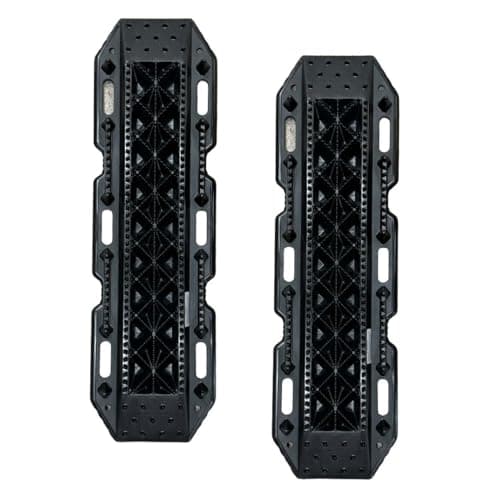
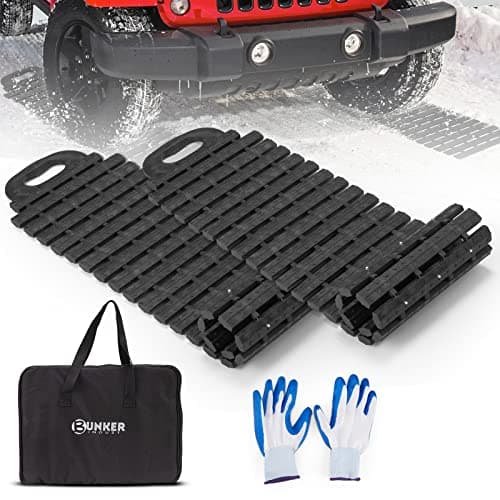
The alternatives, in order: a textile snow sock, which needs far less clearance and is legal in US chain-law states, then four winter tires, which need no clearance at all and work every day rather than only on the day you fit them. Recovery boards, the picks above, are the third thing: not a traction device for driving, but the way out of one specific hole.
What to buy, given all that
Manual permits chains, front-wheel drive, occasional use: one pair for the front axle. Accept that the rear has less grip and drive accordingly.
Manual permits chains and you drive mountain passes in winter: two pairs, if the size codes match front and rear. That is what the chain maker recommends, and the benefit is in the stopping rather than the starting.
Clearance under a quarter inch: cables or snow socks only. Check the size code against the sidewall and read the cables-versus-links comparison before you order.
Manual prohibits traction devices entirely: snow socks if they clear, winter tires if they do not, and a pair of recovery boards in the trunk for the stuck-in-a-driveway case. Boards are the picks on this page because they are the only thing here that works on a car that cannot wear anything on its tires.
Whichever you buy, fit it once in October. Thirty minutes on a dry driveway in daylight is the difference between a device you will actually use and a box you will not open at the side of a highway in the dark.