Clearing snow without scratching the paint
The damage is mechanical and entirely avoidable. It comes down to one tool decision and one habit.
Heads up: the buy links on this page are affiliate links. If you buy through one, we earn a commission at no extra cost to you. It does not change what we recommend or the order we rank things in - here is how we keep those separate.
What is actually doing the damage
Snow is soft. Snow does not scratch paint.
What scratches paint is everything mixed into the snow by the time it is sitting on your car: road grit thrown up by traffic, salt crystals, the sand that plows spread, and the film of all three that was already on the panels before it snowed. Those are hard particles. A brush head pressed against the paint holds them there, and moving the brush drags them across the clear coat.
That is abrasion. It is the same process as sanding, differing only in grit size and pressure. The result is the fine, shallow, roughly circular scratching that shows up as a haze in direct sunlight — usually noticed in spring, usually blamed on the car wash.
The tool decision
Closed-cell foam. That is the answer, and the reason is that foam does not trap and hold grit against the surface the way bristles do, and it deforms around the panel rather than raking across it.
Bristles are not automatically ruinous — a soft bristle head used gently on a clean car is fine. But bristles plus grit plus pressure is the combination that marks paint, and two of those three are outside your control on a February morning.
Every good foam broom also has a scraper on the opposite end, and this is the important part of using one: the scraper touches glass and nothing else, ever. A plastic scraper on a painted panel will mark it immediately and visibly. The brushes we would buy are here.
The technique, which costs nothing
- Start the engine and put the defroster on first. By the time you have done the roof, the windshield ice has softened and the glass work is half as hard.
- Work top down. Roof first, then rear glass and trunk, then hood, then the windshield last. Clearing the windshield first means clearing it twice when the roof snow slides down.
- Push, do not scrub. Let the head do the work with its own weight. Every extra pound of pressure presses grit harder into the finish, and it does not clear the snow faster.
- Long strokes, off the edge. Push snow off the nearest edge rather than dragging it across the whole panel.
- Clear the roof properly. Snow left on the roof slides onto your own windshield at the first hard stop, or leaves the car at speed into someone else’s. It is illegal in several states.
- Finish with the lights, the mirrors and the tailpipe.
Skip this
Never use any of these
A household broom. Stiff bristles designed for moving grit across a floor, plus a handle you cannot control at arm’s length, plus a metal ferrule near your paint.
A gas station squeegee. The rubber is fine. What is embedded in it from a hundred other cars is not.
Hot water. Thermal shock cracks cold glass. This is a several-hundred-dollar mistake that takes three seconds to make.
Your sleeve, a credit card, a spatula. All of these get used when someone is late and has no tool. Keeping a proper brush in the car is what prevents them.
The part that happens in October
A well-sealed paint surface is more forgiving of everything above, because the sacrificial layer takes the abrasion instead of the clear coat, and because a slick surface releases snow more easily in the first place.
Twenty minutes with a spray sealant before the season starts is the preventive half of this page. It is not a force field and we are not going to claim it is — but it is the cheap thing that makes the expensive thing less likely. The sealants worth using are here.
And the version of this page that involves no brushing at all: put a cover on the windshield the night before, so the only thing left in the morning is the roof.
What to buy, given all that
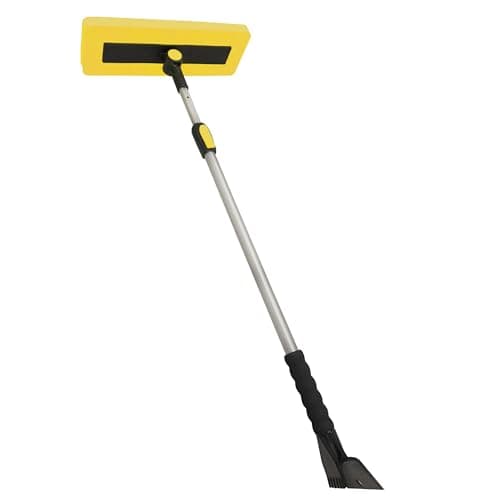
Snow Joe
Snow Joe 2-In-1 Telescoping Snow Broom and Ice Scraper
Roughly $25-$35
A foam head instead of bristles, on a pole that extends to reach the middle of a roof. The foam is the point: it pushes snow off without dragging grit across the clear coat the way a stiff bristle brush does.
Skip it if: You need to break thick ice off glass. The foam head is for snow; use the scraper end for ice and do not lean on the foam.
#ad Price as of October 18, 2026, from Amazon. Prices change. How this site is funded.
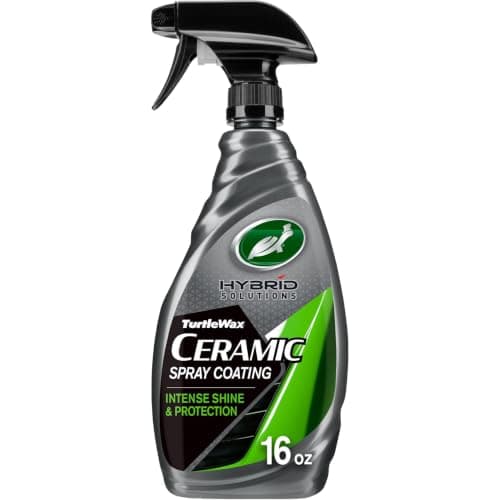
Turtle Wax
Turtle Wax Hybrid Solutions Ceramic Spray Coating
Roughly $15-$25
A spray-on sealant that goes on in twenty minutes and gives salt a slicker surface to fail to stick to. The honest claim is durability and ease, not miracle protection: this is a sacrificial layer, and reapplying it mid-winter matters more than which bottle you bought.
Skip it if: Your clear coat is already failing. A sealant over damaged paint is a coat of gloss on a problem.
#ad Price as of October 18, 2026, from Amazon. Prices change. How this site is funded.
How this was ranked
Every site in this category says it tested twenty of these. We have not tested any, and we say so. What we did instead: built the candidate set from what Amazon actually stocks, compiled the published specifications from each manufacturer’s own pages, did the arithmetic on running cost and on what the thing prevents, and read owner reviews for failure patterns rather than star averages. Every number on this page has a link to where it was published, so you can check the work.
- Units we claim to have tested
- 0
- Sponsored placements
- 0
- Free products accepted
- 0
Frequently asked
Will a snow brush scratch my car?
It can, and the variable is grit rather than the brush alone. Hard particles in the snow get dragged across the clear coat under pressure. A closed-cell foam head with light pressure is substantially safer than a stiff bristle head used with force, and technique matters as much as the tool.
What is the safest way to remove snow from a car?
A foam-headed snow broom, used top down with light pressure, after running the defroster for a few minutes. Push the snow off the nearest edge rather than dragging it across panels, and keep the plastic scraper on glass only.
Can I use a leaf blower to clear snow off my car?
For light, dry, fresh snow it works well and touches nothing, which makes it the gentlest method available. It is useless on wet or packed snow and on any ice, and it is not something most people want to run at 6am in a residential street.
Does wax stop snow scratching paint?
It reduces the risk rather than removing it. A sealant is a sacrificial layer that takes some of the abrasion instead of the clear coat, and it makes the surface slicker so snow releases more easily. It is worth doing, and it is not a substitute for the right brush.