The shortlistRanked, with the prices
Ranked on published manufacturer specifications and, where the numbers exist, the arithmetic on what each option costs and what it saves. Tap any row for the full write-up, including who should skip it.
| # | Product | Best for | Score | Price |
|---|
| 01 | 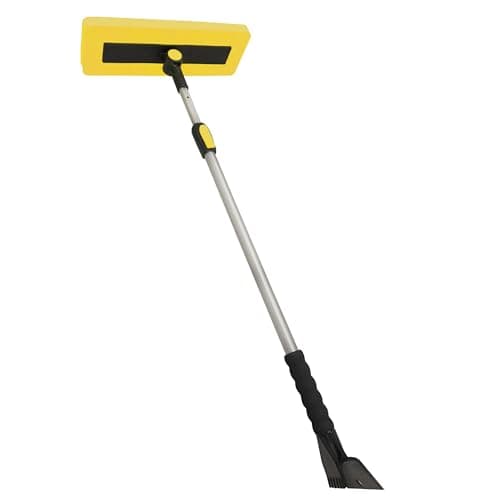 Snow Joe 2-In-1 Telescoping Snow Broom and Ice ScraperClearing a roof and hood without scratching paint Snow Joe 2-In-1 Telescoping Snow Broom and Ice ScraperClearing a roof and hood without scratching paint | Best paint-safe brush | 9.0★★★★★ | $31.97 - View on Amazon |
| 02 | 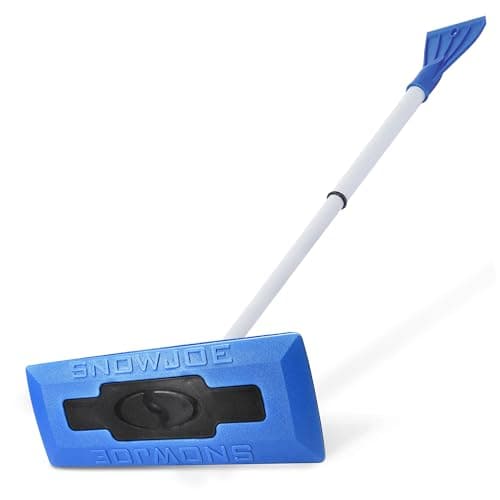 Snow Joe SJBLZD 18-Inch Snow Broom and Ice ScraperWet, heavy snow and slush that a brush only smears Snow Joe SJBLZD 18-Inch Snow Broom and Ice ScraperWet, heavy snow and slush that a brush only smears | Best for wet snow | 8.3★★★★☆ | $25.97 - View on Amazon |
| 03 | 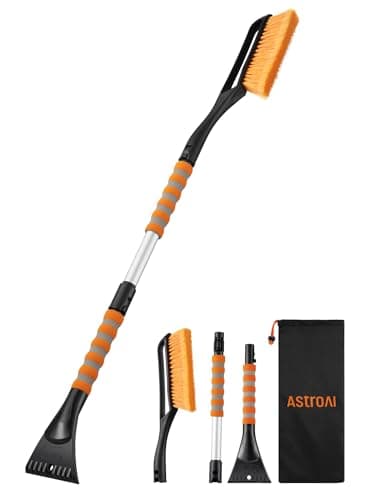 AstroAI Snow Brush with Detachable Ice ScraperThe cheapest tool that is still worth owning AstroAI Snow Brush with Detachable Ice ScraperThe cheapest tool that is still worth owning | Best under $25 | 7.4★★★★☆ | $16.99 - View on Amazon |
Scores are ours and editorial. They are never published as review or rating markup, because we have not tested these products - see how we pick.
The damage mechanism, stated properly
Fresh, clean snow is harmless. It is not the snow that marks paint.
What marks paint is what is mixed into the snow — road grit, salt crystals, sand thrown up by plows and passing traffic, and the film of the same that was already on the car. A stiff bristle head pressed down firmly holds those particles against the clear coat and drags them across it. That is, mechanically, sanding. The fine circular scratching people notice in spring sunlight and blame on the car wash very often started on a February morning with a hardware store brush.
The trade, in money
A paint-safe foam broom is about $30. Machine polishing to remove fine scratching is commonly $200 to $400 for a panel and considerably more across a whole car, because it is skilled labor measured in hours.
You do not need to believe the damage is certain for that trade to make sense. You only need to think it is more likely than one chance in ten.
Foam or bristles
Closed-cell foam does not hold grit against the surface the way bristles do, and it deforms around the panel rather than raking across it. That is why every serious brush in this category has moved to a foam head, and it is the single specification worth choosing on.
The honest limitation: foam is for snow, not ice. Levering at a frozen patch with a foam head tears the foam and does not shift the ice. Every good broom therefore has a scraper on the other end, and the rule is simple — the scraper goes on glass and nowhere else. For a dedicated hand scraper, we rank those separately, on what the blade is made of and what the published glass research says about it.
Snow brush head types compared| Head | On paint | On ice | Notes |
|---|
| Closed-cell foam | Safe with normal pressure | Poor - use the scraper | The right default. Tears if used as a lever. |
|---|
| Soft bristle | Acceptable if you brush rather than scrub | Poor | Fine on a car you keep clean. Grit is still the risk. |
|---|
| Stiff bristle | This is the one that marks paint | Poor anyway | Sold everywhere and cheap. That is its whole case. |
|---|
| Squeegee blade | Safe | No | Genuinely useful in wet snow and slush, where a brush smears. |
|---|
Reach, and the roof nobody clears
A short brush means you cannot reach the middle of the roof, so you leave the snow there and drive off. It then slides forward onto your own windshield at the first hard stop, or leaves the roof at speed and hits the car behind you. Several states have laws about exactly this, and the physics does not care either way.
A frozen door lock or a door sealed shut by ice is a different problem with its own cheap fix. A telescoping handle is not a luxury feature on anything taller than a sedan. It is the difference between clearing the car and clearing the parts of it you can reach. On an SUV or a truck, reach stops being one criterion among several and becomes the whole specification.
Skip this
Skip the credit-card-sized scraper as your only tool
The small plastic scraper in the door pocket is a genuinely useful emergency item and a hopeless primary tool. It has no reach, no leverage and no brush, so clearing a car with one takes long enough that people start improvising — with a broom from the garage, or a squeegee from the gas station, or their sleeve. All three are worse for the paint than the brush they did not buy. A hand scraper is still worth owning alongside the brush; which one is its own question.
Technique, which is free
- Top down. Roof, then rear glass, then hood, then windshield. Clearing the windshield first means doing it twice.
- Push, do not scrub. Let the tool move the snow. Pressure is what turns grit into abrasive.
- Start the engine and the defroster before you clear. Five minutes of warming softens the bond between ice and glass, and the scraper then does far less work.
- Never hot water. Thermal shock on cold glass cracks windshields, and it is a several-hundred-dollar mistake that takes three seconds to make. The methods that do work are here.
- Clear the lights, the mirrors and the tailpipe. The last one matters if you are going to sit in the car with the engine running.
And the technique that beats all of them: put a cover on the night before, so the glass needs no tool at all.
How this was ranked
Every site in this category says it tested twenty of these. We have not tested any, and we say so. What we did instead: built the candidate set from what Amazon actually stocks, compiled the published specifications from each manufacturer’s own pages, did the arithmetic on running cost and on what the thing prevents, and read owner reviews for failure patterns rather than star averages. Every number on this page has a link to where it was published, so you can check the work.
- Units we claim to have tested
- 0
- Sponsored placements
- 0
- Free products accepted
- 0
The full method, including what we refuse to claim