Why this is a winter problem, not a tidiness problem
A starter motor pulls hundreds of amps. Every bit of resistance between the battery and that motor turns into heat and lost voltage instead of turning the engine, and corrosion on a terminal is resistance.
In July, a slightly furry terminal costs you nothing you would notice, because a warm battery has current to spare. In January it lands on top of two things at once: a battery that already delivers far less when cold and an engine that is harder to turn. That is the morning a marginal connection becomes a click.
The corrosion itself comes from hydrogen and acid fumes escaping past the post seals and reacting with the metal of the clamps. Which is why the fix is a barrier at the post, and why it has to go on clean metal.
How we judged these
1. Does it stay where you put it? A terminal lives through enormous temperature swings and constant vibration. A preventative that migrates or flakes off has stopped working, and you will not notice until it matters.
2. Can you tell you have covered everything? A clear film on a black clamp in a dark engine bay is a coverage problem.
3. What does the maker publish? In this category that is mostly composition and behavior - whether it dries, what it protects, what removes it.
4. Does it get in the way? Anything you have to scrub off before the next battery test is a small tax on the next person to touch the car.
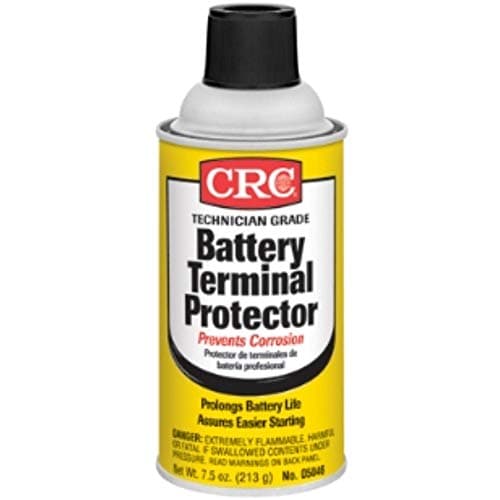
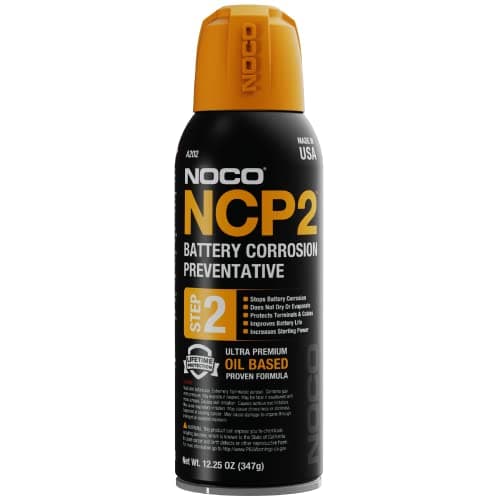
Published behavior of the three approaches | NOCO NCP2 | CRC Terminal Protector | Felt washers |
|---|
| Type | Oil-based coating | Soft, dry, lead-free film | Fiber washer under the clamp |
|---|
| Dries? | "Does not dry or evaporate" | Dries to a soft film | Not applicable |
|---|
| Visible coverage | Oil film, hard to audit | Dark red, published as a visual aid | Obvious - you can see them |
|---|
| Where it goes | Terminals, cables, hold-downs, carriers | Metal contacts | Under the clamp, on the post |
|---|
| Removal | Degreaser | Degreaser or brake cleaner | Lift the clamp |
|---|
| Service temperature | Not published | Not published | Not published |
|---|
Note the bottom row. None of these publishes a service temperature range, which is a gap worth naming on a product whose entire job happens in an engine bay that swings from -10 F to well over 150 F. We are not going to guess at one.
The order of operations, which matters more than the product
Every product here is a preventative. Put any of them over existing corrosion and you have sealed the problem in rather than stopped it. The sequence is not optional:
- Disconnect the negative terminal first, then the positive. Reversing that order is how a wrench across the positive post and a grounded surface ruins somebody's afternoon.
- Clean the posts and clamps back to bright metal. A terminal brush costs a few dollars; baking soda and water neutralizes acid residue, and then everything needs to be dried properly.
- Fit the felt washers now if you are using them, because this is the only moment they can go on.
- Reconnect - positive first, then negative - and tighten to snug rather than to heroic.
- Then coat the outside with the spray of your choice, covering the clamp, the post and the first inch of cable.
Coating before you reconnect is the classic mistake. These products are insulators by design; they belong on the outside of a made connection, not between the clamp and the post.
Skip this
Skip the old tricks: grease, Coke, and painting over it
Ordinary grease does work as a barrier, and it also collects grit and turns into a mess that hides what is underneath. The purpose-made products cost a few dollars and behave better.
Pouring cola on the terminals genuinely does fizz away some corrosion - and leaves sugar syrup on your battery tray and whatever it drips onto. Baking soda and water does the same job without the sugar.
Coating over corrosion is the one that actually costs you. The resistance stays, the connection keeps degrading, and now it is invisible. If the posts are furry, the job is cleaning them - the spray is what you do afterward.
What we would buy
For most cars: the oil-based NOCO. It is published as not drying or evaporating, it covers the terminals, cables and hold-downs rather than just the posts, and it costs less than a coffee.
If you want to see your work: the CRC. The dark red film is published as a visual aid, it dries rather than staying wet, and an engine bay you keep clean will thank you for it.
Add the washers while the clamps are off. Three dollars, and they sit exactly where the fumes escape. There is no reason to skip them if the battery is already disconnected.
And do it in the fall. This is a ten-minute job that belongs with the rest of the pre-winter list, alongside getting a maintainer on the battery and having it load-tested while there is still time to replace it.