How to use a battery maintainer
Ten minutes of setup in October, then two seconds a night for the rest of the winter. Skip the setup and you will stop using it by December.
Heads up: the buy links on this page are affiliate links. If you buy through one, we earn a commission at no extra cost to you. It does not change what we recommend or the order we rank things in - here is how we keep those separate.
Do the harness first. It is the whole thing.
Almost every maintainer includes a ring-terminal harness, and almost everybody ignores it and uses the clamps. That is the decision that determines whether the device gets used.
With clamps, connecting means opening the hood, in the dark, in the cold, every single night. People do that for about a fortnight.
With the harness, the connector lives behind the grille or under the edge of the hood, and connecting means plugging one thing into another. Two seconds, no hood, no gloves off.
Fitting the harness
- Engine off, key out, cold engine.
- Disconnect the negative terminal first. Always negative first when disconnecting — if the wrench touches the body while you are on the positive, you short the battery.
- Bolt the red ring terminal to the positive post and the black one to the negative post, or to a clean chassis ground point.
- Reconnect the negative terminal last.
- Route the connector somewhere reachable — behind the grille or just inside the hood line — and cable-tie it so it cannot foul a belt, a fan or an exhaust component.
- Fit the weatherproof cap so the contacts stay clean.
If your maintainer has an inline fuse in the harness, keep it. It is the protection against the harness itself becoming a fault path.
Connecting it, in order
- Plug the maintainer into the battery first, while it is unplugged from the wall.
- Then plug it into the mains.
- Reverse that to disconnect: mains out first, then the battery.
The reason is sparks. Making or breaking a connection at the battery while the charger is energized can arc, and a lead-acid battery under charge vents small quantities of hydrogen. It is a small risk and it is free to avoid.
What the lights mean
Interpretations vary between makers, so read the manual for yours, but the pattern is consistent.
| Indication | Usually means | What to do |
|---|---|---|
| Charging / amber | Actively putting current in | Nothing. Leave it. |
| Full / maintained / green | Battery is at full charge, unit is in float or standby | Nothing. This is the normal winter state. |
| Alternating or pulsing | Analyzing, or in a repair/desulfation mode | Leave it. These modes take hours by design. |
| Error / red | Reverse polarity, a bad connection, or a battery the unit cannot bring up | Disconnect and investigate. Do not leave it. |
| Nothing at all | No mains power, or the harness fuse has blown | Check the outlet, then the inline fuse. |
A unit that sits on charging for days rather than reaching full is telling you something. Either the battery is failing to hold charge, or there is a parasitic draw on the car pulling as fast as the maintainer supplies.
Skip this
Four things that undo the point
Using clamps all winter. They corrode, they get knocked off, and the friction of opening the hood every night means you stop.
Connecting to a battery with corroded terminals. Corrosion is resistance. Clean the posts with a wire brush and a baking soda solution first, or the maintainer is fighting a bad connection all season.
Leaving the harness where it can chafe. A cable rubbing against a moving part all winter eventually wears through, and then you have an unfused conductor loose in an engine bay.
Using it to nurse a dead battery. A maintainer keeps a good battery good. If the battery is more than five years old and cranks slowly, replace it — the maintainer is postponing that, not preventing it.
How often, realistically
A car parked for the season: connect it and leave it. That is the whole plan.
A daily driver on short trips: connect it overnight once or twice a week. The deficit builds slowly, so you do not need to be religious about it, and any regular topping up beats none.
Something stored: connect it and leave it, and check the indicator once a month so a fault does not sit undetected until spring.
At roughly three dollars a winter to run, there is no reason to be sparing about it.
Two cold-weather caveats belong on top of all of this, and they have a page of their own: check that your unit publishes an operating range that covers your garage, and never connect anything to a battery whose case has bulged, because frozen electrolyte has to be thawed before it is charged.
What to buy, given all that

NOCO
NOCO GENIUS1 1A Smart Charger and Maintainer
Roughly $25-$35
The published operating range is the reason this is the pick: NOCO rates it from -4 F to 104 F, which is the only spec on this page that speaks to whether the thing works in an unheated garage in January. Most rivals simply do not publish one.
Skip it if: You need to recover a flat battery quickly. At 1 amp this is a maintainer, and a genuinely dead battery takes it more than a day.
#ad Price as of October 18, 2026, from Amazon. Prices change. How this site is funded.
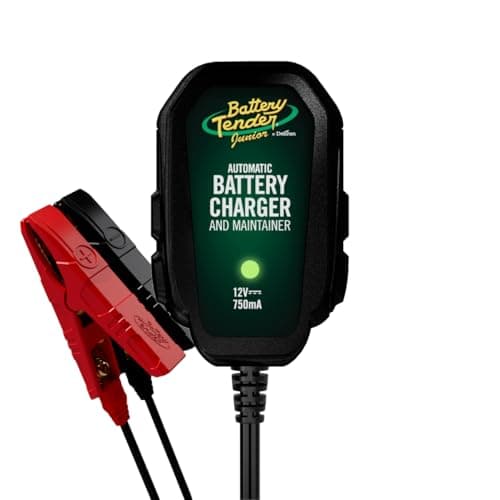
Battery Tender
Battery Tender Junior 750mA Charger
Roughly $25-$35
The maintainer that gave the whole category its nickname. It does one thing, has done it for decades, and the quibble is that the published specification sheet is thinner than the rival's - notably on cold operating limits.
Skip it if: You have 6-volt or lithium batteries to look after as well.
#ad Price as of October 18, 2026, from Amazon. Prices change. How this site is funded.
How this was ranked
Every site in this category says it tested twenty of these. We have not tested any, and we say so. What we did instead: built the candidate set from what Amazon actually stocks, compiled the published specifications from each manufacturer’s own pages, did the arithmetic on running cost and on what the thing prevents, and read owner reviews for failure patterns rather than star averages. Every number on this page has a link to where it was published, so you can check the work.
- Units we claim to have tested
- 0
- Sponsored placements
- 0
- Free products accepted
- 0
Frequently asked
Which terminal do you connect first on a battery maintainer?
Positive first, then negative, with the maintainer unplugged from the wall. Then plug it in. To disconnect, reverse it: unplug from the wall first, then remove the leads. The sequence exists to avoid making or breaking a connection at the battery while the charger is energized.
Can you leave a battery maintainer on overnight?
Yes, and for the whole winter if it is a genuine smart maintainer that drops to float or standby. That is what they are designed for. A constant-current trickle charger with no cutoff is a different device and should not be left unattended.
Do you need to disconnect the battery to use a maintainer?
No. A maintainer is designed to be connected to a battery still installed in the vehicle, and disconnecting it would mean losing radio presets and stored settings on many cars. Just connect and leave it.
Why is my battery maintainer flashing red?
Usually reverse polarity, a poor connection, or a battery the unit cannot bring up. Check the leads are the right way round, clean the terminals, and check the inline fuse in the harness. If everything is correct and it still errors, the battery may be too far gone for the unit to work with.
Sources
- Charging a car battery in freezing weather
- What actually stops battery terminal corrosion
- The best block heater timers, and what one saves you
- The best battery maintainer for a motorcycle
- The best battery maintainers for winter
- What size battery maintainer do you need?
- Why car batteries die in the cold
- Battery and cold starts