Skip to content
Frost & Fender
Roundup

The best battery maintainers for winter

Amperage is the number on the box. The number that matters is the operating temperature range, and most makers do not print one.

By Scooter M.Published September 1, 2026

Heads up: the buy links on this page are affiliate links. If you buy through one, we earn a commission at no extra cost to you. It does not change what we recommend or the order we rank things in - here is how we keep those separate.

The shortlist

Ranked, with the prices

Ranked on published manufacturer specifications and, where the numbers exist, the arithmetic on what each option costs and what it saves. Tap any row for the full write-up, including who should skip it.

#ProductBest forScorePrice
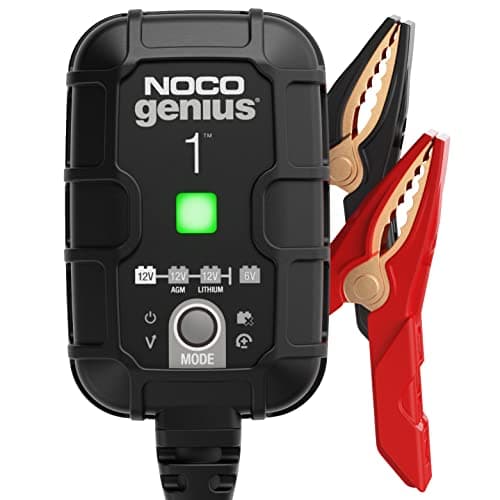
01A car battery under the hood, of the kind a maintainer keeps charged - a stand-in for the NOCO GENIUS1 1A Smart Charger and Maintainer, not a photograph of this modelNOCO GENIUS1 1A Smart Charger and MaintainerA car, motorcycle or mower left parked through a cold winterBest cold-rated maintainer9.3Check price on Amazon
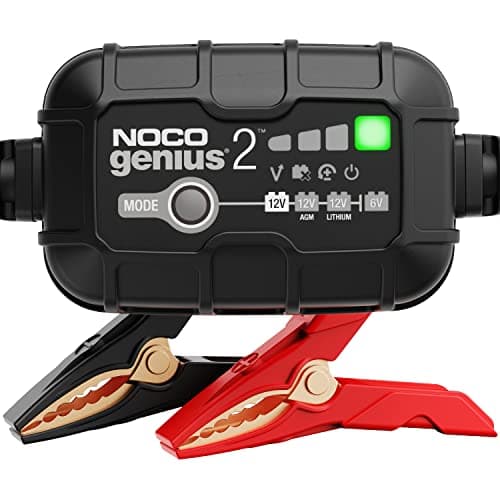
02A car battery under the hood, of the kind a maintainer keeps charged - a stand-in for the NOCO GENIUS2 2A Smart Charger, not a photograph of this modelNOCO GENIUS2 2A Smart ChargerA car that gets driven rarely and sometimes ends up flatBest if it goes flat8.8Check price on Amazon
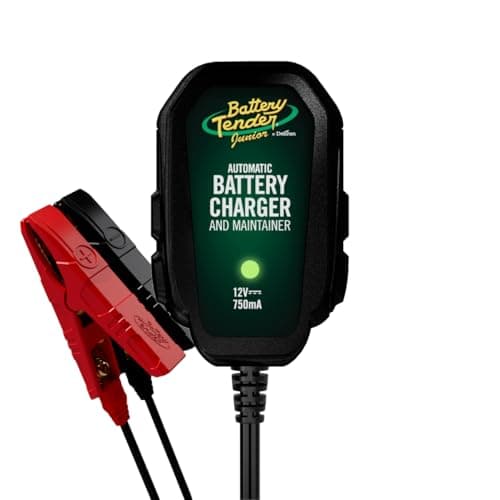
03A car battery under the hood, of the kind a maintainer keeps charged - a stand-in for the Battery Tender Junior 750mA Charger, not a photograph of this modelBattery Tender Junior 750mA ChargerA no-decisions 12-volt maintainer for a stored vehicleLongest track record8.4Check price on Amazon
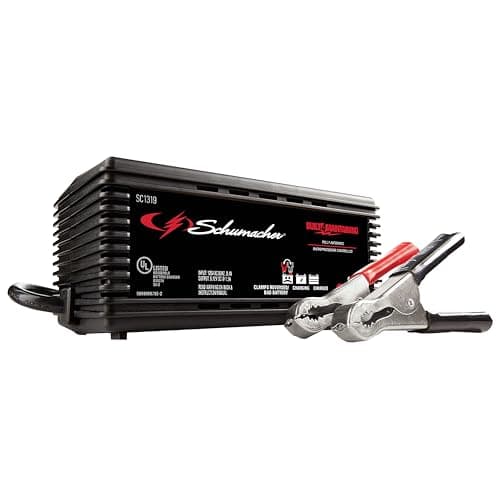
04A car battery under the hood, of the kind a maintainer keeps charged - a stand-in for the Schumacher Fully Automatic Battery Maintainer, not a photograph of this modelSchumacher Fully Automatic Battery MaintainerThe lowest price on a float maintainerCheapest that works7.5Check price on Amazon

Scores are ours and editorial. They are never published as review or rating markup, because we have not tested these products - see how we pick.

The problem this solves

Cold does two things to a battery at once, and it is the combination that kills otherwise healthy ones.

It reduces available cranking power, because the chemical reaction that delivers current slows as temperature falls. CTEK publishes the commonly cited figures: roughly a 35 percent loss of strength at 32 F and about 60 percent at 0 F. Other sources put slightly different numbers on it — some quote 20 percent and 40 percent — but every one agrees on the direction and the rough scale.

At the same time the engine becomes harder to turn, because cold oil is thick and resists the starter. Demand rises exactly as supply falls. That is why a battery that was completely fine in October fails on the first genuinely cold morning.

A maintainer does not warm the battery. What it does is make sure the battery meets that morning at a full state of charge rather than the partial charge that short winter journeys leave it at — because short trips with the heater, lights, wipers and rear defroster all running frequently take more out of a battery than the alternator puts back.

The specification that decides this

Not amperage. For maintaining a healthy battery, anything from 750 mA to 2 A does the job; the difference only shows if you are trying to recover a flat battery.

The specification that matters is the operating temperature range, because this device is going to spend its winter in an unheated garage. Of the four maintainers here, exactly one publishes one: NOCO rates the GENIUS1 from -4 F to 104 F. Battery Tender and Schumacher do not publish a figure for their equivalent units.

We mark that as unpublished on their entries rather than assuming they are fine. An unpublished specification is not a passed specification, and on a product whose entire job happens in the cold it is a strange thing to leave out.

What it costs to leave one running

NOCO publishes 15 W maximum consumption for the GENIUS1, and it draws far less than that once the battery is topped up and it drops to standby.

Take the worst case anyway. 15 W for 8 hours = 0.12 kWh. At the U.S. average residential rate of 18.34 cents per kWh (EIA Electric Power Monthly, June 2026), that is 2.2 cents a night.

Across a 120-night winter: $2.64, at maximum draw, which it will not sustain. A replacement battery fitted is commonly $150 to $250.

The naming problem

Three words get used interchangeably in shops and in listings, and they should not be.

Maintainer, trickle charger and charger compared
What it doesSafe to leave connected?
Maintainer / smart chargerMonitors voltage, charges when needed, drops to float or standby when notYes - this is the whole point of it
Trickle charger (strictly)Delivers a small constant current and does not stopNo - it will overcharge and boil off electrolyte
ChargerHigher current, sized to recover a flat battery quicklyDepends - modern smart chargers do both jobs; older ones do not

One trap worth stating plainly: “Battery Tender” is a brand name, not a product category. People searching for a battery tender are searching for a maintainer, and the two are not synonyms. The distinction, and why it matters, is here.

Check the chemistry

If your car has an AGM battery — common on anything with stop-start — the charger needs an AGM mode. Charging AGM on a flooded-lead-acid profile uses the wrong voltage and shortens its life. If you are also maintaining a lithium powersports battery, it needs a lithium mode, and running lithium on a lead-acid profile is worse than merely inefficient.

Both NOCO units here publish support for wet, gel, MF, CA, EFB, AGM and lithium. The cheaper units cover less.

Skip this

Skip the solar trickle charger on a dashboard

The small solar panel that sits on the dash and plugs into the 12 V socket is a popular winter purchase and it does very little. Winter is the season with the least daylight and the weakest sun angle, the panel is behind glass, and it is usually under a layer of frost for the first part of every day.

There is a second problem: on many cars the 12 V socket is switched off with the ignition, so it is not connected to anything when the car is parked. If you have mains power within reach of the car, use it.

How to actually connect one

Use the ring-terminal harness rather than the clamps. Most maintainers include one: it bolts permanently to the battery terminals and leaves a weatherproof connector you can reach without opening the hood.

Clamps are for occasional use. Left on all winter they corrode, they can be knocked off, and they require opening the hood in the cold every time. The harness turns a five-minute job into a two-second one, which is the difference between a maintainer you use and one that lives in a drawer. The full method is here.
The write-ups

Every pick, in full

01 / Best cold-rated maintainerA car battery under the hood, of the kind a maintainer keeps charged - a stand-in for the NOCO GENIUS1 1A Smart Charger and Maintainer, not a photograph of this model

NOCO

9.3 / 10

Roughly $25-$35

NOCO GENIUS1 1A Smart Charger and Maintainer

The published operating range is the reason this is the pick: NOCO rates it from -4 F to 104 F, which is the only spec on this page that speaks to whether the thing works in an unheated garage in January. Most rivals simply do not publish one.

Check price on Amazon

#ad We hold no verified live price for this product, so we show none. How this site is funded.

Published specifications for the NOCO GENIUS1 1A Smart Charger and Maintainer, with the source of each
SpecificationPublished valueWhere it is published
Charging current1 A DCNOCO GENIUS1 specification sheet
Voltages6 V and 12 VNOCO GENIUS1 specification sheet
Operating temperature-4 F to 104 F (-20 C to 40 C)NOCO GENIUS1 specification sheet
Battery capacity rangeUp to 30 Ah, maintains all battery sizesNOCO GENIUS1 specification sheet
Power consumption15 W maximumNOCO GENIUS1 specification sheet
ChemistriesWet, gel, MF, CA, EFB, AGM and lithiumNOCO GENIUS1 specification sheet

The arithmetic

About 4 cents a night to run, against a battery that costs $200 to replace.

NOCO publishes 15 W maximum consumption, and a maintainer draws far less than that once a battery is topped up. Even at the full 15 W for 8 hours that is 0.12 kWh, and at the U.S. average residential rate of 18.34 cents per kWh (EIA Electric Power Monthly, June 2026) it costs about 2.2 cents. Over a 120-night winter the worst case is roughly $2.64.

What it does well

  • Publishes a cold operating limit, which is the spec that decides winter suitability
  • Handles AGM and lithium as well as flooded lead-acid
  • Small enough to leave permanently zip-tied in an engine bay

What it does not

  • 1 amp is slow if you are trying to recover rather than maintain
  • The clamps are small; the ring-terminal lead is the better way to leave it connected
  • Status lights need a manual to interpret confidently

Skip this one if

You need to recover a flat battery quickly. At 1 amp this is a maintainer, and a genuinely dead battery takes it more than a day.

How it scores, by criterion

Cold-weather rating10.0
Published data10.0
Recovery speed5.0
Chemistry support9.5
Price8.5
02 / Best if it goes flatA car battery under the hood, of the kind a maintainer keeps charged - a stand-in for the NOCO GENIUS2 2A Smart Charger, not a photograph of this model

NOCO

8.8 / 10

Roughly $40-$55

NOCO GENIUS2 2A Smart Charger

Twice the current of the GENIUS1 for a modest step in price. Buy this one if the battery you are looking after is ever actually flat rather than merely idle, because 2 amps recovers in a day what 1 amp takes two to do.

Check price on Amazon

#ad We hold no verified live price for this product, so we show none. How this site is funded.

Published specifications for the NOCO GENIUS2 2A Smart Charger, with the source of each
SpecificationPublished valueWhere it is published
Charging current2 A DCNOCO published specifications
Voltages6 V and 12 VNOCO published specifications
ChemistriesLead-acid and lithiumNOCO published specifications
Repair modePublished as a manual desulfation modeNOCO published specifications

What it does well

  • Twice the recovery speed of the 1-amp unit
  • Same chemistry coverage and same interface
  • Force mode allows charging a battery too flat to be detected automatically

What it does not

  • Costs meaningfully more than the 1-amp unit for a job many people never need
  • Still slow next to a workshop charger
  • Larger than the GENIUS1 for permanent installation

Skip this one if

You only ever need to hold a healthy battery at float. The 1-amp unit is cheaper.

How it scores, by criterion

Cold-weather rating9.0
Published data9.0
Recovery speed7.0
Chemistry support9.5
Price6.5
03 / Longest track recordA car battery under the hood, of the kind a maintainer keeps charged - a stand-in for the Battery Tender Junior 750mA Charger, not a photograph of this model

Battery Tender

8.4 / 10

Roughly $25-$35

Battery Tender Junior 750mA Charger

The maintainer that gave the whole category its nickname. It does one thing, has done it for decades, and the quibble is that the published specification sheet is thinner than the rival's - notably on cold operating limits.

Check price on Amazon

#ad We hold no verified live price for this product, so we show none. How this site is funded.

Published specifications for the Battery Tender Junior 750mA Charger, with the source of each
SpecificationPublished valueWhere it is published
Charging current750 mABattery Tender charger range
Voltage12 VBattery Tender charger range
ModeFour-stage charge then float maintenanceBattery Tender charger range
Operating temperature rangeNot published by the manufacturerBattery Tender charger range

What it does well

  • Genuinely long track record in this exact application
  • Ring-terminal harness included, which is how a maintainer should be connected
  • Simple two-light status that is hard to misread

What it does not

  • No published cold operating limit, which is the figure that matters here
  • 12 volt only
  • Slower than the 1-amp rivals

Skip this one if

You have 6-volt or lithium batteries to look after as well.

How it scores, by criterion

Cold-weather rating5.5
Published data5.5
Recovery speed4.5
Track record9.5
Price8.5
04 / Cheapest that worksA car battery under the hood, of the kind a maintainer keeps charged - a stand-in for the Schumacher Fully Automatic Battery Maintainer, not a photograph of this model

Schumacher

7.5 / 10

Roughly $20-$30

Schumacher Fully Automatic Battery Maintainer

The hardware-store option. It works, it is usually the cheapest of the three, and the published specification is the thinnest - which is exactly the trade you are making at this price.

Check price on Amazon

#ad We hold no verified live price for this product, so we show none. How this site is funded.

Published specifications for the Schumacher Fully Automatic Battery Maintainer, with the source of each
SpecificationPublished valueWhere it is published
TypeFully automatic float-mode maintainerSchumacher Electric published specifications
Voltage12 VSchumacher Electric published specifications
Operating temperature rangeNot published by the manufacturerSchumacher Electric published specifications

What it does well

  • Cheapest credible maintainer of the group
  • Widely available off a shelf rather than by mail
  • Automatic float mode needs no supervision

What it does not

  • Thin published specification, including no cold rating
  • Fewer supported chemistries than the NOCO units
  • Build quality is priced in

Skip this one if

You want a published cold-weather operating limit before you buy.

How it scores, by criterion

Cold-weather rating5.0
Published data4.5
Recovery speed6.0
Availability9.5
Price9.5

How this was ranked

Every site in this category says it tested twenty of these. We have not tested any, and we say so. What we did instead: built the candidate set from what Amazon actually stocks, compiled the published specifications from each manufacturer’s own pages, did the arithmetic on running cost and on what the thing prevents, and read owner reviews for failure patterns rather than star averages. Every number on this page has a link to where it was published, so you can check the work.

Units we claim to have tested
0
Sponsored placements
0
Free products accepted
0

The full method, including what we refuse to claim

Questions people actually ask

Frequently asked

Do battery maintainers actually work?

Yes, for what they do: keeping a healthy battery at a full state of charge so it meets a cold morning with its full available cranking power. What they cannot do is repair a battery that has failed internally, and using one to keep restarting a dying battery just postpones the replacement.

Can you leave a battery maintainer connected all winter?

Yes, that is exactly what a maintainer is for — it monitors voltage and drops to float or standby rather than charging continuously. A true trickle charger, which delivers constant current and does not stop, must not be left connected: it will overcharge the battery and boil off electrolyte.

How much electricity does a battery maintainer use?

Very little. NOCO publishes 15 W maximum for the GENIUS1, and it draws far less once the battery is topped up. Even at full draw for 8 hours a night, that is about 2.2 cents at the U.S. average rate of 18.34 cents per kWh, or roughly $2.64 across a 120-night winter.

What size battery maintainer do I need?

For maintaining a healthy battery, 750 mA to 1 A is sufficient for almost anything with a 12-volt lead-acid battery. Step up to 2 A if the battery is sometimes genuinely flat rather than merely idle, because 1 A takes roughly twice as long to recover it. The sizing guide is here.

Will a battery maintainer work in a cold garage?

Check the published operating range, and be aware that most makers do not publish one. NOCO rates the GENIUS1 from -4 F to 104 F. Where a maker publishes nothing, you are assuming rather than knowing — which is why we flag the absence on each product entry instead of glossing over it.

Sources

Read next