The shortlistRanked, with the prices
Ranked on published manufacturer specifications and, where the numbers exist, the arithmetic on what each option costs and what it saves. Tap any row for the full write-up, including who should skip it.
| # | Product | Best for | Score | Price |
|---|
| 01 | 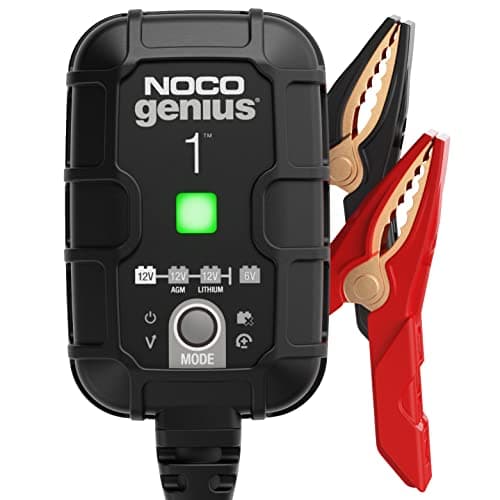 NOCO GENIUS1 1A Smart Charger and MaintainerA car, motorcycle or mower left parked through a cold winter NOCO GENIUS1 1A Smart Charger and MaintainerA car, motorcycle or mower left parked through a cold winter | Best value charger | 9.3★★★★★ | $29.95 - View on Amazon |
| 02 | 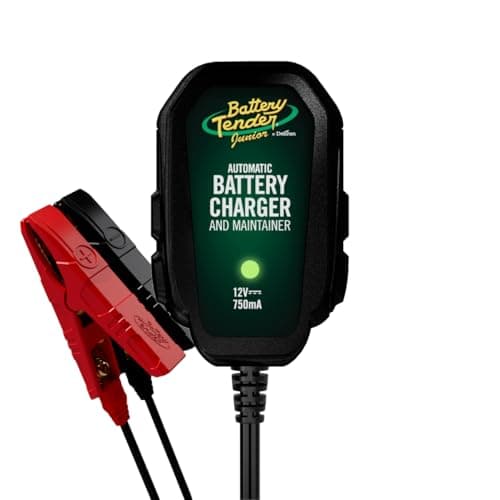 Battery Tender Junior 750mA ChargerA no-decisions 12-volt maintainer for a stored vehicle Battery Tender Junior 750mA ChargerA no-decisions 12-volt maintainer for a stored vehicle | Best simple option | 8.4★★★★☆ | $39.98 - View on Amazon |
| 03 | 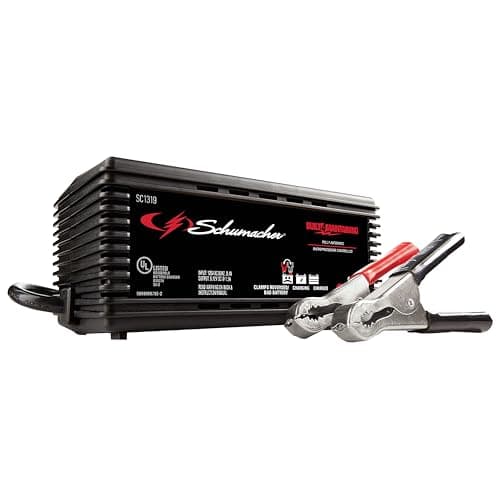 Schumacher Fully Automatic Battery MaintainerThe lowest price on a float maintainer Schumacher Fully Automatic Battery MaintainerThe lowest price on a float maintainer | Cheapest that works | 7.5★★★★☆ | $29.95 - View on Amazon |
Scores are ours and editorial. They are never published as review or rating markup, because we have not tested these products - see how we pick.
What under $50 actually buys
A modern smart charger in the $20 to $50 range will charge a 12-volt battery, hold it at float indefinitely without overcharging it, and protect against reverse polarity. That has been true for years and it is true across the price band.
What varies at the bottom is not usually the hardware. It is the published information: cold operating limits, supported chemistries, consumption figures, whether a repair or force mode exists and what it actually does.
That is a real cost, because it means you cannot tell whether the cheapest unit is appropriate for an AGM battery in an unheated garage at 5 F. You are buying on brand reputation instead of on specification, and this site’s whole position is that you should not have to.
Charger or maintainer? Decide before you buy
Which type of unit you actually need| Your situation | What you need | Amperage |
|---|
| Car parked all winter, battery healthy | Maintainer, left connected | 750 mA to 1 A is plenty |
|---|
| Car driven on short trips, battery never quite full | Maintainer, connected overnight when you remember | 1 A to 2 A |
|---|
| Battery sometimes goes genuinely flat | Smart charger with a recovery or force mode | 2 A minimum, 4 A better |
|---|
| You need the car started in ten minutes | A jump starter, not a charger | Not applicable - see the comparison |
|---|
The last row is the one people get wrong. No charger under $50 starts a flat car quickly — at 1 to 2 amps you are looking at many hours, sometimes more than a day. If the problem is that you need to drive now, that is a jump starter.
The case for $30 over $20
Ten dollars, and it buys three specific things.
- A published cold operating range. The one specification that determines whether the unit is suitable for the job you bought it for.
- Chemistry modes that cover AGM and lithium. If your car has stop-start, it very likely has an AGM battery, and charging it on the wrong profile shortens its life.
- A ring-terminal harness in the box. This is the accessory that decides whether you actually use the thing, because it turns connecting it from a hood-opening job into a two-second one.
Ten dollars, in context
The thing being protected is a battery that costs $150 to $250 fitted. The difference between the cheapest charger and the one with published specifications is $10.
That is not a close call, and it is the one place in this whole site where we would tell a budget buyer to spend more rather than less.
Skip this
Skip the manual 'shop charger' with a dial and no automatic cutoff
The heavy metal-cased chargers with an analog ammeter and a selector switch are still sold, they are frequently cheap, and they are the wrong tool for this job. Many have no automatic cutoff at all: they charge until you unplug them, and left overnight they will overcharge and gas the battery.
They exist for workshop use where somebody is watching. For an unattended winter connection you want a smart charger that decides for itself when to stop.
What you are giving up at the very bottom
Below about $20 the units are usually 12-volt only, lead-acid only, no published cold rating, no published consumption, clamps only with no ring harness, and a status LED whose meaning is not documented well enough to interpret confidently.
They still charge batteries. But you are buying a device to protect a $200 component and choosing the version that will not tell you what it does, to save the price of a sandwich.
How this was ranked
Every site in this category says it tested twenty of these. We have not tested any, and we say so. What we did instead: built the candidate set from what Amazon actually stocks, compiled the published specifications from each manufacturer’s own pages, did the arithmetic on running cost and on what the thing prevents, and read owner reviews for failure patterns rather than star averages. Every number on this page has a link to where it was published, so you can check the work.
- Units we claim to have tested
- 0
- Sponsored placements
- 0
- Free products accepted
- 0
The full method, including what we refuse to claim