Battery charger vs jump starter
One treats the cause and one treats the symptom. If you are only buying one, the answer depends on a question about your driveway.
Heads up: the buy links on this page are affiliate links. If you buy through one, we earn a commission at no extra cost to you. It does not change what we recommend or the order we rank things in - here is how we keep those separate.
The decision table
| Maintainer / charger | Jump starter | |
|---|---|---|
| What it does | Keeps the battery at full charge over time | Delivers a large current burst to start a dead car |
| Time to be useful | Hours to days | Under a minute |
| Needs mains power | Yes | No - it is a battery itself |
| Needs another vehicle | No | No |
| Treats the cause | Yes | No |
| Price | $25 to $55 | $80 to $110 |
| Where it lives | In the garage, connected | In the car, charged |
| Cold weather caveat | Check the published operating range | Lithium capacity falls in the cold - keep it indoors |
Pick a maintainer if...
...you have mains power within reach of where the car parks.
This is the preventive purchase and it is the better one, because it addresses why the battery goes flat rather than what to do afterwards. Short winter journeys with the heater, headlights, wipers and rear defroster running frequently take more out of a battery than the alternator puts back, and a battery held at a partial state of charge all season both starts worse and ages faster.
A maintainer keeps it full, costs about three dollars a winter to run, and means the emergency mostly does not happen.
Pick a jump starter if...
...you have nowhere to plug a maintainer in, or you have already been stranded once.
Street parking with no outdoor outlet is a genuine situation and it rules out the preventive option entirely. In that case a jump pack in the trunk is the practical answer, and which one comes down to your engine size rather than the peak-amp number on the box.
It is also the right purchase if you drive somewhere remote, or if being unable to start the car is a serious problem rather than an inconvenience. A modern lithium pack starts a dead car with nobody else present, and the spark-proof reverse-polarity-protected clamps remove the classic jump-leads mistake.
The cold-weather caveat nobody mentions.
Lithium cells lose usable capacity as they get cold, and they charge poorly below freezing. A jump pack left in a freezing trunk from October to February may have substantially less capacity than you assumed at the moment you need it.
Charge it fully before the season, store it indoors if you can, and check the charge level mid-winter. A dead jump starter in a cold trunk is worse than no jump starter, because you were counting on it.
The honest answer: both, in an order
They cost about $135 together and they cover different failures.
Maintainer first, if you can plug one in. It stops the problem happening, it protects the battery’s lifespan, and it is a third of the price.
Jump starter second, as the thing in the trunk for the morning something goes wrong anyway — a light left on, a door not fully shut, a battery that has quietly reached the end of its life.
Skip this
Skip the jump starter as a substitute for a new battery
If you are jump starting the same car repeatedly, the pack is not solving anything. It is letting you avoid a conversation about a battery that has failed.
Batteries last three to five years and they fail gradually. Slow cranking that gets worse through the season, a battery that needs a jump twice in a month, or one that is more than five years old: that is a replacement, and continuing to jump it just moves the inevitable to a less convenient morning.
What about jumper cables?
They still work and they cost $20, and they have one requirement that the modern alternative does not: another vehicle, with a willing driver, positioned close enough. In an empty car park at 6am in January, that requirement is the whole problem.
Cables also carry the risk a lithium pack designs out. Reversed polarity damages electronics on both cars, and the last connection made should always be to a ground point on the dead vehicle rather than to its negative terminal, because that is where the spark happens and a charging battery vents hydrogen.
Keep cables if you have them. Do not choose them over a jump pack to save sixty dollars.
What to buy, given all that
NOCO
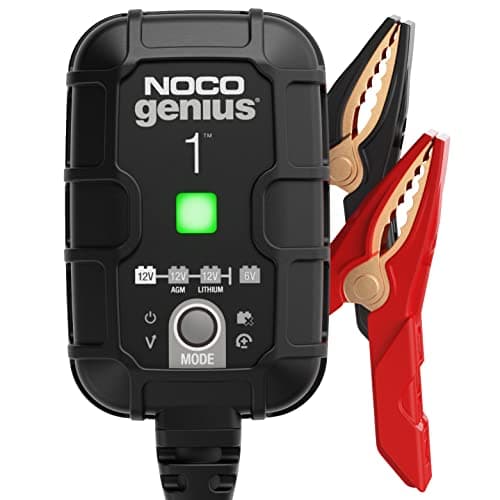
NOCO GENIUS1 1A Smart Charger and Maintainer
Roughly $25-$35
The published operating range is the reason this is the pick: NOCO rates it from -4 F to 104 F, which is the only spec on this page that speaks to whether the thing works in an unheated garage in January. Most rivals simply do not publish one.
Skip it if: You need to recover a flat battery quickly. At 1 amp this is a maintainer, and a genuinely dead battery takes it more than a day.
#ad Price as of October 18, 2026, from Amazon. Prices change. How this site is funded.
Schumacher
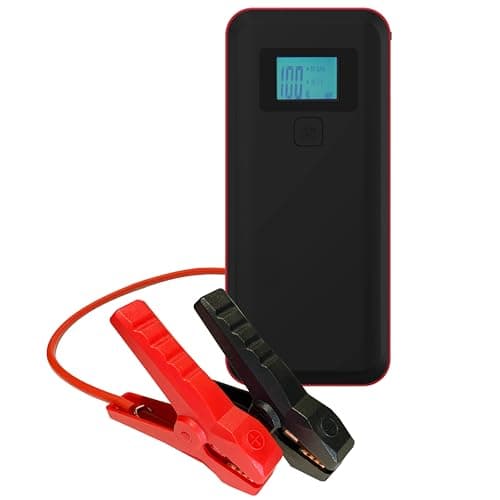
Schumacher SL1639 Lithium Jump Starter and Power Pack
The cheapest jump starter on this page
A lithium jump pack that starts a dead car without a second vehicle, and the one here that publishes the most capability for the least money: 1000 peak amps, 29.6 watt-hours, and engine ratings of 8.0 liters gas and 6.0 diesel. It solves the emergency; it does not solve the cause, which is why it belongs beside a maintainer rather than instead of one.
Skip it if: The battery is simply old. A jump pack is a way to keep restarting a battery you should be replacing.
#ad Price as of October 18, 2026, from Amazon. Prices change. How this site is funded.
How this was ranked
Every site in this category says it tested twenty of these. We have not tested any, and we say so. What we did instead: built the candidate set from what Amazon actually stocks, compiled the published specifications from each manufacturer’s own pages, did the arithmetic on running cost and on what the thing prevents, and read owner reviews for failure patterns rather than star averages. Every number on this page has a link to where it was published, so you can check the work.
- Units we claim to have tested
- 0
- Sponsored placements
- 0
- Free products accepted
- 0
Frequently asked
Do I need a battery charger if I have a jump starter?
They do different jobs. The jump starter gets you moving after the battery has gone flat; the charger stops it going flat and protects the battery’s lifespan. If you can plug a maintainer in where you park, buy that first and add the jump pack as insurance.
Can a jump starter charge a car battery?
Not meaningfully. A jump pack delivers a short high-current burst to turn the engine over; it is not designed to deliver the sustained low current that recharges a battery, and using it that way flattens the pack without filling the battery. Once the engine is running, the alternator does the charging.
Do jump starters work in cold weather?
They work, with reduced capacity. Lithium cells lose usable capacity as they get cold, so a pack that has lived in a freezing trunk since October may deliver noticeably less than its rating. Charge it before the season, store it indoors where you can, and check it mid-winter.
How many amps do I need to jump start a car?
Manufacturers publish a peak amp figure, and 1,000 peak amps is comfortable for a typical gasoline car. Larger engines and diesels need more. Peak amps is a burst figure rather than a sustained one, so treat it as a comparison number between products rather than a physical guarantee.
Sources
- NOCO GENIUS1 - published specification sheet (operating range -4F to 104F, 15W max consumption)
- Schumacher SL1639 Lithium Portable Power Pack and 1000 Peak Amp 12V Jump Starter - published product page
- CTEK - 'How the cold affects your car battery' (publishes approximately 35% loss of strength at 32F and 60% at 0F)