First: do you actually have an AGM battery?
A surprising number of people are charging an AGM without knowing it, because the change happened underneath them. Absorbent Glass Mat batteries became the default on vehicles with stop-start systems, and stop-start became the default on a great many ordinary cars. If your engine shuts off at traffic lights, the odds are high.
Three ways to check, in order of reliability:
Read the label. AGM batteries almost always say so — “AGM”, “Absorbent Glass Mat”, or sometimes “VRLA” (valve-regulated lead-acid, the family AGM belongs to). This takes ten seconds and settles it.
Look for filler caps. A traditional flooded battery has removable caps or a removable strip so you can top up the electrolyte. An AGM is sealed and has none. No caps is a strong signal.
Check whether the car has stop-start. Not proof on its own, but a car with stop-start is very unlikely to be running a plain flooded battery, because flooded chemistry does not survive that duty cycle.
Why the charger has to know
An AGM holds its electrolyte in a glass mat rather than as free liquid, and it is sealed. Those two facts change what a charger should do.
A flooded battery tolerates a bit of overcharge: it gasses, you lose a little water, and you top it back up through the caps you have. An AGM cannot be topped up. Gas it and the water is gone permanently, and the capacity goes with it. That is why AGM charging is more conservative about voltage, and why a charger with an explicit AGM mode is not marketing.
This is also why the failure is quiet. Using a flooded-profile charger on an AGM does not produce a bang or a warning light. It produces a battery that dies a year or two earlier than it should have, at a replacement cost noticeably higher than the flooded battery it replaced.
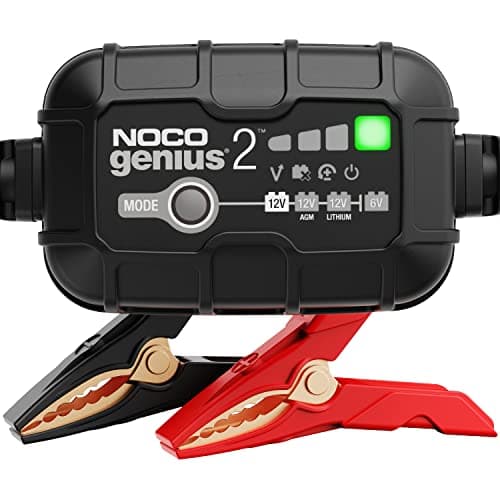
Published chemistry support, which is the whole criterion here | NOCO GENIUS1 | NOCO GENIUS2 | Battery Tender Junior |
|---|
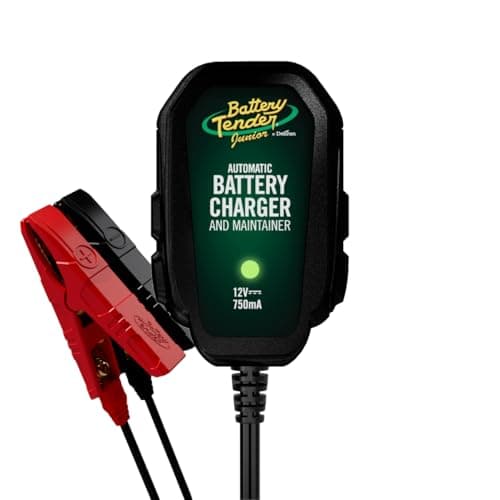
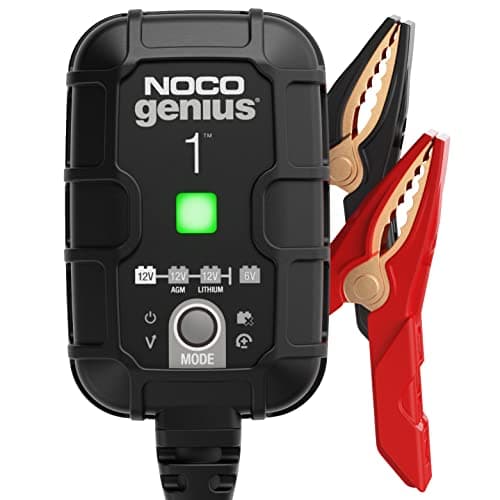
| Chemistries published | Wet, gel, MF, CA, EFB, AGM and lithium | Lead-acid and lithium | Lead-acid |
|---|
| AGM named explicitly | Yes | Not named separately | No |
|---|
| Charge current | 1 A | 2 A | 750 mA |
|---|
| Desulfation / repair mode | Not published | Manual repair mode published | Not published |
|---|
| Operating temperature range | -4 F to 104 F, published | Not published in the same form | Not published |
|---|
That first row is the ranking. NOCO publishes a chemistry list for the GENIUS1 that names AGM outright, alongside wet, gel, MF, CA, EFB and lithium. That is a maker telling you, in writing, that the device has a profile for your battery. Nothing else on this page does that for AGM specifically, and where a maker has not said it, we are not going to say it for them.
What the right charger is worth on an AGM
The arithmetic here is not about electricity. NOCO publishes a maximum consumption of 15 W for the GENIUS1, which even run flat out for a 120-day winter is 43.2 kWh, or $7.92 at the U.S. average rate of 18.34 cents per kWh (EIA, June 2026). The running cost is a rounding error.
The arithmetic is about the battery. An AGM is a materially more expensive part than the flooded battery it replaced, and it is fitted to cars whose stop-start systems will not operate correctly on a degraded one. Buying the charger that publishes support for the chemistry you own is a two-figure decision protecting a three-figure one, and unlike most of the arithmetic on this site it does not even need a payback period to make sense.
The honest caveat, as ever: correct charging preserves a healthy battery. It does not recover one that has been sitting deeply discharged. AGMs in particular dislike being left flat.
Skip this
Skip the lead-acid-only charger if your battery is AGM
This is the one genuinely negative recommendation on this page, and it is aimed at a product we otherwise like. The Battery Tender Junior is a good, long-established maintainer and it is published for lead-acid. AGM is technically a lead-acid chemistry, but it is the sealed, valve-regulated kind, and what you want in writing is the word AGM — not an inference from a family name.
If your battery is flooded, ignore this box entirely: the Junior is a perfectly sound choice and the cheapest route to the job. The brand comparison is here, and it turns on a different specification again.
The stop-start wrinkle worth knowing
On many vehicles with stop-start, a replacement battery has to be registered or coded to the car so the charging system knows it is looking at a fresh one. That is a dealer or scan-tool job and it has nothing to do with your maintainer — but it is the reason people conclude their new battery is faulty when the stop-start stops working a month later.
Maintaining the battery you already have sidesteps the whole question, which is a quietly good argument for a maintainer on exactly these cars. The cheapest AGM is the one you do not replace this year.
What we would buy
If your battery is AGM: the 1-amp NOCO, because it is the only unit here whose maker names AGM in a published chemistry list, and because it also publishes an operating range down to -4 F for the very common case of a car parked outside or in an unheated garage.
If your AGM has already been run down more than once, step up to the 2-amp unit for the published manual repair mode. Two amps is still a maintenance-sized current for a car battery, and going bigger than that buys you nothing for this job.
If you checked the label and found filler caps, you have a flooded battery, this page does not apply to you, and the general maintainer roundup is the one to read.