Battery maintainer vs trickle charger
The words get used interchangeably and they describe genuinely different behavior. One is safe to leave connected all winter. The other is not.
Heads up: the buy links on this page are affiliate links. If you buy through one, we earn a commission at no extra cost to you. It does not change what we recommend or the order we rank things in - here is how we keep those separate.
The difference in one sentence
A maintainer decides when to stop. A true trickle charger does not.
The decision table
| Maintainer / smart charger | True trickle charger | |
|---|---|---|
| Behavior | Monitors voltage, charges when needed, drops to float or standby | Delivers a small constant current continuously |
| Leave connected for months? | Yes - designed for it | No - it will overcharge |
| What goes wrong if you do | Nothing | Electrolyte boils off, plates are damaged, battery life shortens |
| Needs supervision | No | Yes |
| Typical current | 750 mA to 2 A, variable | Fixed, often around 1 A |
| Chemistry awareness | Selectable modes for AGM, lithium and others | Usually none |
| Price | $25 to $55 | Often cheaper |
Why the naming is such a mess
Three separate things happened.
“Trickle charger” became a generic term for any small charger, regardless of behavior, so many products sold under that name today are actually smart maintainers. That is the benign case.
“Battery Tender” is a brand name that became a category name. People say it meaning “maintainer”, in the way they say Hoover meaning vacuum.
And genuine dumb constant-current chargers are still manufactured and still sold, often at the cheapest end of the shelf, alongside the smart ones with similar-looking packaging.
The result is that the name on the box tells you very little. The specification does.
How to tell what you already own
- Look for the word “automatic” or “float” on the unit or in the manual. A smart maintainer always advertises this, because it is the feature.
- Look at the status indicators. A maintainer has at minimum a charging state and a maintained or full state. A single power LED with no state indication is a strong hint that it is dumb.
- Check for a published operating temperature range and chemistry modes. Dumb chargers do not have modes, because they have only one behavior.
- Watch it. Connect it to a fully charged battery. A smart unit will show a maintained or standby state within a short period. A dumb one will keep indicating charging indefinitely.
If you cannot establish it, treat it as dumb: connect it while you are around, and disconnect it after a few hours.
What overcharging actually does
It is worth understanding, because the failure is slow and invisible rather than dramatic.
Once a lead-acid battery is full, additional current has nothing left to convert, so it electrolyzes the water in the electrolyte into hydrogen and oxygen. The electrolyte level falls, exposing the tops of the plates. Exposed plates sulfate and corrode, and lost capacity does not come back.
On a sealed battery you cannot top the water up, so the damage is permanent. On a serviceable one you can, if you notice. Either way, you have shortened the life of the thing you connected the charger to protect.
Skip this
Skip the dumb charger, even at half the price
The saving is roughly $10 to $20. The risk is a battery that costs $150 to $250 to replace, plus the winter morning where it does not start.
There is no case for a constant-current charger in a domestic garage. The only thing it does that a smart charger does not is damage batteries when you forget about it, and forgetting about it is the entire use case.
The practical answer
Buy a smart maintainer with a published cold operating range and modes for whatever chemistry your battery is. Connect it with the ring-terminal harness rather than the clamps. Leave it connected all winter and stop thinking about it.
That is the whole strategy, it costs about $30, and it runs for about three dollars a winter in electricity.
What to buy, given all that
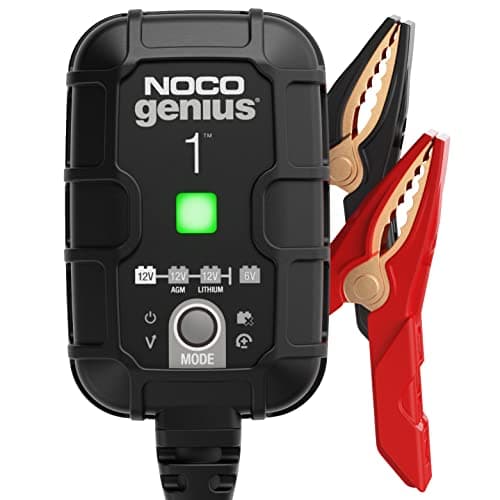
NOCO
NOCO GENIUS1 1A Smart Charger and Maintainer
Roughly $25-$35
The published operating range is the reason this is the pick: NOCO rates it from -4 F to 104 F, which is the only spec on this page that speaks to whether the thing works in an unheated garage in January. Most rivals simply do not publish one.
Skip it if: You need to recover a flat battery quickly. At 1 amp this is a maintainer, and a genuinely dead battery takes it more than a day.
#ad Price as of October 18, 2026, from Amazon. Prices change. How this site is funded.
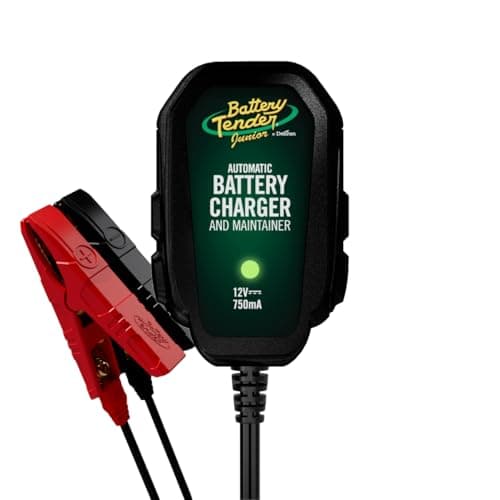
Battery Tender
Battery Tender Junior 750mA Charger
Roughly $25-$35
The maintainer that gave the whole category its nickname. It does one thing, has done it for decades, and the quibble is that the published specification sheet is thinner than the rival's - notably on cold operating limits.
Skip it if: You have 6-volt or lithium batteries to look after as well.
#ad Price as of October 18, 2026, from Amazon. Prices change. How this site is funded.
How this was ranked
Every site in this category says it tested twenty of these. We have not tested any, and we say so. What we did instead: built the candidate set from what Amazon actually stocks, compiled the published specifications from each manufacturer’s own pages, did the arithmetic on running cost and on what the thing prevents, and read owner reviews for failure patterns rather than star averages. Every number on this page has a link to where it was published, so you can check the work.
- Units we claim to have tested
- 0
- Sponsored placements
- 0
- Free products accepted
- 0
Frequently asked
Is a battery maintainer the same as a trickle charger?
No, although the names are used interchangeably. A maintainer monitors voltage and stops charging when the battery is full, resuming only when it drops. A true trickle charger delivers a small constant current continuously and does not stop, which overcharges a full battery.
Can you leave a trickle charger on all winter?
Not a true constant-current one. It will keep charging a full battery, electrolyzing the water out of the electrolyte and exposing the plates. A smart maintainer is designed for exactly this and is safe to leave connected indefinitely. Check which one you have before you leave it for three months.
Will a battery maintainer overcharge my battery?
A genuine smart maintainer will not — it monitors voltage and drops to float or standby. That is the defining feature of the category. A device sold as a trickle charger with no automatic cutoff will, which is why the distinction matters more than the marketing name suggests.
Is a Battery Tender a trickle charger?
“Battery Tender” is a brand name, not a product category. Their maintainer products are smart float chargers rather than dumb constant-current trickle chargers. The confusion is entirely linguistic, and it is why you should read the specification rather than the name.