Should you cover your car in winter?
Yes for a stored car. Usually no for a daily driver, and the reason is behavioral rather than technical.
Heads up: the buy links on this page are affiliate links. If you buy through one, we earn a commission at no extra cost to you. It does not change what we recommend or the order we rank things in - here is how we keep those separate.
The decision table
| Covered | Uncovered | |
|---|---|---|
| Snow load on the car | Kept off entirely | Cleared manually, every time |
| Salt spray settling on paint | Blocked | Lands, and needs washing off |
| Time cost per day | Several minutes each way | Several minutes of clearing when it snows |
| Risk to paint | Real, if fitted to a dirty or wet car | Low, apart from the brush you use |
| Moisture trapped against paint | Possible, if fitted wet | No |
| Windshield clear in the morning | Yes | No, unless you use a windshield cover |
| Realistically sustained all winter | Rarely, for a daily driver | Yes, by definition |
The case for covering
Snow load never lands on the car. No clearing, no brush, no grit dragged across panels — you pull the cover and the snow comes with it. On a car that sits for weeks, this is a genuinely large benefit.
Salt spray does not settle on paint. Airborne salt from treated roads lands on parked cars near them, and a cover intercepts it.
The car stays clean. Which matters for the same reason: a clean surface is one you are not abrading every time you touch it.
The case against, for a daily driver
You will not keep doing it. This is the real argument and it is behavioral rather than technical. Several minutes at each end of every day, in the dark and the cold, with a bulky wet sheet to fold. Most people stop by December, and a cover in the trunk protects nothing.
Fitting it to a wet, salty car is actively harmful. Which is exactly what a daily driver is when you get home. You have sealed moisture and abrasive against the finish with no airflow, and left it there overnight.
Wind moves it, and movement plus grit is the damage mechanism. An outdoor cover on a daily driver is fitted hurriedly, so it is fitted loosely, so it moves.
The cover itself gets wet and has nowhere to dry. Folding a soaked cover into a trunk every morning is how they mildew. The drying problem is real.
The middle option, which is what most people should do
A windshield cover gets a large share of the daily benefit for twenty seconds of effort at each end.
It keeps the glass clear, which is the part of the morning that actually costs you time; it wraps the wipers so they are not frozen down; and it is small enough to fold into a door pocket, so the drying problem is manageable.
What it does not do is keep snow off the roof and hood. You still need a brush for those. That is a fair trade for a routine you will actually keep. The covers are here.
Cover it if...
- The car is stored for the season and not being driven.
- It is parked under a roof, where an indoor cover is a clear win.
- It is a car you are protecting rather than using — a classic, a second vehicle, something being kept.
- You will genuinely wash it first and fit the cover to dry paint.
Do not cover it if...
- You drive it daily and park it outside.
- It arrives home wet and salty, which a daily driver does.
- You park somewhere very exposed, where the cover will flap all night.
- You would be fitting it over existing snow or ice, which traps both.
Skip this
Do not use a tarp
A builder’s tarpaulin is the worst possible version of this product and people reach for it constantly because there is one in the garage.
It is fully impermeable, so it traps every bit of moisture underneath. Its surface is coarse, so it abrades paint whenever it moves. It has no fitted shape, so it flaps continuously. And its grommets and edges are hard enough to chip paint directly.
If a proper cover is not worth the money, leave the car uncovered. That is genuinely the better option.
What to buy, given all that

Budge
Budge Rain Barrier Car Cover
Roughly $70-$130
A multi-layer outdoor cover with a soft inner face, which is the specification that matters: the inner layer is what sits against your clear coat every time the wind moves the cover, and a coarse one sands the paint over a winter.
Skip it if: You park in a garage, or you need to drive daily. Fitting and removing a full cover in the dark at 7am is a job people abandon by December.
#ad We hold no verified live price for this product, so we show none. How this site is funded.
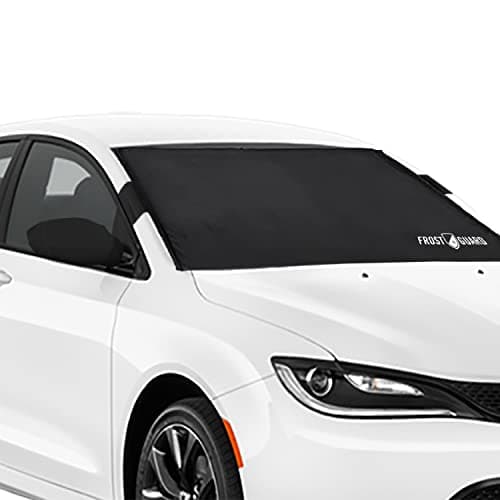
FrostGuard
FrostGuard Plus Windshield Cover, Standard Size
Roughly $25-$40
The version of this product that solves the actual problem: it wraps the wiper arms and hooks over the mirrors, so wind does not get under it and lift it off overnight. That single design decision is the whole reason a windshield cover is worth buying rather than a tarp.
Skip it if: You park in a garage. A cover on a car that never frosts is a thing to fold up wet and store somewhere.
#ad Price as of October 18, 2026, from Amazon. Prices change. How this site is funded.
How this was ranked
Every site in this category says it tested twenty of these. We have not tested any, and we say so. What we did instead: built the candidate set from what Amazon actually stocks, compiled the published specifications from each manufacturer’s own pages, did the arithmetic on running cost and on what the thing prevents, and read owner reviews for failure patterns rather than star averages. Every number on this page has a link to where it was published, so you can check the work.
- Units we claim to have tested
- 0
- Sponsored placements
- 0
- Free products accepted
- 0
Frequently asked
Is it better to cover your car in winter or leave it uncovered?
Cover it if it is stored. Leave it uncovered if you drive it daily, because you will not sustain fitting one and because putting a cover on a wet salty car traps moisture and grit against the paint. A windshield cover is the middle option.
Do car covers prevent frost on the windshield?
A full car cover does, and so does a windshield cover, which is far quicker to use. If keeping the glass clear is your actual goal, buy the windshield cover — it takes twenty seconds instead of several minutes and you will still be using it in February.
Can snow damage car paint?
Clean snow does not. What damages paint is the grit and salt in the snow being dragged across the clear coat when you clear it, and salt left sitting on the finish for weeks. Both are addressed more effectively by a sealant and the right brush than by a cover.
Should I cover my car if I park it under a tree?
An extra argument for covering a stored car, and a complication for a daily driver: the cover accumulates debris that becomes the grit trapped against your paint. If you cover under a tree, shake the cover out thoroughly every time before it goes back on.