The answer first
Measure your car bumper to bumper with a tape along the ground, write the number down, and then buy a cover whose published size band has a lower bound as well as an upper one. The Classic Accessories PolyPRO 3 compact sedan cover publishes “153"-165" L”; that is a band you can match. A Budge Lite publishes “fits sedans up to 200"”; that is a ceiling with nothing underneath it.
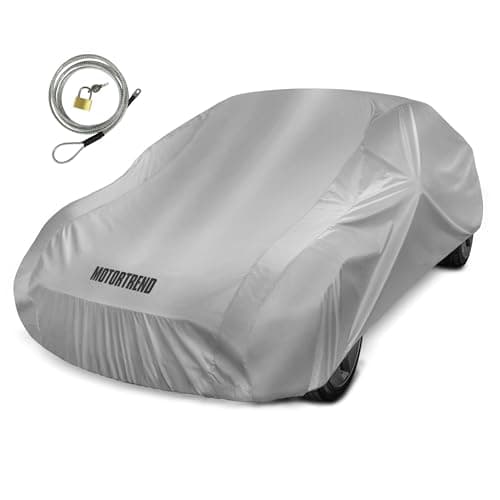
If your car is tall, measure height too. A tall crossover can defeat a cover that is long enough, because the cover has to go over the roof as well as along the body. The Motor Trend FlexCover is the one here that publishes all three numbers — “fits up to 190 x 70 x 50 inches”.
And do not trust the letter or the number. “Size 3” and “L” mean nothing across brands. Only the inches mean anything, and three of the four brands here express them in a different unit or convention.
How to measure, in ninety seconds
Length. Tape measure along the ground from the outermost point of the front bumper to the outermost point of the rear bumper. Along the ground, not along the bodywork — following the curve of the body adds inches that are not there, which is how people end up a size too big.
Width. Mirror tip to mirror tip, with the mirrors in their normal driving position, unless the cover publishes mirror pockets. Most universal covers do not, and they expect the mirrors to push the fabric out.
Height. Ground to the highest point of the roof, which on an SUV with rails means the rails. This is the measurement people skip and the one that produces the “it fits the length but will not reach down the sides” complaint.
Then check your own figure against a published spec for the car. Manufacturers publish overall length for every model and trim, and a hatchback and a sedan version of the same car can differ by nine inches. If your tape and the spec sheet disagree by more than an inch, measure again.
Three brands, three sizing conventions, and why it matters
Nobody in this category has agreed on how to publish a size. Here is what the four listings we checked actually say.
Published size conventions on four current covers| Cover | How the size is published | What you can do with that |
|---|
| Budge Lite sedan | "Fits Sedans up to 200"" - and sister listings at up to 228" and up to 264" | A ceiling only. A 185 in car and a 200 in car buy the same cover |
|---|
| Classic Accessories PolyPRO 3 compact sedan | "153"-165" L" | A real band. Match your measurement and you have a fit |
|---|
| Classic Accessories PolyPRO 3 hatchback | "Fits hatchbacks/Wagons 14' - 15'" | A band, but published in feet - convert before comparing |
|---|
| Motor Trend FlexCover, size L | "Fits up to 190 x 70 x 50 inches" | Length, width and height - the most information here, still a ceiling |
|---|
Two things fall out of that table. First, a letter or a number on the box is meaningless: a “3” at one brand is a 153-to-165-inch compact sedan, and at another it is a 200-inch band. Second, the “up to” convention is the one to be suspicious of, because it is silent on the only failure mode that actually matters outdoors.
The price detail that tells you what you are really buying
The three Budge Lite sedan listings publish three different length bands — up to 200 inches, up to 228 inches and up to 264 inches — and at the time of writing all three carry exactly the same price.
Think about what that means. The maker is not charging for material, or at least not enough for it to show. Nothing about the purchase pushes you toward the right size, and nothing penalizes you for buying the biggest one “to be safe”. The only thing standing between you and a cover five feet too long is your own tape measure.
And too long is not harmless. A cover with slack flaps, and a flapping cover is an abrasive being dragged over paint by the wind with road grit between the two. That is the mechanism behind every “my cover scratched my car” story, and it is the main argument against covering a car at all. Buying the right size is how you take that argument off the table.
That observation is ours, from the three published bands and their listed prices.
Universal, semi-custom and custom: what the size question becomes
Universal covers are the ones with bands. They are cut to a generic profile and sized by length, and the fit is as good as your measurement and the tightness of the band.
Semi-custom covers are cut to a body style — compact sedan, hatchback, full-size SUV — which is why the Classic Accessories listings name one. The roofline is closer to correct, so there is less slack to flap even within the same length.
Custom covers are patterned per year, make, model and trim, with mirror pockets and antenna grommets in the right places. There is no size question at all: you give them the car. They cost several times a universal cover, which is a real trade and not one this site waves away.
For a winter cover specifically, the fit question is weighted more heavily than it would be for a garaged dust cover, because the cover has to survive wind with snow load on it. A loose cover in a February gale is the worst version of this product.
Width, mirrors and the measurement people skip
Length gets all the attention because that is what brands publish. Width is where a cover that is nominally the right size still ends up taut over the mirrors and short at the sills.
Mirror pockets are the dividing line. A custom or semi-custom cover may publish mirror pockets; a universal cover almost never does, and it expects the mirrors to push the fabric out. That is fine on a sedan with modest mirrors and a real problem on a truck or a van, where the mirrors stand a long way off the body. The fabric stretched over a mirror housing is the first place a universal cover tears, and the point load is also where it rubs hardest.
Fold the mirrors if they fold. On most modern cars they do, and it removes the problem for free. If they do not, measure mirror tip to mirror tip and treat that as your width requirement rather than the body width.
Antennas and roof rails need the same thought. A mast antenna goes through a cover or gets bent by one. Roof rails and crossbars add to your height measurement and give the fabric something to chafe against from the inside. Remove what is removable before you put a cover on anything.
Breathable or waterproof changes how much slack you can tolerate
The fabric spec and the size spec interact, which is not obvious from either listing.
A breathable cover — the single-layer polypropylene type Budge publishes for indoor dust protection — lets moisture out, so a slightly loose fit is a nuisance rather than a hazard. The risk with a loose breathable cover is abrasion in wind, and indoors there is no wind.
A waterproof cover is a stricter proposition. It keeps rain and snowmelt out and it also keeps moisture in, which is why a waterproof cover over a damp car is the classic way to make paint worse. On a waterproof cover the fit matters twice: once for the flapping, and once because trapped moisture collects wherever the fabric sits slack against a panel.
That is the practical reason the Budge Lite is published for indoor use and the Motor Trend FlexCover for rain and wind. They are not better and worse versions of one product; they answer different questions, and the waterproof one brings a drying routine with it.
Skip this
A cover that is too big is worse than no cover
It is worth being blunt, because the sizing conventions above make it easy to get this wrong in the generous direction. An oversized cover holds slack. Slack moves in wind. Moving fabric with grit under it polishes the clear coat, and the places it does the most damage are the high points — the roof edge, the shoulder lines, the mirrors.
An undersized cover is a different failure and a more obvious one: it will not reach down the sides, the hem rides up, and the lower body and sills get no protection at all. Both are failures, but only the oversized one quietly costs you paint while looking like it is working.
If your measurement lands between two bands, go to the smaller band if the cover publishes a range, and to the smaller band if it publishes a ceiling you still fit under. Do not round up.
Which to buy, given your measurement
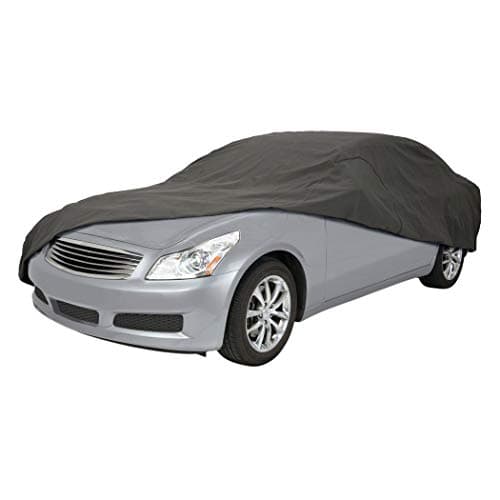
If you measured between 153 and 165 inches — a Civic, a Corolla, a Mazda3, most compact sedans — the Classic Accessories PolyPRO 3 compact sedan cover publishes exactly your band and is cut for the body style. That is as close to a known fit as a universal cover gets.
If your car is tall rather than long — a crossover, anything with roof rails — the Motor Trend FlexCover publishes height as well as length, which is the number that decides whether it reaches the sills. Note that it is published as waterproof rather than breathable, so never put it on a wet car and plan on drying it.
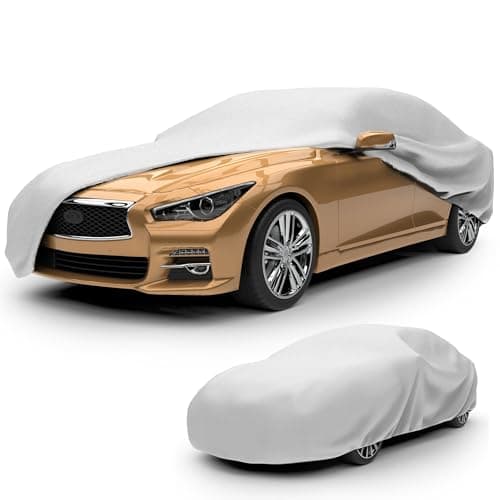
If the car lives in a garage or carport and the enemy is dust rather than weather, the Budge Lite is cheap, breathable and published for indoor use. Buy the band your measurement actually sits at rather than the biggest one, since they all cost the same.
If you park outdoors all winter and the car matters to you, the sizing advice here is the cheap half of the job; the material and anchoring half is a separate page. And if there is no garage at all, the full no-garage playbook puts a cover in context against everything else you could spend the money on.