Undercoating: DIY or pay a shop?
The product cost is not the difference. The difference is access, and access is most of what you would be paying for.
Heads up: the buy links on this page are affiliate links. If you buy through one, we earn a commission at no extra cost to you. It does not change what we recommend or the order we rank things in - here is how we keep those separate.
The trap, before the comparison
Some undercoating is worse than none, and it is worth understanding which before you spend money either way.
A hard rubberized coating applied over metal that already has surface rust seals the rust in. Water gets under the film through the first chip, sits against bare steel, cannot evaporate, and the coating hides the whole process from view for years.
A non-drying creeping product cannot do this, because there is no film to chip and it displaces moisture rather than covering it. That is why it is the default recommendation for an older car in a salted climate, and why the annual reapplication is a feature rather than a nuisance.
The comparison
| DIY | Shop | |
|---|---|---|
| Product cost | $50 to $80 a year for a car | Included |
| Total cost | $60 plus an afternoon | $150 to $600 depending on product and area |
| Access to the underbody | Ramps or jack stands, on your back | A lift - they can see and reach everything |
| Inside box sections and rockers | Only with a wand and existing access holes | Standard, with proper wands |
| Surface prep | As thorough as you make it | Usually pressure washed and dried first |
| Time | Three to five hours, first time longer | You drop the car off |
| Repeatability | Annual, and you control when | Annual, and you book it |
| Mess | Considerable - it gets everywhere | Theirs |
Five years, both ways
DIY: $60 of product a year × 5 = $300, plus five afternoons, plus owning ramps.
Shop: $250 a year × 5 = $1,250, plus five drop-offs.
The difference: about $950 over five years, which is roughly $190 an afternoon for your own labor. Whether that is a good rate is a genuinely personal question, and the honest additional factor is that a shop reaches inside box sections that you probably will not.
Choose DIY if...
- You have ramps or jack stands and somewhere flat to use them.
- The car is newer, with sound metal, so you are preventing rather than treating.
- You are willing to do it every year rather than once.
- You do not mind getting comprehensively filthy.
The realistic DIY job is the accessible underbody: floor pan, subframe, suspension components, the visible seams and the wheel arches. That is most of the exposed area and it is genuinely worth doing. Which undercoating spray to use depends on the metal you are spraying and the temperature on the day.
Choose a shop if...
- The car already has visible surface rust, where preparation matters and getting it wrong makes things worse.
- You want the inside of the rockers and box sections treated, which needs a proper wand and drain-hole access.
- You have no safe way to get the car in the air.
- You are keeping the car long-term and want it done properly once a year without arguing with yourself about it.
Safety, since this involves being under a car.
Never work under a vehicle supported only by a jack. Use ramps or jack stands on level concrete, chock the wheels that stay on the ground, and check the car is stable before any part of you goes underneath. Wear eye protection — you are spraying upward — and a respirator appropriate to the product, per the manufacturer’s published safety data.
Doing it yourself, in order
- Wash the underbody thoroughly and let it dry completely. Applying over salt or damp metal defeats the whole exercise. Give it a warm day and several hours.
- Get the car safely in the air and chock the wheels.
- Mask the exhaust, the brake rotors and the driveshafts. Coating on a hot exhaust smokes; coating on a rotor is a braking problem.
- Work systematically, front to back, one section at a time so you can see what you have covered.
- Get into the seams. Where two panels meet is where rust starts, and a creeping product will wick in if you give it a chance.
- Use the wand for box sections if the product supplies one and your car has access holes.
- Leave it to settle before driving. Check the product’s published guidance.
Skip this
Skip undercoating a car that is already substantially rusty
If the underbody has flaking scale rather than light surface rust, coating over it achieves very little. The rust continues underneath, and you have spent money and an afternoon on a cosmetic result.
At that point the honest options are a proper mechanical preparation and rust treatment before any coating, or accepting the car’s condition and spending the money on regular underbody washing to slow it down. Undercoating is a preventive product, not a remedial one.
What to buy, given all that
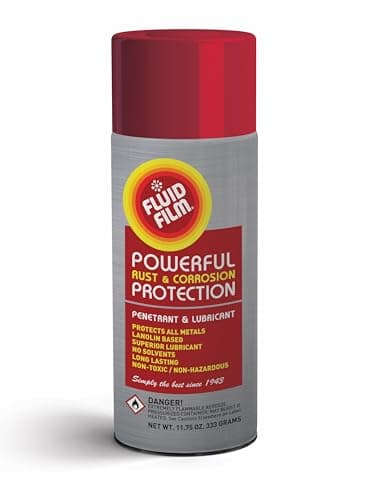
Fluid Film
Fluid Film Rust and Corrosion Protection
One of the cheapest items on this site - a single aerosol can
A lanolin-based, non-drying coating. Non-drying is the whole argument: it stays soft, so it creeps into seams and does not crack and trap moisture underneath the way a hard rubberized coating can once it chips.
Skip it if: You want a permanent, one-time coating. This is deliberately impermanent and must be redone each year.
#ad Price as of October 18, 2026, from Amazon. Prices change. How this site is funded.
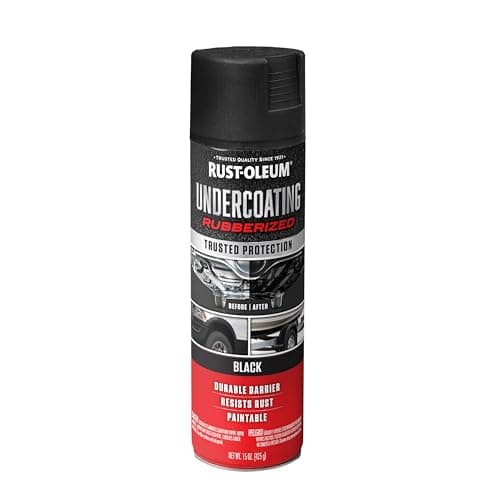
Rust-Oleum
Rust-Oleum Automotive Rubberized Undercoating
Roughly $8-$14 a can
A hard rubberized coating that also deadens road noise. The failure mode is worth understanding before you buy: once a hard film chips, water sits under it against bare steel, and rust spreads out of sight.
Skip it if: The metal underneath is already surface-rusted. Sealing rust in is the classic undercoating mistake.
#ad Price as of October 18, 2026, from Amazon. Prices change. How this site is funded.
How this was ranked
Every site in this category says it tested twenty of these. We have not tested any, and we say so. What we did instead: built the candidate set from what Amazon actually stocks, compiled the published specifications from each manufacturer’s own pages, did the arithmetic on running cost and on what the thing prevents, and read owner reviews for failure patterns rather than star averages. Every number on this page has a link to where it was published, so you can check the work.
- Units we claim to have tested
- 0
- Sponsored placements
- 0
- Free products accepted
- 0
Frequently asked
Is DIY undercoating worth it?
On a newer car with sound metal, yes: about $60 of product and an afternoon, repeated annually, and it covers most of the exposed underbody. What DIY usually misses is the inside of box sections and rockers, which needs a wand and proper access.
How much does undercoating cost at a shop?
Commonly $150 to $600 depending on the product, the vehicle and how much of the interior of the body cavities is treated. Annual reapplication is normal with creeping products, so treat it as a recurring cost rather than a one-off.
Can undercoating make rust worse?
Yes, and this is the main trap. A hard film applied over existing rust, or one that chips later, holds water against bare steel where it cannot evaporate and where you cannot see it. Non-drying creeping products avoid this because there is no film to chip.
How often should you undercoat a car?
Annually for non-drying creeping products in a salted climate — that is what their published guidance describes and it is the honest commitment. Hard coatings are sold as longer-lasting, and their real interval depends entirely on whether the film is still intact, which you have to get under the car to check.