Big Buddy or Portable Buddy?
Mr. Heater publishes coverage and run times for both, and those two numbers answer the question faster than any review. The catch is that one of them is measured on a fuel cylinder you will get tired of changing.
Heads up: the buy links on this page are affiliate links. If you buy through one, we earn a commission at no extra cost to you. It does not change what we recommend or the order we rank things in - here is how we keep those separate.
The two numbers that decide it
Mr. Heater publishes a coverage figure and a run time for each heater, and between them they answer this question for most people.
The Portable Buddy is published at 4,000 or 9,000 BTU per hour, heating up to 225 square feet, running 3 hours at maximum and 6 hours at minimum on a 1 lb cylinder.
The Big Buddy adds a third setting at 18,000 BTU, covers up to 450 square feet, and is published for up to 11 hours with dual tanks - or a 20 lb cylinder with an optional hose and filter.
A single-car garage is roughly 200 to 260 square feet of floor. A two-car garage is roughly 400 to 600. Put those next to the published coverage and the split is obvious: one bay is Portable Buddy territory, two bays is Big Buddy territory, and a big or leaky double garage is beyond both.
| Portable Buddy (MH9BX) | Big Buddy | |
|---|---|---|
| Output | 4,000 / 9,000 BTU/hr | 4,000 / 9,000 / 18,000 BTU/hr |
| Coverage | Up to 225 sq ft | Up to 450 sq ft |
| Fuel | 1 lb cylinder | Two 1 lb cylinders, or 20 lb with optional hose |
| Run time | 3 hr max / 6 hr min | Up to 11 hr with dual tanks |
| Safety | ODS and tip-over shut-off | ODS and tip-over shut-off |
| Maximum elevation | 7,000 ft | 7,000 ft |
| Weight | 10.6 lb | 17.1 lb |
| Ignition | Piezo | Piezo |
The cylinder arithmetic, which is the real cost
Both heaters are cheap to buy and neither is cheap to feed on 1 lb cylinders.
Portable Buddy on high: 3 hours per cylinder. Two evenings in the garage and you have burned through two of them.
Big Buddy on dual tanks: up to 11 hours - but that is two cylinders being consumed, and on the 18,000 BTU setting the published figure is the upper end of a range that falls as you turn it up.
This is why the 20 lb cylinder option matters more than the BTU rating for anyone using a heater regularly. A 20 lb tank holds twenty times what a 1 lb cylinder does, and refilling one costs a fraction of buying twenty disposables. Only the Big Buddy publishes that connection, and the hose and filter are sold separately - budget for them as part of the purchase.
How many disposable cylinders you are really buying
Work it from Mr. Heater’s own run times rather than from the shelf price. The Portable Buddy is published at 3 hours on high, and high is 9,000 BTU per hour. That means a 1 lb cylinder delivers roughly 27,000 BTU before you are swapping it.
A 20 lb cylinder holds twenty times the propane. So one refillable tank is, near enough, twenty disposable cylinders - and a refill costs a small fraction of twenty disposables at hardware store prices. That arithmetic is ours, from the maker’s published run time and the obvious weight ratio, and it is the single strongest argument for the Big Buddy: it is the one published to connect to a 20 lb tank.
For what the fuel itself costs per hour, we already did that sum against the published BTU content of propane rather than repeating it here.
Check whether the model you are buying has the fan
One detail that catches people out: Mr. Heater notes on the Big Buddy product page that it has removed the fan on some models. The fan version pushes warm air rather than relying purely on radiant heat, which in a garage is the difference between warming the person in front of it and warming a wider area.
The listings are not always obvious about which version you are looking at, and a model suffix is often the only clue. If the fan matters to you, confirm it on the specific listing before you buy - and remember the fan needs batteries, which is another thing to have in the drawer in February.
What neither of them is
Neither is a way to heat a garage all winter. Both are radiant heaters: they warm what they are pointed at rather than the air in the room, which is genuinely useful when you are working on one side of a car and useless for keeping a space at temperature overnight.
If what you want is background heat you can leave running, that is a different question and often a different answer. And if you are sizing for a whole garage rather than a work area, the BTU calculator will tell you what the space actually needs.
Skip this
The ventilation rule applies to both, and it is not optional
Burning propane indoors produces water vapor and combustion products. Both heaters carry an oxygen depletion sensor that shuts them down if the oxygen level falls far enough, and that sensor is a backstop rather than a ventilation strategy.
Mr. Heater publishes a fresh-air requirement for these heaters. Follow the manual for your model, crack a door or a window, and never run one in a sealed garage or while you are asleep. The water vapor matters too: in a garage you park a wet car in, adding moisture to the air is the opposite of what you are usually trying to do.
Both are published to a maximum elevation of 7,000 feet. Above that, the oxygen depletion sensor can trip on thin air rather than on a real problem, and Mr. Heater's rating stops there for a reason.
Which one we would buy
One bay, occasional use: the Portable Buddy. Its published 225 square feet matches a single-car garage, it is 10.6 lb so it moves with one hand, and it costs roughly half what the bigger unit does.
Two bays, or longer sessions: the Big Buddy - but buy it for the 20 lb cylinder connection rather than the 18,000 BTU setting. The hose and filter turn it from a heater you feed disposables into one you can actually run for an afternoon.
Either way: ventilate, keep it away from anything flammable, and treat it as a work-session heater rather than a way to make the garage warm. The electric alternatives, and their running costs, are worth comparing before you commit to buying propane all winter.
What to buy, given all that
Mr. Heater
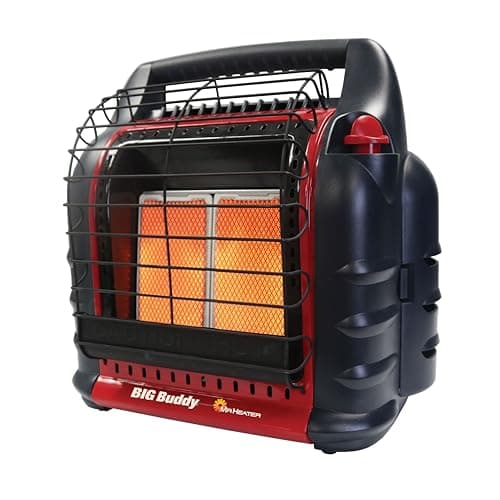
Mr. Heater Big Buddy Portable Propane Heater
Roughly $130-$180 plus fuel
Propane, so no electrical circuit and no installation - which is exactly why it is popular and exactly why the ventilation requirement in the manual is not optional reading. Burning propane indoors produces water vapor and combustion products, in a space you also park a car in.
Skip it if: You want unattended, thermostat-controlled background heat, or you cannot ventilate. Read the manufacturer's ventilation instructions before buying, not after.
#ad Price as of October 18, 2026, from Amazon. Prices change. How this site is funded.
Mr. Heater
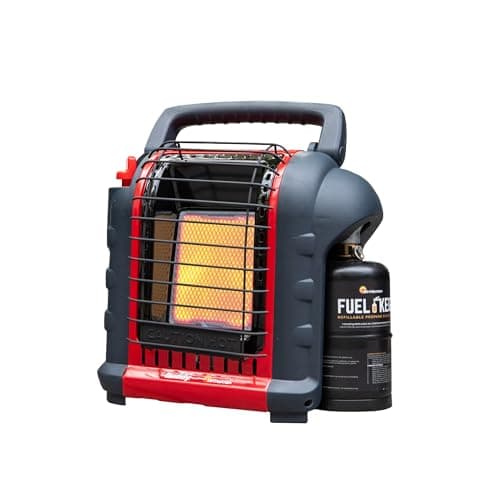
Mr. Heater MH9BX Portable Buddy
Roughly half the price of the Big Buddy
The small one, and for a single-bay garage it is usually the right one. Mr. Heater publishes 4,000 and 9,000 BTU settings, 225 square feet of coverage and 3 to 6 hours on a 1 lb cylinder - which is the figure that decides whether you are happy with it.
Skip it if: You want to heat a double garage, or you want to run all afternoon without changing cylinders.
#ad Price as of October 18, 2026, from Amazon. Prices change. How this site is funded.
How this was ranked
Every site in this category says it tested twenty of these. We have not tested any, and we say so. What we did instead: built the candidate set from what Amazon actually stocks, compiled the published specifications from each manufacturer’s own pages, did the arithmetic on running cost and on what the thing prevents, and read owner reviews for failure patterns rather than star averages. Every number on this page has a link to where it was published, so you can check the work.
- Units we claim to have tested
- 0
- Sponsored placements
- 0
- Free products accepted
- 0
Frequently asked
Is the Big Buddy worth it over the Portable Buddy?
For a two-car garage, yes - Mr. Heater publishes 450 sq ft of coverage against 225, and the Big Buddy can run from a 20 lb cylinder with an optional hose. For a single bay used for an hour or two, the Portable Buddy covers the published area for about half the price.
How long does a Mr. Heater Buddy run on a 1 lb cylinder?
Mr. Heater publishes 3 hours at maximum and 6 hours at minimum for the Portable Buddy on a 1 lb cylinder. The Big Buddy is published at up to 11 hours running on two tanks, which is why the 20 lb cylinder option matters for regular use.
Can you use a Buddy heater in a garage?
They are sold as indoor-safe radiant heaters with an oxygen depletion sensor and tip-over shut-off, and Mr. Heater publishes a fresh-air requirement you have to follow. Ventilate, never run one in a sealed garage or unattended overnight, and keep it clear of fuel and solvents.
What size garage will a Portable Buddy heat?
Up to 225 sq ft, per Mr. Heater's published figure - about one standard bay. A two-car garage is typically 400 to 600 sq ft, which is Big Buddy territory at 450 sq ft, and a large or poorly sealed double garage is beyond either.
Do Buddy heaters work at altitude?
Both are published to a maximum elevation of 7,000 feet. Above that the oxygen depletion sensor is liable to shut the heater down on thin air, which is exactly what it is designed to do.
Do you need the hose and filter for the Big Buddy?
Only if you want to run from a 20 lb cylinder - and most regular users do, because 1 lb disposables get expensive fast. Mr. Heater publishes the hose and filter as sold separately, so budget for them with the heater rather than after.