Three jobs, and most people buy for the wrong one
“Snow shovel for a car” describes three genuinely different tasks, and the reason people end up disappointed is that they buy the tool for one and then need it for another.
What each job actually demands of the tool| The job | What it demands | What suits it |
|---|
| Clearing snow off and around a parked car at home | Blade width and volume per stroke; storage is not a constraint | A full-size shovel with an 18 in blade and a D-grip |
|---|
| Digging a driven wheel out of packed snow | An edge that cuts compacted snow without folding, and leverage | A metal scoop with a published temper |
|---|
| The thing that lives in the trunk all winter | Weight and collapsed length, above everything else | A one-pound telescoping shovel you never take out |
|---|
The third row is the one that fools people, because a trunk shovel looks like a small version of the first row and is actually a different product with a different constraint. A pound of tool at 28 inches collapsed stays in the car for years. A three-and-a-half pound tool at nearly fifty inches comes out of the car in April and does not go back in November.
The material question decides most of this
Nearly every shovel sold for a car has a polyethylene scoop. It is light, it is cheap, it does not rust, and against fresh snow it works perfectly well. What it does not do is chop. Compacted snow under a tire that has been spun on it is closer to ice than to snow, and a plastic edge pushed into it flexes and skates rather than cutting.
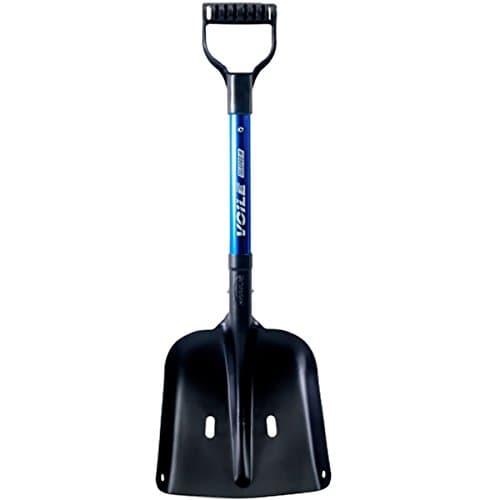
Nobody in this category publishes a low-temperature rating for a poly scoop, and we are not going to supply one — the entries below say exactly that. What we can point at is what the alternative publishes. Voile states that its scoop is cold forged from 6061 aluminum and heat-treated to a T6 temper, and gives the resulting figures: 42,000 psi ultimate tensile strength and 35,000 psi yield. That is a specification you can compare against. “Heavy duty” on a package is not.
The honest framing is not that plastic is bad. It is that plastic is a snow tool and metal is a snow and ice tool, and the job you bought the shovel for is usually the second one.
Is a shovel worth it at all?
The comparison here is not shovel against shovel. It is a shovel against being stuck, and the value depends entirely on a question only you can answer: how often do you park somewhere that does not get plowed?
If the answer is never — a garage at home, a maintained lot at work, plowed streets in between — then a shovel is dead weight and this is one of the pages on this site where the correct recommendation is to buy nothing. That is a real answer and we would rather give it than sell you a tool that rides in your trunk for a decade.
If the answer is a few times a winter — a street that gets plowed late, a trailhead, a rural driveway, visiting somewhere unfamiliar — then the arithmetic is simple. A trunk shovel is under twenty-five dollars. A metal one is seventy-two. A tow from an unplowed street is a call-out charge you pay once and remember, and the wait for it in a storm is measured in hours.
Where it lives is a specification
This sounds obvious and it is the single biggest predictor of whether a shovel is any use to you. A shovel in the garage is not available on the road, and the roadside is where the expensive version of this problem happens.
The published numbers make the trade-off concrete. The EMSCO trunk shovel is 3.25 x 9.75 x 28 in and one pound. The EMSCO 18-inch driveway shovel is 49.5 x 18.75 x 5.25 in and 3.8 pounds. One of those goes under a parcel shelf and is forgotten about; the other needs a folded rear seat. Both are useful. They are not substitutes.
The Voile sits in between in an interesting way: the handle detaches from the scoop, so it packs flat rather than long. That is a backcountry design decision — it is meant to go inside a pack — and it happens to be exactly what a car needs.
Skip this
Skip the shovel if what you actually lack is traction
A shovel removes snow from around the tire. It does not give the tire anything to grip once the snow is gone, and on packed snow or ice the surface underneath is often the real problem. People dig for twenty minutes, get back in, and spin in the same spot on a polished patch they just exposed.
If you are getting stuck repeatedly rather than freakishly, the shovel is half the answer at most. Traction boards put a surface under the wheel, and chains or snow socks stop you needing to dig in the first place. Buying a better shovel to solve a traction problem is the most common mistake in this corner of the category.
How to dig a car out, in the order that works
The technique matters more than the tool, and the first step is the one almost nobody mentions.
1. Clear the tailpipe before anything else. If the exhaust outlet is packed with snow and the engine is running, exhaust gas can back up into the cabin. This is the genuinely dangerous part of being stuck, and it takes thirty seconds to rule out. The National Weather Service’s winter storm guidance covers the wider version of this — stay with the vehicle, keep the exhaust clear, run the engine intermittently rather than continuously.
2. Dig ahead of and behind both drive wheels. Not just in front. You will almost certainly rock the car backward and forward, and a clear path in one direction only means you get one attempt.
3. Make a ramp, not a hole. Clear the snow out to a shallow slope rather than excavating a neat pit around the tire. A tire at the bottom of a vertical-sided hole has to climb; a tire on a ramp drives out.
4. Straighten the wheels. Turned wheels have to plow sideways as well as move forward, and on a front-wheel-drive car this alone is often the difference.
5. Do not spin. Spinning melts snow, and the melt refreezes into ice under the contact patch. Every second of wheelspin makes the surface you are trying to leave more slippery. Gentle throttle, rocking between drive and reverse, and stop as soon as it is not working.
6. Put something under the tire. Traction boards, a floor mat, gravel, cat litter, the shovel blade itself if you have nothing else and do not mind what happens to it. The full kit checklist covers what else is worth having in the trunk while you are buying a shovel anyway.
How to choose, in four questions
One: where will it live? If the answer is the car, collapsed length and weight beat every other consideration, and you are shopping among trunk shovels whatever their limitations. If the answer is the garage, ignore packability entirely and buy blade width.
Two: snow or ice? Fresh snow is a volume problem and any decent poly blade handles it. Compacted or refrozen snow is a cutting problem, and that is a metal-scoop purchase. Be honest about which one your winters actually produce.
Three: blade width against leverage. A wide blade moves more per stroke and is heavier when loaded — 18 inches of wet snow is a real lift. A narrow scoop is slower and far easier to use for a long time. For digging out a wheel, narrow and strong beats wide and light.
Four: how many joints does it have? Every telescoping section and every folding hinge is a place that seizes with ice or works loose. A collapsible shovel is a compromise you accept for storage, not a feature. Fewer joints is better, and a two-piece design that separates cleanly beats a four-section telescope.
What we would actually buy
If you park somewhere unplowed more than once or twice a winter: the metal one, and leave it in the car. It is the only pick here whose maker publishes what the scoop is made of and how strong that makes it, and the whole reason to own a car shovel is the one occasion when the cheap one folds.
If this is insurance against an event you do not expect: the trunk shovel, for under twenty-five dollars, and accept that it is a snow tool rather than an ice tool. That is a completely reasonable purchase and it is what most readers should do.
If the problem is your own driveway rather than the road: the 18-inch shovel, which EMSCO publishes as suited to steps, stoops and around vehicles, and which will clear a car in a fraction of the time a trunk scoop takes. Then keep a trunk shovel as well, because the driveway tool is not going with you.