Skip to content
Frost & Fender
Roundup

The best portable tire inflators for cold mornings

Your tires lose pressure every time the temperature falls, and the warning light is not required to tell you until you are 25 percent down. That gap is the whole reason to own one of these.

By Scooter M.Published September 19, 2026

Heads up: the buy links on this page are affiliate links. If you buy through one, we earn a commission at no extra cost to you. It does not change what we recommend or the order we rank things in - here is how we keep those separate.

The shortlist

Ranked, with the prices

Ranked on published manufacturer specifications and, where the numbers exist, the arithmetic on what each option costs and what it saves. Tap any row for the full write-up, including who should skip it.

#ProductBest forScorePrice
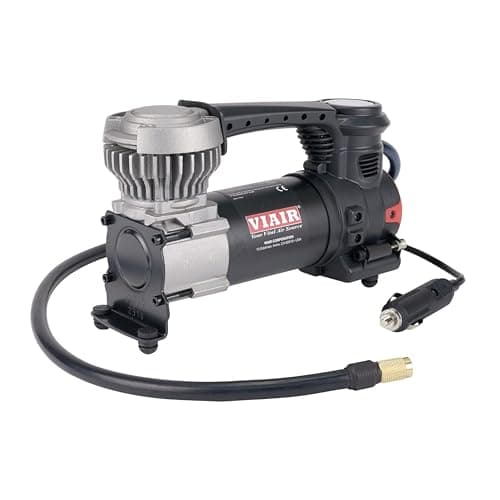
01VIAIR VIAIR 85P Portable Tire InflatorVIAIR 85P Portable Tire InflatorTopping up car and crossover tires through the winterBest all-rounder8.8$69.69 - View on Amazon
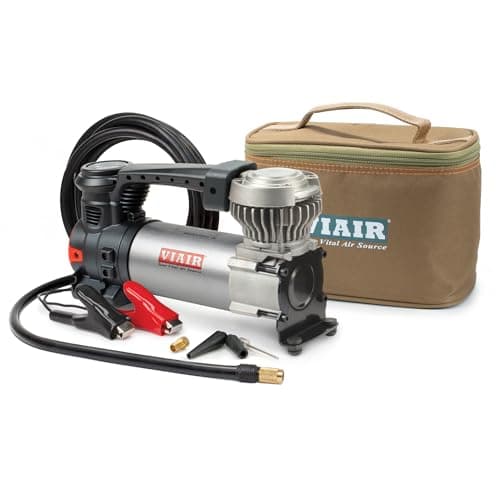
02VIAIR VIAIR 88P Portable Air CompressorVIAIR 88P Portable Air CompressorTrucks, SUVs and anyone whose rear tire is a long walk from the batteryBest for trucks and long vehicles8.5$89.89 - View on Amazon
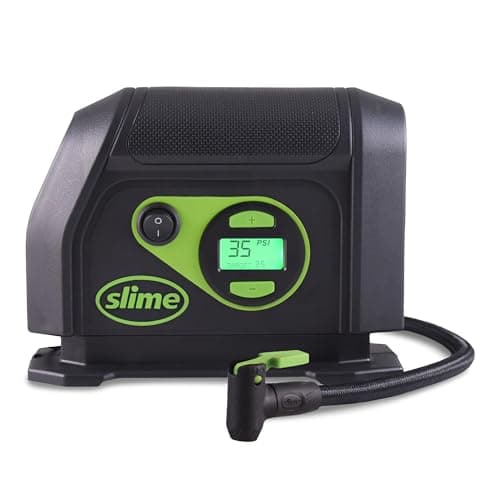
03Slime Slime 40088 12V Digital Tire InflatorSlime 40088 12V Digital Tire InflatorA monthly top-up in a garage, at the lowest price on this pageBest cheap option7.5$32.88 - View on Amazon

Scores are ours and editorial. They are never published as review or rating markup, because we have not tested these products - see how we pick.

The gap the warning light leaves you in

Air contracts as it cools, so the same air in the same tire reads a lower pressure on a cold morning than it did on the afternoon you set it. Nothing has leaked. The tire is simply low, and it will be low every cold morning until somebody puts air in it.

The part most people get wrong is assuming the dashboard light covers this. It does not. The federal standard for tire pressure monitoring (FMVSS 138) requires the low pressure telltale to illuminate within 20 minutes once a tire is 25 percent or more below the manufacturer’s recommended cold inflation pressure. Twenty-five percent is a long way down. Everything above that line is your problem to find, and the tool that finds it is a gauge and something to put air back with.

What a cold snap actually costs you

Take a tire set to the placard figure of 35 psi on a 70 F afternoon, and park it out on a 10 F morning. Pressure and temperature move together in absolute terms, so the arithmetic runs on absolute pressure (gauge + 14.7) and absolute temperature (F + 459.67):

49.7 psia × (469.67 ÷ 529.67) = 44.1 psia, which is 29.4 psi on your gauge. The tire is 5.6 psi low, about 16 percent under the placard.

The warning threshold for that tire is 25 percent down, or 26.25 psi. Running the same arithmetic backward, the air would have to fall to roughly -23 F before the light is required to come on. So on a normal freezing morning you are driving a meaningfully soft tire with a dark dashboard.

This is our arithmetic from the gas law, assuming the tire volume does not change and sea-level atmospheric pressure. Treat it as the shape of the problem rather than a reading for your car: your placard figure and your weather are the ones that matter.

How we judged these

We have not run these compressors on a test bench. We ranked them on what their makers publish, because in this category the published numbers are unusually revealing, and because two of the four things that decide whether an inflator is any good in winter are routinely not published at all.

1. A published minimum working temperature. You are buying this for cold mornings, and it likely lives in an unheated trunk. Whether the maker will commit to a low-temperature figure is the most on-point specification in the category, and most makers simply do not give one.

2. A published duty cycle. Small 12-volt compressors are not built to run continuously; they heat up and need to rest. Four tires that are each 5 psi down is a real stretch of running time, so a figure like “20 minutes at 30 psi” tells you whether you can do the whole car in one go.

3. How it takes power, and what it draws. An accessory socket has a fuse, and a compressor is one of the heaviest loads you can plug into one. A published amp draw lets you check before you blow the fuse in a freezing parking lot.

4. Reach. Cord length plus hose length has to cover the distance from the socket to the far tire. This sounds trivial until you are parked on the street and the hose stops a foot short.

What each maker publishes

Published specifications for the three inflators, side by side
VIAIR 85PVIAIR 88PSlime 40088
Max working pressure60 psi120 psi0-99 psi display
Duty cycle20 min. at 30 psi25 min. at 30 psiNot published
Min ambient temperature-4 F-4 FNot published
Max amp draw15A / 180W20ANot published
Power connectionAccessory socketBattery clamps12-volt accessory power
Reach (cord + hose)10 ft + 3 ft10 ft + 16 ftNot published
Ingress protectionIP53IP53Not published

That table is the page in miniature. VIAIR publishes a full sheet for both units, including the two figures that matter most in winter. Slime publishes the pressure range, an inflation time and the fact that it shuts off on its own — genuinely the things most buyers look at — and stops there.

We are not calling the cheap one bad. It is the one we would rather you owned than nothing, and its auto shut-off is the feature that turns this into a five-minute job. But when a tool is bought for cold weather and the maker will not say how cold it can work, that is worth knowing before you buy rather than after.

The duty cycle question, in practice

Say all four tires are 5 psi down after the first hard freeze, which the arithmetic above says is an ordinary morning rather than a bad one. That is four separate runs, back to back, in the cold.

The VIAIR units publish 20 and 25 minutes at 30 psi, so a full set of top-ups sits inside what the maker says the pump will take. For the Slime, you have the published claim that it inflates a mid-size car tire in six minutes, and no statement at all about running it four times in a row. If you use a no-duty-cycle inflator, the sensible habit is to let it cool between tires and not to treat it as a tool that can also air up a trailer.

Skip this

Skip treating the TPMS light as a pressure gauge

The tire pressure monitoring light is a safety backstop, not a maintenance tool. The standard requires it to come on within 20 minutes of a tire being 25 percent or more below the placard pressure, and that is exactly what it does.

Two practical consequences. First, a tire can be several psi low all winter without ever lighting it up, which costs you grip, wear and fuel with no warning. Second, when the light does come on during a cold snap, the usual reason is the temperature rather than a nail — so check all four with a gauge before you assume a puncture, and set them against the placard in the door jamb rather than the maximum figure on the sidewall.

Check pressures cold, before driving, because rolling warms the air and inflates the reading.

Where it lives, and why that matters

Most of these end up in a trunk, which means the tool spends the winter at the temperature you are buying it to deal with. VIAIR gives both units a published minimum ambient temperature of -4 F. We have no equivalent figure for the Slime, and we are not going to invent one.

The same logic applies to the cordless inflators that have taken over this category. They are convenient, and a lithium pack in a freezing trunk is being asked to deliver at its worst exactly when you need it — the same problem we run into with jump starters. If you buy cordless, keep it indoors and take it out when you need it, and prefer one whose maker publishes a working temperature range.

What we would buy

For most cars: the VIAIR 85P. It plugs into the accessory socket, it publishes the numbers that matter, and 60 psi is more than a passenger tire asks for. The short hose is the compromise; park with the socket on the same side as the tire you are doing and it is a non-issue.

For a truck, an SUV or street parking: the VIAIR 88P. The 16-foot hose is the real upgrade rather than the 120 psi. Accept that you will be opening the hood for the clamps every time.

If the choice is a cheap inflator or none at all: the Slime. Set the pressure, let it stop itself, give it a rest between tires. Owning one you use every month beats admiring a better one you did not buy.

Either way, add a decent gauge and a routine. Check all four cold, once a month through the winter, and again after any sharp drop in temperature. That habit is worth more than the difference between any two inflators on this page, and it belongs on the October list with everything else.
The write-ups

Every pick, in full

01 / Best all-rounderVIAIR VIAIR 85P Portable Tire Inflator

VIAIR

8.8 / 10

The middle of the three on this page

VIAIR 85P Portable Tire Inflator

The one inflator here whose maker publishes what you need to know before winter: a duty cycle, an amp draw, an ingress rating and a minimum ambient temperature. It plugs into the accessory socket, and VIAIR labels this version for a 15 A aux port - check your own socket's fuse before you buy.

$69.69 - View on Amazon

#ad Price as of October 18, 2026, from Amazon. Prices change. How this site is funded.

What it does well

  • Publishes a minimum ambient temperature, which almost nothing in this category does
  • Published duty cycle tells you how long it can run before it needs to rest
  • Plugs into the accessory socket, so no hood-opening and no clamps

What it does not

  • 60 psi ceiling rules out light-truck tires that need more
  • Only a 3 ft hose, so the 10 ft cord is doing the reaching
  • Costs roughly twice the cheapest inflator on this page

Skip this one if

You run light-truck tires that need more than 60 psi, or you need to reach a rear tire on a long vehicle - the hose is only 3 feet.

How it scores, by criterion

Published specifications9.5
Cold-weather disclosure9.0
Reach6.5
Ease of use8.5
Price6.5
02 / Best for trucks and long vehiclesVIAIR VIAIR 88P Portable Air Compressor

VIAIR

8.5 / 10

The most expensive of the three here

VIAIR 88P Portable Air Compressor

The same disclosure as the 85P with more capability: 120 psi, a longer duty cycle and a 16 ft hose. It draws a published 20 A and connects with battery clamps rather than a plug, which tells you plainly that an accessory socket cannot feed it.

$89.89 - View on Amazon

#ad Price as of October 18, 2026, from Amazon. Prices change. How this site is funded.

What it does well

  • 26 feet of combined cord and hose reaches every tire from one parking spot
  • Longest published duty cycle here, and the same -4F minimum ambient as the 85P
  • 120 psi covers light-truck tires the 85P cannot

What it does not

  • Battery clamps mean opening the hood every single time
  • Heavier and bulkier than the 85P for no benefit on a normal car
  • The most expensive way to solve a five-minute job

Skip this one if

You only top up car tires in a garage. You would be paying for pressure and hose you never use, and opening the hood every time.

How it scores, by criterion

Published specifications9.5
Cold-weather disclosure9.0
Reach9.5
Ease of use6.0
Price5.0
03 / Best cheap optionSlime Slime 40088 12V Digital Tire Inflator

Slime

7.5 / 10

The cheapest of the three here

Slime 40088 12V Digital Tire Inflator

The cheap, mainstream answer, and it does the actual job: set a pressure, it shuts off there. What you give up is disclosure - Slime publishes the pressure range and an inflation time, and not the duty cycle, amp draw or temperature range the VIAIR units publish.

$32.88 - View on Amazon

#ad Price as of October 18, 2026, from Amazon. Prices change. How this site is funded.

Published specifications for the Slime 40088 12V Digital Tire Inflator, with the source of each
SpecificationPublished valueWhere it is published
Pressure range0-99 psi digital displaySlime - 12V Digital Tire Inflator (40088) product page
Inflation time claim"Inflates a standard mid-sized car tire in 6 minutes"Slime - 12V Digital Tire Inflator (40088) product page
Auto shut-offInflate-Right, stops at the set pressureSlime - 12V Digital Tire Inflator (40088) product page
Power12-volt accessory powerSlime - 12V Digital Tire Inflator (40088) product page
Duty cycleNot published by the manufacturerSlime - 12V Digital Tire Inflator (40088) product page
Min ambient temperatureNot published by the manufacturerSlime - 12V Digital Tire Inflator (40088) product page
Max amp drawNot published by the manufacturerSlime - 12V Digital Tire Inflator (40088) product page

What it does well

  • Auto shut-off at a set pressure, which is the feature that makes this a five-minute job
  • Cheapest route to having one in the trunk at all
  • Digital gauge and a work light, at a price where neither is a given

What it does not

  • No published duty cycle, so how long it can run is unknown
  • No published ambient temperature range, on a tool bought for cold mornings
  • No published amp draw, so you cannot check it against your socket's fuse

Skip this one if

You want to know how long it can run, or how cold it can be asked to work. Those figures are not published.

How it scores, by criterion

Published specifications4.0
Cold-weather disclosure2.0
Reach6.0
Ease of use8.5
Price9.5

How this was ranked

Every site in this category says it tested twenty of these. We have not tested any, and we say so. What we did instead: built the candidate set from what Amazon actually stocks, compiled the published specifications from each manufacturer’s own pages, did the arithmetic on running cost and on what the thing prevents, and read owner reviews for failure patterns rather than star averages. Every number on this page has a link to where it was published, so you can check the work.

Units we claim to have tested
0
Sponsored placements
0
Free products accepted
0

The full method, including what we refuse to claim

Questions people actually ask

Frequently asked

How much tire pressure do you lose in cold weather?

Pressure falls with temperature because air contracts. Working the gas law for a tire set to 35 psi on a 70 F day, a 10 F morning reads about 29.4 psi - roughly 5.6 psi down, with no leak. The exact figure depends on your placard pressure and the temperature swing, so check with a gauge rather than assuming.

Does the tire pressure light come on as soon as a tire is low?

No. FMVSS 138 requires the telltale to illuminate within 20 minutes once a tire is 25 percent or more below the recommended cold inflation pressure. A tire several psi low - enough to cost grip and wear - can sit well above that threshold all winter without ever lighting the dashboard.

What is a duty cycle on a tire inflator?

How long the compressor can run before it needs to cool down. VIAIR publishes 20 minutes at 30 psi for the 85P and 25 minutes for the 88P. Many inflators publish nothing, which matters when you are topping up four tires in a row on a cold morning.

Can you run a tire inflator from the cigarette lighter socket?

Usually, but check the numbers. The VIAIR 85P publishes a 15A draw and is sold for a 15A accessory port; the 88P publishes 20A and ships with battery clamps instead of a plug, which tells you a socket cannot feed it. If a maker does not publish an amp draw, you cannot check it against your own fuse.

Should you set tire pressure when the tires are cold?

Yes. Driving warms the air and raises the reading, so a pressure set on warm tires is low once they cool. Check before driving, and use the placard figure in the door jamb - the number on the sidewall is the tire's maximum, not your car's recommendation.

Is a cordless tire inflator better for winter?

It is more convenient and it has a cold-weather catch: a lithium pack stored in a freezing trunk delivers less exactly when you need it. If you go cordless, store it indoors and favor a maker that publishes a working temperature range. A corded 12-volt unit takes its power from the car, which sidesteps the problem.

Sources

Read next