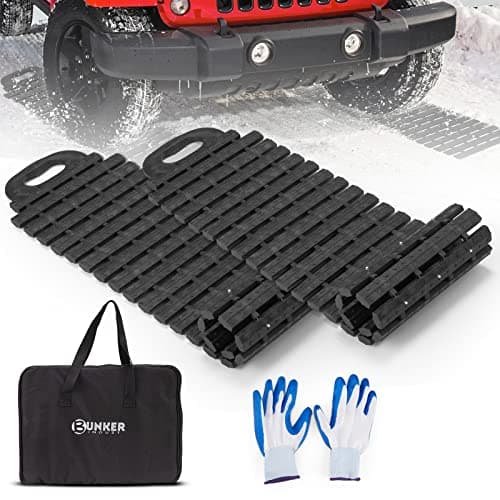
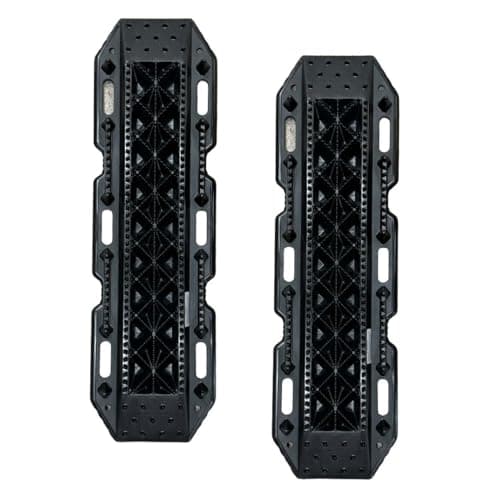
The problem these solve, which is not the chain problem
Tire chains are a driving device. You fit them before you set off, and they let a moving car keep finding grip on packed snow. We rank those separately, and for most people they are the more useful purchase.
Traction boards answer a different question: the car is stationary, one driven wheel is in a rut of polished ice or slush, and the differential is sending all the torque to the wheel with nothing under it. Fitting chains at that point is difficult and often impossible, because the stuck wheel is the one you cannot turn or reach.
A board is simply a rigid surface with teeth that you wedge under the spinning tire so it has something to bite. It is a five-minute fix for a situation that otherwise costs a tow.
How we judged these
This is an unusual category for this site, because there is almost nothing published to judge on. Most of what is sold is unbranded, with no manufacturer page and no load rating. We have said so rather than dressing up listing copy as specification.
1. Whether anyone stands behind the product. A named maker with a product page is worth a premium in a category where most sellers are interchangeable.
2. Published load rating. Effectively nobody publishes one, including the pair we rank first. That is a genuine gap and it affects how we would use them.
3. Size and storage. A board long enough to be useful is a board too long for a small trunk. This is the real trade-off.
4. Whether it survives being used properly. Boards fail when a spinning tire polishes the teeth off them, which is a technique problem as much as a product one.
Which tool for which situation| Situation | What works | Why |
|---|
| Plowed in at the end of the driveway | Shovel first, then boards | Moving the snow is most of the job; the board handles the ice underneath |
|---|
| One wheel spinning on polished ice | Traction boards | The tire needs a surface with teeth, not more torque |
|---|
| Driving a snowy road or a mountain pass | Chains or snow socks | Boards do nothing once you are moving |
|---|
| Deep unplowed snow, high-centered | A shovel, and often a tow | If the car is resting on its belly, the tires are not the problem |
|---|
| Occasional slush, mild climate | A bag of sand or cat litter | Cheap, doubles as ballast, and good enough for shallow ruts |
|---|
Using them without breaking them
Almost every broken traction board and every board thrown across a parking lot comes from the same mistake: too much throttle.
- Clear the snow in front of the tire first. A board pushed into deep snow just compacts it; you want the board on the surface the tire will actually climb onto.
- Wedge it hard under the tread, angled so the tire climbs onto it rather than pushing it away. If it sits loose, it will shoot backward the moment the wheel turns.
- Straighten the wheels. Turned wheels dig; straight wheels roll.
- Use the least throttle that moves the car. A spinning tire melts and polishes the teeth off a plastic board in seconds. Steady and gentle is the whole technique.
- Do not stop once you are moving — drive to somewhere with grip, then walk back for the boards.
Skip this
Stand clear, and never put your hands under a loaded tire
A board that squirts out from under a spinning wheel leaves at speed. Keep everyone, especially children and anyone filming, well away from directly behind or in front of the tire.
The other rule is about hands. Do not reposition a board while anyone is in the driver's seat with the car in gear, and never put fingers under a tire that is loaded. If it needs adjusting, the engine is off and the keys are in your pocket.
And if the car is high-centered on packed snow with the wheels hanging, boards are the wrong tool. That is a shovel job or a tow, and forcing it is how people bend suspension components.
What nobody publishes, and why it matters
In a category where a product goes under two tons of vehicle, you would expect a load rating. In practice you will not find one on most of what is sold, including the boards we rank first. We checked.
What that means practically: treat any pair as a traction aid rather than a jacking or bridging device. Boards marketed for off-road use are sometimes sold with a jack base built in; unless a load rating is published, do not put the weight of the car on the board as a static support.
It also means price is a weak signal here. You are largely buying thickness, tooth design and the number of ribs, all of which you can see in photographs, rather than an engineering claim you can check.
What we would buy
If you get stuck more than once a winter: the sturdier pair, from the maker that at least has a product page. They are bulky, and that is the price of boards long enough to be worth deploying.
If this is insurance against a once-a-year event: the cheaper pair does the same job. You are accepting an unbranded product with no published rating, and at that price that is a reasonable trade.
If your trunk is small: honestly, a folding shovel and a bag of sand cover most suburban situations for less money and less space. The full kit list is here, and the shovel is the item on it that gets used most.
And remember what they are not. Boards get you out of a spot. They do nothing for a snowy drive home, which is what chains and snow socks are for.