Battery Tender vs NOCO
Two brands so established that people use their names as the product category. They are not interchangeable, and the thing that separates them is exactly the thing a winter buyer needs.
Heads up: the buy links on this page are affiliate links. If you buy through one, we earn a commission at no extra cost to you. It does not change what we recommend or the order we rank things in - here is how we keep those separate.
The decision table, first
| Battery Tender Junior | NOCO GENIUS1 | |
|---|---|---|
| Charging current | 750 mA | 1 A |
| Voltages | 12 V | 6 V and 12 V |
| Chemistries | Lead-acid | Wet, gel, MF, CA, EFB, AGM and lithium |
| Operating temperature range | Not published by the manufacturer | -4 F to 104 F, published |
| Power consumption | Not published in the same form | 15 W maximum, published |
| Mode of operation | Four-stage charge then float maintenance | Smart charge with maintenance, plus repair mode on the GENIUS2 |
One row in that table is doing almost all the work, and it is the fourth. NOCO publishes an operating temperature range for the GENIUS1 of -4 F to 104 F. Battery Tender does not publish an operating temperature range for the Junior.
That is not an accusation that the Battery Tender fails in the cold. We have not tested either product and we are not going to pretend otherwise. It is a statement about what you can know before you buy. If the charger is going to spend December in an unheated garage in Minnesota, one of these two brands has told you what it is rated for and the other has not.
Pick the NOCO if...
The charger lives somewhere cold. A published -4 F floor is the single most relevant number for this site’s readers, and it is the reason the GENIUS1 is the top pick on our battery maintainer roundup as well.
You have more than one kind of battery. Six-volt is the case people forget — a classic, a tractor, some motorcycles. The GENIUS1 covers 6 V and 12 V; the Junior is 12 V only. And if anything you own has a lithium battery, the NOCO publishes support for it and the Junior does not.
You want the numbers. NOCO publishes a specification sheet with current, voltages, consumption, chemistry list and operating range. On a site that ranks published data as a criterion, that is worth something on its own.
Pick the Battery Tender if...
You want the thing that has been doing this for decades. The Junior’s four-stage charge and float routine is one of the longest-running designs in the category, and there is a real argument for a device whose behavior is thoroughly understood by everyone who has ever owned one.
The vehicle is stored somewhere temperate. A heated garage, a basement, a storage unit that does not swing far below freezing. In that environment the unpublished temperature range stops being the deciding factor, and the two products are much closer.
You want one decision, not five. The Junior is 12 V, lead-acid, plug it in. There is no mode to select and nothing to get wrong, and for a lot of people that is the actual feature.
What either of them costs to run
This is the part that surprises people, so it is worth doing with real numbers. NOCO publishes a maximum power consumption of 15 W for the GENIUS1. That is the maximum, drawn while it is actually charging; on float maintenance it is a fraction of it.
Take the worst case anyway. Fifteen watts continuously for 120 days is 15 × 24 × 120 ÷ 1000 = 43.2 kWh, or $7.92 at the U.S. average residential rate of 18.34 cents per kWh (EIA, June 2026). Realistically it is a small fraction of that, because a maintainer spends nearly all its time holding rather than charging.
Under eight dollars for a whole winter, worst case, against a battery that will not start the car in February. This is the least controversial purchase on the entire site, and the brand argument above matters far less than the decision to own one at all.
The naming confusion, cleared up
“Battery Tender” is a brand. It is not a category, it is not a type of device, and a NOCO is not “a battery tender” in any technical sense — it is a smart charger and maintainer, which is what the Battery Tender products are too. The reason this matters is that people search for a brand when they mean a function, and then buy inside that brand without comparing outside it.
The function you want is a maintainer: a device that charges a battery and then holds it at a float voltage indefinitely without cooking it. A plain trickle charger does not do the second half, which is why leaving one connected all winter is a genuinely bad idea. The difference between those two device types is a bigger deal than the difference between these two brands.
Skip this
Skip this comparison entirely if the battery is already flat
Neither of these is a recovery tool in any hurry. At 750 mA and 1 A respectively, bringing a deeply discharged car battery back up is a multi-day proposition, and a battery that has been sitting flat may not come back at all.
If you need to drive today, that is a jump starter, not a maintainer — we separate those two jobs here. If you need to recover a battery over a weekend rather than a week, step up to the 2-amp unit, which also publishes a manual desulfation mode. Maintainers are a prevention product, and prevention has to happen first.
What we would actually buy
For a car parked outside or in an unheated garage in a cold climate: the NOCO, on the published temperature range alone. That is the scenario this whole site is written for, and it is the one specific question where one brand answers and the other stays quiet.
For a vehicle stored somewhere that stays above freezing, where you already own a Battery Tender and it works: keep it. Replacing a working maintainer with a different working maintainer is not an upgrade, and the money is better spent on understanding why the battery is struggling in the first place.
And whichever you buy, the sizing question is smaller than people think. What size maintainer you need has a short answer for maintenance duty, and a longer one only if you also want the thing to recover a discharged battery.
What to buy, given all that
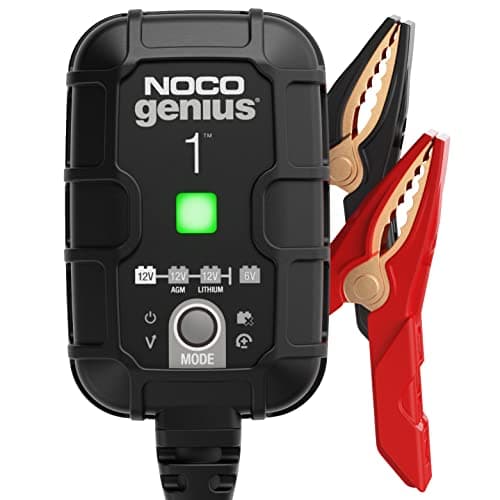
NOCO
NOCO GENIUS1 1A Smart Charger and Maintainer
Roughly $25-$35
The published operating range is the reason this is the pick: NOCO rates it from -4 F to 104 F, which is the only spec on this page that speaks to whether the thing works in an unheated garage in January. Most rivals simply do not publish one.
Skip it if: You need to recover a flat battery quickly. At 1 amp this is a maintainer, and a genuinely dead battery takes it more than a day.
#ad Price as of October 18, 2026, from Amazon. Prices change. How this site is funded.
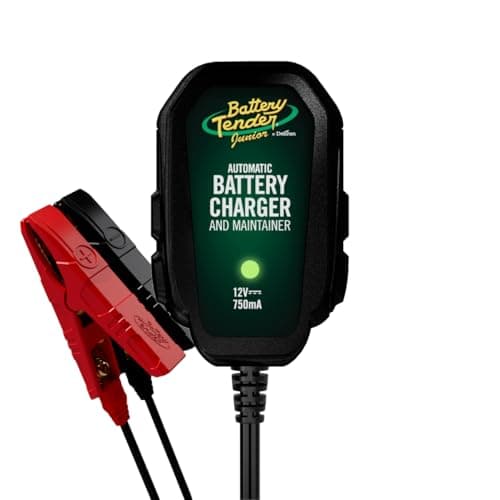
Battery Tender
Battery Tender Junior 750mA Charger
Roughly $25-$35
The maintainer that gave the whole category its nickname. It does one thing, has done it for decades, and the quibble is that the published specification sheet is thinner than the rival's - notably on cold operating limits.
Skip it if: You have 6-volt or lithium batteries to look after as well.
#ad Price as of October 18, 2026, from Amazon. Prices change. How this site is funded.
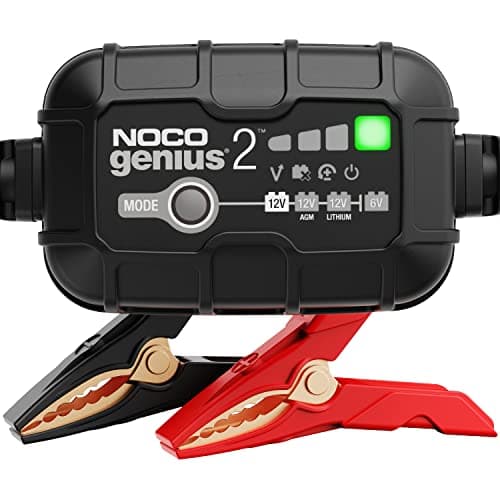
NOCO
NOCO GENIUS2 2A Smart Charger
Roughly $40-$55
Twice the current of the GENIUS1 for a modest step in price. Buy this one if the battery you are looking after is ever actually flat rather than merely idle, because 2 amps recovers in a day what 1 amp takes two to do.
Skip it if: You only ever need to hold a healthy battery at float. The 1-amp unit is cheaper.
#ad Price as of October 18, 2026, from Amazon. Prices change. How this site is funded.
How this was ranked
Every site in this category says it tested twenty of these. We have not tested any, and we say so. What we did instead: built the candidate set from what Amazon actually stocks, compiled the published specifications from each manufacturer’s own pages, did the arithmetic on running cost and on what the thing prevents, and read owner reviews for failure patterns rather than star averages. Every number on this page has a link to where it was published, so you can check the work.
- Units we claim to have tested
- 0
- Sponsored placements
- 0
- Free products accepted
- 0
Frequently asked
Is NOCO better than Battery Tender?
For a cold garage, NOCO has the stronger case, and it rests on published specifications rather than opinion: NOCO states an operating range of -4 F to 104 F for the GENIUS1 and supports 6 V, 12 V and lithium, while Battery Tender does not publish an operating temperature range for the Junior and it is 12 V lead-acid. In a temperate space the two are much closer and the Junior’s long track record is a fair reason to choose it.
Is a Battery Tender the same as a battery maintainer?
Battery Tender is a brand name; battery maintainer is the category. The confusion is so common that people ask for one brand when they mean the function. What you want is a device that charges and then holds at float indefinitely, which both brands make, and which a plain trickle charger does not do.
Will a battery maintainer work in a freezing garage?
It depends on the unit, and this is exactly why the published range matters. NOCO publishes -4 F to 104 F for the GENIUS1. Where a maker publishes nothing, you are relying on assumption. Note also that the battery itself behaves differently in the cold, which is a separate problem from whether the charger is rated for it.
How much does it cost to leave a maintainer plugged in all winter?
Very little. NOCO publishes 15 W maximum consumption for the GENIUS1. Even running flat out continuously for 120 days that is 43.2 kWh, or $7.92 at the U.S. average of 18.34 cents per kWh — and real use is far below the maximum because a maintainer spends most of its time holding rather than charging.
Can I use the same maintainer on a motorcycle and a car?
Usually yes for a 12 V lead-acid motorcycle battery, and a 1-amp unit is a sensible size for one. The thing to check is voltage and chemistry: some older bikes and classics are 6 V, and some modern powersports batteries are lithium. The GENIUS1 publishes support for 6 V, 12 V and lithium; the Battery Tender Junior is 12 V lead-acid.
Do I need the 2-amp version instead?
Only if you want the charger to recover a discharged battery in reasonable time as well as maintain a healthy one. For pure maintenance duty the 1-amp unit is enough and cheaper. The 2-amp unit also publishes a manual repair mode for desulfation, which the smaller one does not.