What size battery maintainer do you need?
Almost everyone asks about amps. For maintaining a healthy battery, the answer is that it barely matters - and here is what does.
Heads up: the buy links on this page are affiliate links. If you buy through one, we earn a commission at no extra cost to you. It does not change what we recommend or the order we rank things in - here is how we keep those separate.
The short answer
For maintaining a healthy battery, 750 mA to 1 A is enough for anything with a 12-volt lead-acid battery, from a motorcycle to a full-size truck. The maintainer is replacing self-discharge and small parasitic loads, and those are small.
For recovering a battery that is genuinely flat, amperage decides how long you wait, and 1 A is slow enough to be impractical.
By use case
| What you are doing | Amperage | Why |
|---|---|---|
| Motorcycle, mower or powersports stored for winter | 750 mA to 1 A | Small battery, no parasitic draw. More current buys nothing. |
| Car parked all winter, battery healthy | 1 A | Replacing self-discharge and the car's standby draw. Comfortable margin. |
| Daily driver on short winter trips | 1 A to 2 A | Making up a real deficit overnight, not just holding a level. |
| Battery sometimes goes genuinely flat | 2 A minimum, 4 A better | You are recovering, not maintaining. Time matters. |
| Several vehicles from one unit | 2 A with a selectable mode | You are moving it between batteries, so speed matters. |
The charge-time arithmetic
How long a recovery actually takes
Rough time in hours = amp-hours needed ÷ charger amps, then add 20 to 30 percent because charging is not perfectly efficient and the final stage slows deliberately.
A typical car battery is 50 to 70 Ah. One discharged to about half needs roughly 30 Ah returned.
At 1 A: 30 hours, plus inefficiency, so call it 36 to 40 hours.
At 2 A: 15 hours, so about 18 to 20 hours.
At 4 A: about 9 to 10 hours.
That is why 1-amp units are described as maintainers rather than chargers. They are sized to hold a full battery full, and asking one to refill an empty battery means waiting most of two days.
Two things that matter more than amperage
1. The published operating temperature range
This is the specification that decides whether the unit works in the place you are going to use it. NOCO rates the GENIUS1 from -4 F to 104 F. Most competitors publish nothing at all, which means you are assuming rather than knowing.
2. Chemistry support
Check what your battery is before you buy the charger.
- Flooded lead-acid: the traditional type. Every charger handles it.
- AGM: common on anything with stop-start. Needs an AGM mode; charging it on a flooded profile uses the wrong voltage and shortens its life.
- EFB: also common on stop-start cars. Usually supported alongside AGM.
- Lithium (LiFePO4): on some powersports vehicles. Requires a lithium mode — running it on a lead-acid profile is actively bad rather than merely inefficient.
The battery label usually says. If it does not and the car has stop-start, assume AGM.
Skip this
Do not buy a bigger charger 'to be safe'
A 10-amp charger left connected to a healthy battery all winter is not better than a 1-amp maintainer. If it is a genuine smart unit it will simply sit in float and behave identically, so you paid extra for nothing. If it is not, the higher current does more damage when it overcharges.
Buy for the job. Maintaining is a 1-amp job. Recovering is a 2-to-4-amp job. Fast workshop charging is not something you need in a domestic garage.
One maintainer for several vehicles
Perfectly reasonable, and the way to do it is to fit a permanent ring-terminal harness to each battery and move the charger between them with the quick-connect. Harnesses are a few dollars each.
The alternative — moving clamps between vehicles — means opening hoods in the cold, which is how a maintainer ends up in a drawer. The setup takes ten minutes.
What to buy, given all that
NOCO
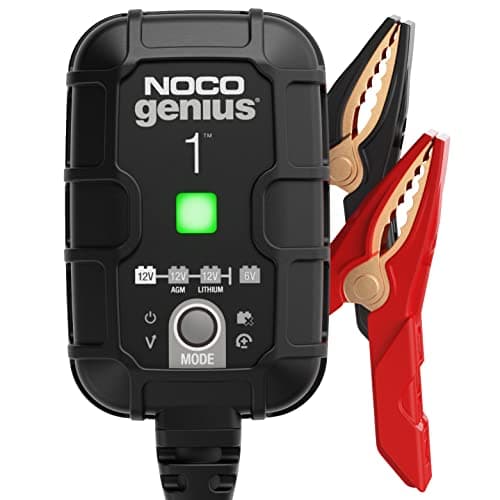
NOCO GENIUS1 1A Smart Charger and Maintainer
Roughly $25-$35
The published operating range is the reason this is the pick: NOCO rates it from -4 F to 104 F, which is the only spec on this page that speaks to whether the thing works in an unheated garage in January. Most rivals simply do not publish one.
Skip it if: You need to recover a flat battery quickly. At 1 amp this is a maintainer, and a genuinely dead battery takes it more than a day.
#ad Price as of October 18, 2026, from Amazon. Prices change. How this site is funded.
NOCO
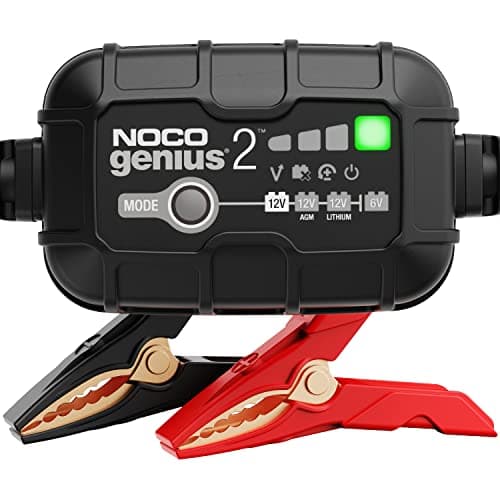
NOCO GENIUS2 2A Smart Charger
Roughly $40-$55
Twice the current of the GENIUS1 for a modest step in price. Buy this one if the battery you are looking after is ever actually flat rather than merely idle, because 2 amps recovers in a day what 1 amp takes two to do.
Skip it if: You only ever need to hold a healthy battery at float. The 1-amp unit is cheaper.
#ad Price as of October 18, 2026, from Amazon. Prices change. How this site is funded.
How this was ranked
Every site in this category says it tested twenty of these. We have not tested any, and we say so. What we did instead: built the candidate set from what Amazon actually stocks, compiled the published specifications from each manufacturer’s own pages, did the arithmetic on running cost and on what the thing prevents, and read owner reviews for failure patterns rather than star averages. Every number on this page has a link to where it was published, so you can check the work.
- Units we claim to have tested
- 0
- Sponsored placements
- 0
- Free products accepted
- 0
Frequently asked
Is a 1 amp battery maintainer enough for a car?
For maintaining a healthy battery, yes — it only has to replace self-discharge and the car’s standby draw, and both are small. It is not enough to recover a flat battery in a useful time: that would take most of two days at 1 amp.
What amp battery maintainer for a motorcycle?
750 mA to 1 A. Motorcycle batteries are small, and a higher current buys nothing when the job is holding a charged battery charged. Check that the unit supports your chemistry: many powersports batteries are AGM or lithium and need the matching mode.
How long can you leave a battery maintainer connected?
Indefinitely, if it is a genuine smart maintainer that drops to float or standby. Months is normal and is what they are designed for. A constant-current trickle charger with no automatic cutoff must not be left connected — the difference is here.
Can I use a car battery maintainer on a motorcycle?
Yes, as long as it supports the battery chemistry and the voltage. A 12-volt 1-amp maintainer is appropriate for both, which is why the same units are sold for both. Check for a lithium mode if the bike has a lithium battery.