The answer first
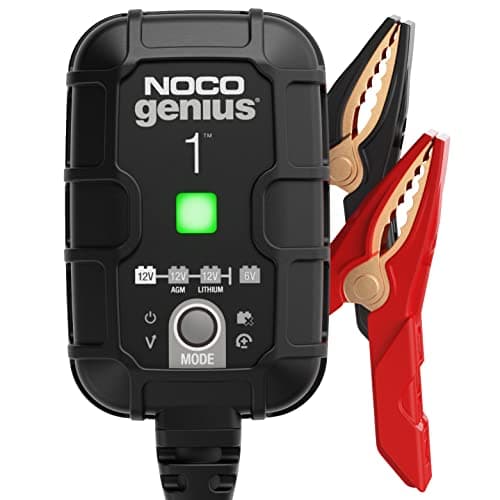
Yes, you can charge a lead-acid battery in freezing weather, and in an unheated garage you should — but only if it is not already frozen, and only with a charger that publishes an operating limit below the temperature in your garage. Of the four maintainers ranked above, exactly one publishes that limit: the NOCO GENIUS1, rated −4 F to 104 F.
And the rule that matters more than any of it: never charge a frozen battery. Schumacher publishes it as safety instruction 14 in plain capitals — “NEVER charge a frozen battery. If battery fluid (electrolyte) is frozen, bring into a warm area to thaw before charging.” Pushing current into frozen electrolyte is how a battery case splits.
The two numbers that explain winter battery failure
CTEK publishes the pair of figures that makes all of this make sense, and they are worth reading twice:
“With a battery at 40% state of charge, the electrolyte will freeze at −8 °C.” That is 18 F — an ordinary January night in most of the northern half of the country.
“With a battery at 100% state of charge the electrolyte will freeze at −33 °C.” That is −27 F, which most people never see.
The difference between those two temperatures is 45 degrees Fahrenheit of margin, and the only thing that buys it is state of charge. A full battery is, in a real and physical sense, antifreeze. A half-flat one is mostly water.
CTEK is blunt about what happens if it does freeze: “Once the battery is damaged, it will no longer hold a charge and will need replacement.” So this is not a performance question. It is the difference between a battery that is fine in March and a battery you are buying again.
Published figures that decide cold-weather charging| Published figure | Source | What follows from it |
|---|
| Electrolyte freezes at -8 C (18 F) at 40% state of charge | CTEK | A half-flat battery is at risk on an ordinary winter night |
|---|
| Electrolyte freezes at -33 C (-27 F) at 100% state of charge | CTEK | Keeping it full is the protection, and a maintainer is how |
|---|
| "NEVER charge a frozen battery ... bring into a warm area to thaw before charging" | Schumacher owner's manual, safety item 14 | Thaw first, always. No exceptions and no fast charging |
|---|
| Operating temperature -4 F to 104 F; 15 W maximum draw | NOCO GENIUS1 specification | The only charger here that states a cold limit at all |
|---|
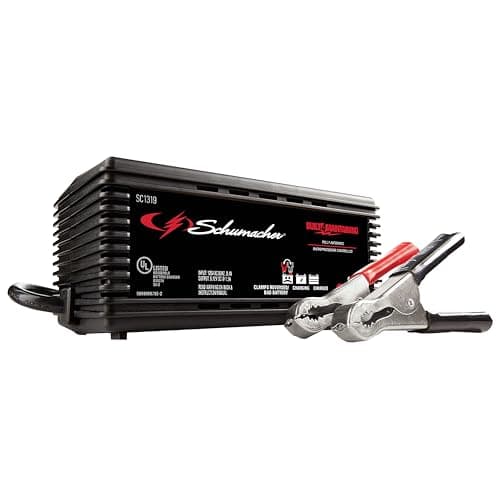
| Operating temperature range: not published | Schumacher maintainer specification | Cheapest option, and you are buying without the number |
|---|
| A battery blanket warms the battery core 60-70 F above ambient | Phillips & Temro (Zerostart) | The answer when the garage is colder than the charger's limit |
|---|
How to tell whether a battery has frozen
You are looking for mechanical evidence, not electrical. Frozen electrolyte expands, and it has nowhere to go.
Bulged or puffed-out sides. A lead-acid case is flat and square. If the long sides are bowed outward, the electrolyte has frozen and expanded against them.
A lifted or cracked top, or a seam weeping. Any deformation at all is a stop sign.
No response at all to a charger that is working. A charger that refuses to initiate on a battery that read some voltage yesterday, on a morning well below 18 F, after a week of sitting — assume ice until proven otherwise.
Slush you can hear. On a battery with removable caps, a cell that does not behave like a liquid is the answer.
If any of those are true, do not connect anything. Move it somewhere above freezing, let it thaw completely, and then test it — knowing that CTEK’s published position is that a battery damaged this way needs replacing rather than recovering.
Why a trickle of current beats a big charger here
The GENIUS1 publishes a 15 W maximum draw. At the U.S. average residential rate of 18.34 cents per kWh, running it flat out for a full 24 hours costs 0.015 kW × 24 h = 0.36 kWh, about 6.6 cents. Across a 120-day winter that is roughly $7.90, and in practice far less, because a maintainer spends most of its life in float rather than at maximum.
Against that: a battery. The device that keeps the electrolyte freeze point at −27 F instead of 18 F costs under ten dollars a winter to run.
This is also the argument against reaching for a big charger. A high current into a very cold battery is the least efficient and least pleasant way to do this; the acid is sluggish, the battery accepts current poorly, and you are pushing hard against a chemistry that is not ready. Little and constant beats big and occasional, all winter.
The arithmetic is ours, from the published 15 W figure and the published electricity rate.
Charging in the cold, done properly
1. Look at the battery before you connect anything. Bulged case, cracked top, weeping seam — stop. Thaw first.
2. Check your charger’s published operating range. If it publishes one and your garage is below it, the charger is outside its stated conditions and its behavior is not specified. If it publishes nothing at all, you are operating on hope.
3. Leave it connected rather than topping up occasionally. The published freeze-point pair is the whole reason: the protection comes from being at 100 percent continuously, not from being charged last Sunday.
4. Use the ring terminals, not the clamps. A permanently fitted pigtail with a weatherproof cap turns the nightly routine into one plug, which is the difference between a maintainer that gets used in February and one that does not. The full setup routine is here.
5. If the garage is colder than the charger is rated for, warm the battery instead. A battery blanket published at 60 to 70 F above ambient brings the battery back inside the range the charger is specified for, which is a more honest fix than running the charger outside its limits.
The slower damage, which is the one most batteries actually die of
Freezing is the dramatic failure. There is a quieter one running all winter underneath it, and the same maintainer prevents both.
CTEK publishes the mechanism: in the cold, “these chemical reactions slow down significantly due to the reduced mobility of ions in the battery’s electrolyte,” and the battery’s “ability to accept or deliver sufficient current decreases.” Note that it cuts both ways — accept as well as deliver. A cold battery is worse at taking a charge, not only at giving one.
Put that next to a winter driving pattern and the trap is obvious. Short trips in the dark with the heater, the blower, the lights, the heated seats and the rear screen all running means the alternator is funding the car rather than refilling the battery. And the battery it is trying to refill is accepting current poorly because it is cold. CTEK names the consequence: “the battery will not be fully charged which could lead to sulphation.”
Sulphation is lead sulphate crystallizing on the plates of a battery left sitting partly charged. It permanently reduces the capacity available, which is why a battery that spent one winter at 60 percent charge never quite comes back. It is also why the real cause of most winter no-starts is the months before the morning it happened.
So the maintainer is doing two jobs at once on a car that sits or does short runs: it holds the electrolyte freeze point down at −33 C instead of letting it drift up toward −8 C, and it stops the standing partial discharge that sulphates the plates. Neither is dramatic. Together they are the difference between replacing a battery every three winters and every six.
Where to actually plug it in
Two practical points that decide whether any of this happens, because a maintainer that is awkward to connect is a maintainer that stops getting connected in January.
An outdoor outlet needs to be a proper one. If the car lives on a driveway rather than in a garage, the cord run has to be rated for outdoor use, the connection has to be kept off the ground and out of the slush, and it should be on a GFCI. That is the same chain of requirements as running a block heater off a timer, and the weak link is always the thin indoor extension cord someone found in a drawer.
An unheated garage is colder than you think, but warmer than outside. A detached garage typically tracks a few degrees above the overnight low because the slab holds heat, which is often exactly enough to keep the battery inside the GENIUS1’s published −4 F window on a night when the driveway is not. If you are at the margin, that is a reason to park inside rather than a reason to buy different hardware. And if the garage is where the car lives all winter, sealing the door is the cheapest way to raise that floor.
Skip this
Lithium is a different rule, and a stricter one
Everything above is about lead-acid. Lithium iron phosphate and other lithium chemistries are published with a hard low-temperature charging floor, usually 0 °C (32 F), and the mechanism is lithium plating on the anode — permanent capacity loss rather than a bad night. CTEK’s charger manuals carry the instruction not to charge a lithium battery below 0 °C unless the battery manufacturer specifies otherwise.
That matters for two things in a cold garage. A lithium jump pack left in the trunk should be brought indoors to charge, not charged where it sits. And if you have fitted a lithium starting or accessory battery, the maintainer you were using on lead-acid is not automatically appropriate — check the battery maker’s published charge-temperature window first.
Discharging lithium in the cold is merely inefficient. Charging it below freezing is damaging. The two are not the same, and plenty of advice conflates them.
Which charger, given all that
Unheated garage, one car: the GENIUS1. It is the only unit here that publishes a cold operating limit, and −4 F covers most of the country most nights. That published number is the entire reason it ranks first.
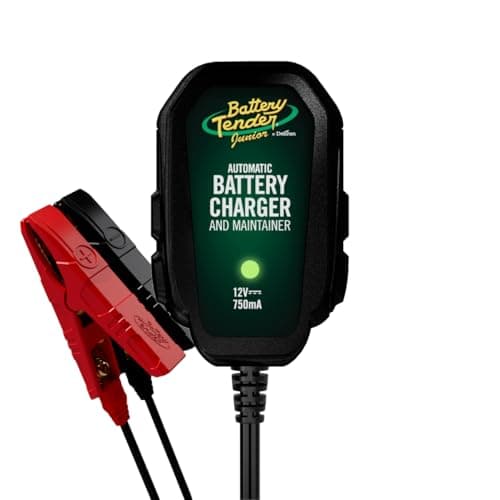
A car put away for the whole winter: the Battery Tender Junior. It is a float maintainer built for exactly this job, and for a vehicle you are not touching until April the set-and-forget behavior matters more than the specification sheet.
Two batteries, or a car and a bike: the GENIUS2, for the extra amp and the headroom.
On a strict budget: the Schumacher works and costs least. It publishes no operating temperature range, and you should know that you are buying without the one number this page is about.
If you are still deciding between a maintainer and something that starts the car when it has already failed, that comparison is a page of its own — and if you are not sure what size maintainer the battery needs, start there instead.