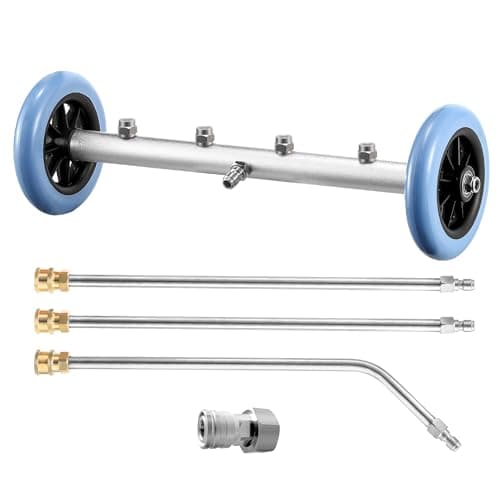
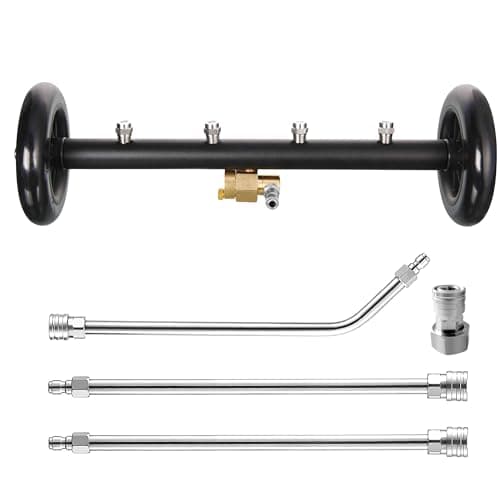
Why the underside is the part that matters
Salt does its damage in the places that never dry: box sections, seam welds, the insides of rocker panels, subframe mounts and behind the wheel arch liners. Salt is hygroscopic — it pulls moisture out of the air — so residue keeps those surfaces damp long after the weather has dried everything you can see.
That is why our road salt guide puts the underbody rinse first, ahead of every product on this site. It is also why the automatic wash's underbody option is worth the couple of dollars it adds.
What a wand buys you is control and frequency. A drive-through pass sprays a fixed pattern at a car moving over it. A wand in your hands lets you spend thirty seconds on each wheel arch and the sills, which is where the salt actually collects — and lets you do it whenever there is a mild afternoon, without queuing.
How we judged these
A warning about this category before the criteria: it is almost entirely unbranded. The same 16-inch head appears under a dozen seller names, and none of them publishes a flow rate, a build specification or a durability figure. We have said what is published and left the rest blank rather than inventing it.
1. Can it run from a garden hose? This is the single most important question, because it decides whether the purchase is $30 or $30 plus a pressure washer.
2. Width of the head. A wider bar covers an underbody in fewer passes, which matters when your hands are cold and the light is going.
3. What pressure it is rated for, where a rating is published at all. On the pressure-washer versions this is the one figure you get.
4. Whether it will survive being dragged on concrete. Wheels and a sturdy bar matter more than the number of nozzles.
What the two types give you | Hose-fed wand | Pressure washer attachment |
|---|
| Water supply | Garden hose, or a pressure washer | Pressure washer only |
|---|
| Published rating | None beyond the head width | Listed to 4000 psi |
|---|
| What it removes | Loose salt and slush - a proper rinse | Caked salt and road film |
|---|
| Total cost to start | The wand alone | The wand plus a machine |
|---|
| Risk of doing harm | Low | Real - see below |
|---|
| Manufacturer spec page | None | None |
|---|
The honest summary: if you own a pressure washer, the pressure version cleans better. If you do not, the hose-fed wand is the one that turns “I should rinse the underside” into something you will actually do six times this winter. Frequency beats thoroughness here, because salt does its damage over months.
What the rinse is worth against what it costs
An underbody rinse at an automatic wash runs a couple of dollars a time. Do it every two weeks through a salted winter and that is roughly $20 to $40 a season, which our road salt guide already calls the best value in the category.
A wand is a one-off purchase in the same range as a single season of those washes, and it works from a tap you already pay for. After the first winter it is free.
What both are preventing is structural rust repair on rockers, subframe mounts and floor pans — body-shop work measured in days rather than parts. That comparison is not close, and it is the whole argument for owning one of these.
The technique, and the ways to get it wrong
- Pick a day above freezing. Water into door seals and locks on a sub-zero day gives you a car frozen shut. That is its own miserable problem.
- Work front to back, slowly. The wand is cheap; your time is the input that decides the result. Spend it on the wheel arches and the sills.
- Do the arches from the side as well. The liner traps salt against the arch, and a bar sliding under the car never touches it.
- Keep high pressure away from what it can damage. CV boots, wheel bearing seals, wiring connectors and any sound deadening that is already lifting. Close range plus 4000 psi drives water past seals rather than off them.
- Then drive for a few minutes. Moving air clears water out of crevices and warms the brakes, which is how you avoid rusty rotors and frozen parking brakes.
Skip this
Skip this if the car has fresh underbody coating curing
If you have just applied an underbody product, check its published cure guidance before you point water at it. A non-drying lanolin-type coating is designed to shrug off water, but a hard rubberized coating that has not fully cured is a different matter.
Fluid Film publishes that removing its film calls for a cold-water pressure wash at 1,000 to 3,000 psi, which is a useful reminder in both directions: a pressure washer close up will strip a coating you paid for, and a garden hose will not. Which coating you have decides how careful to be.
Same logic for a car with heavy flaking rust: blasting scale off does not stop the corrosion underneath, and it opens fresh metal to the next salted week.
What we would buy
For most people: the wand sold for a garden hose as well as a pressure washer. It is the version that gets used, and a frequent rinse with moderate pressure beats a thorough one you do twice a winter.
If you already own a pressure washer: the 4000 psi version cleans faster and gets caked salt off. Keep the head moving and keep it away from seals and connectors.
Either way, buy it before the salt starts. This is a fall purchase that pays through the winter, and it belongs on the October list next to the wiper blades.
And if your own driveway is part of the problem, what you spread on it is worth a look too — chloride tracked in from home reaches the same seams as the road's.