Read the temperature before you read anything else
This category is usually reviewed on finish, hardness and hot tire resistance. All of that matters eventually. None of it matters at all if the product cannot cure on your floor this month, and the three kits below publish three genuinely different windows.
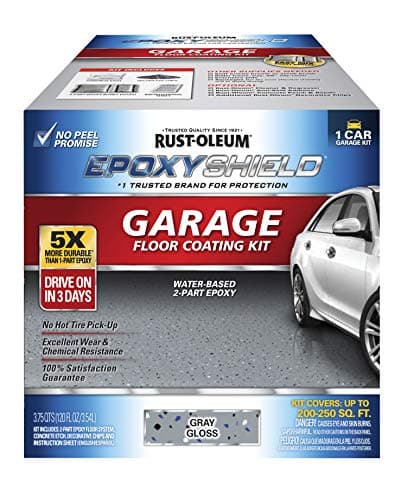
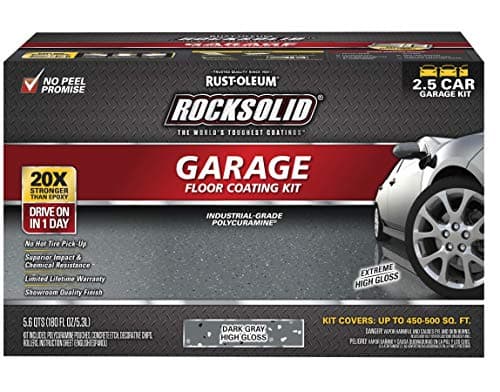
Published application temperature windows for garage floor coatings| Product | Published application window | Time to vehicle traffic | What that means in practice |
|---|
| Rust-Oleum RockSolid Polycuramine | 40-90 F air, material and floor; 55-90 F stated as optimal | 24-36 hours | The only one still open late in the season, and the fastest back into service |
|---|
| BEHR PREMIUM Granite Grip | 50-90 F air and surface | Not published in the same form; two coats required | Ten degrees more room at the bottom than the epoxy kit |
|---|
| Rust-Oleum EpoxyShield | 60-85 F air, material and surface | 3 days for full cure and vehicle traffic | A summer job. A 60 F floor in October is not common in a cold climate |
|---|
Note that every one of those numbers refers to the floor as well as the air. This is the detail that ruins projects. A concrete slab is a large thermal mass sitting on ground that is colder than the air above it, and it lags. Two warm afternoons do not make a 60 F slab. If you are going to do this, buy an infrared thermometer, point it at the middle of the floor in the morning, and believe the number rather than the forecast.
EpoxyShield adds two more conditions that are easy to miss and easy to fail: the surface must be at least 5 F above the dew point, and relative humidity must not exceed 85%. On a cool damp weekend a garage floor can be below the dew point at 9am and above it by noon, which is exactly the window in which people start rolling.
Why a garage floor is a winter-protection topic at all
Because of what drips off the car. Road salt solution and snowmelt run off the underbody onto the slab, soak into unsealed concrete, and then freeze. Water expands about 9% when it freezes, and it does that inside the pore structure of the concrete. Repeat it a few dozen times a winter and the surface spalls — the top layer flakes off in patches, usually right where the tires sit.
A coating is a barrier against that cycle. It is also, unavoidably, the most expensive item in this hub, and it is a whole weekend of preparation work whose quality decides everything about the result. So the useful comparison is not coating against coating. It is coating against the alternative.
Coating versus the cheap alternative
The damage is concentrated. It happens where the car parks, because that is where the salt-laden water drips. A containment mat catches that drip in a tray you tip outside, for a fraction of the cost of a coating kit, in about four minutes of installation, at any temperature, in any month.
The coating protects the whole slab and looks like a finished room. The mat protects the part that actually gets attacked and looks like a mat. If you are optimizing dollars against damage prevented, the mat wins clearly. If you want a floor you can sweep and hose and be pleased with, that is a real reason to coat, and it is fine to want that — it is just not a saving, and we are not going to dress it up as one.
Skip this
Skip coating a slab you have not tested, and skip new concrete entirely
Two failures account for most peeled garage floors, and neither is the product’s fault.
Moisture from below. A slab poured without a vapor barrier passes ground moisture up through itself continuously, and no coating bonds to concrete that is actively pushing water outward. Test before you buy: tape a square of plastic sheet to the floor on all four sides, leave it 24 hours, and look for condensation underneath. Wet plastic means do not coat.
New concrete. Rust-Oleum publishes a minimum 28 day cure for new concrete before EpoxyShield goes on. People who have just had a slab poured are exactly the people most keen to coat it, and 28 days in the fall can easily push you out of the temperature window entirely. That is a wait-until-spring situation.
One-part and two-part are different products
The shelf does not make this obvious. A two-part system — epoxy or polycuramine — arrives as separate components you mix, and cures by chemical reaction into a hard film. A one-part coating like Granite Grip is a paint: it goes on from the can and dries. Both are sold in the same aisle and photographed on the same glossy floor.
The practical difference is hot tire pickup. A warm tire parked on a soft coating can lift it when the car pulls away, and two-part systems resist that far better. What the one-part option buys you is price and flexibility: it is sold by the gallon rather than as a kit, so a single-bay area or a partial repair costs a fraction of the full project, and you can stop after one section without wasting mixed product.
Granite Grip also lands a texture rather than a gloss, and on a floor that regularly has meltwater on it that is a genuine advantage. A high-gloss epoxy floor with a film of salt water on it is slippery in a way people do not anticipate until they walk on one.
Preparation is the product
Every kit in this category fails the same way: it peels, and it peels because it was applied to a floor that was sealed, oily or smooth. Degreasing and etching are not steps you can shorten. The finished appearance comes from the coating; the adhesion comes entirely from what you did to the concrete first, and a cheap kit on a properly prepared floor outlasts an expensive kit on a lazy one every time.
Budget the whole weekend, and budget it in the right season. Prep on Saturday, coat on Sunday morning while the slab is at its warmest point of the weekend, and then leave the car outside for as long as the published cure requires — 24 to 36 hours for the polycuramine, three full days for the epoxy.
If it is already cold: what to do this year
Take the mat, and put the coating in the calendar for early fall. That is the honest recommendation and it costs us the more expensive sale. Applying a coating outside its published window does not produce a slightly worse floor; it produces a floor that does not cure properly and has to be ground off before anything else can go down. There is no careful version of doing it too cold.
In the meantime, the things that actually reduce salt damage are free or cheap: catch the drip, sweep the slab dry rather than leaving a brine puddle to sit under the car, and rinse the underbody on a mild day so there is less salt arriving in the first place.