Skip to content
Frost & Fender
Roundup

Containment mats: the least glamorous purchase here

Nobody wants one. Everybody with a spalled garage apron wishes they had bought one four winters ago.

By Scooter M.Published September 1, 2026

Heads up: the buy links on this page are affiliate links. If you buy through one, we earn a commission at no extra cost to you. It does not change what we recommend or the order we rank things in - here is how we keep those separate.

The shortlist

Ranked, with the prices

Ranked on published manufacturer specifications and, where the numbers exist, the arithmetic on what each option costs and what it saves. Tap any row for the full write-up, including who should skip it.

#ProductBest forScorePrice
01A garage floor with meltwater and salt residue under a parked car - a stand-in for the Drymate Garage Floor Containment Mat, not a photograph of this modelDrymate Garage Floor Containment MatCatching meltwater and salt under a parked carBest full-length mat8.4Check price on Amazon
02A garage floor with meltwater and salt residue under a parked car - a stand-in for the Drymate Under-Vehicle Half-Length Mat, not a photograph of this modelDrymate Under-Vehicle Half-Length MatThe budget way to protect the part of the slab that actually gets wetBest on a budget8.0Check price on Amazon

Scores are ours and editorial. They are never published as review or rating markup, because we have not tested these products - see how we pick.

What actually happens to the concrete

A car driven on salted roads brings a startling amount of salt solution home, packed into wheel arches, sitting along the sills and clinging to the underbody. Park it in a warm-ish garage and all of it melts off onto the floor overnight.

Concrete is porous. Salt solution wicks into the surface, and then two separate mechanisms do the damage. Water in the pores freezes and expands, and salt crystals grow in the pores as the solution dries and re-wets. Both push outward from inside the concrete. The result is spalling: the surface flakes and pits, exactly as you see on the aprons of older garages and on parking structures.

This is not a cosmetic problem. Once the surface is open, water gets in faster, and on a slab with reinforcement near the surface it eventually reaches steel. Resurfacing a garage slab is contractor work.

The comparison, stated plainly

A full-length containment mat is roughly $70 to $160 depending on size, and it lasts multiple seasons. Resurfacing a two-car garage slab is a four-figure job, and patching spalled concrete well enough that it does not simply spall again next winter is genuinely difficult.

The mat is not a cheap version of protecting the slab. It is the only affordable version.

What separates a containment mat from a tarpaulin

Two layers doing two jobs. The top layer is absorbent, so meltwater is held in the fabric rather than sitting in a puddle you walk through. The bottom layer is waterproof, so what the top layer absorbs never reaches the concrete. A plain tarp has only the second property, and water pools on it, runs to the edge and off onto the floor — which is exactly the thing you were preventing.

The specification you would want to compare is absorbency per square foot. Nobody publishes it, so we say that on both entries below instead of estimating one.

Full length or half length?

Most of the drip falls off the front of the car: the engine bay is warm, the front wheel arches carry the most slush, and the front suspension is a tangle of surfaces for it to cling to. A half-length mat under the front of the car catches the majority of it for roughly half the price.

Go full length if you park a longer vehicle, if you have rear-wheel arches that pack with snow, or if the floor already shows the fine pitting that means spalling has started. At that point you are protecting a surface that is already compromised, and partial coverage is a partial answer.

Skip this

Skip the cheap PVC 'garage floor mat' rolls sold for looks

The thin glossy roll-out PVC flooring sold for garage appearance is not a containment product. It is not absorbent, so water sits on top; it is not sealed at the seams, so water runs underneath; and water trapped under an impermeable sheet against concrete is worse than water on open concrete, because it never evaporates. If the purpose is protecting the slab from salt, buy an absorbent containment mat, not a floor covering.

The free half of this job

A mat catches what falls off the car. It does nothing about what stays on the car, which is the part that rusts the vehicle itself. The two go together: a mid-winter underbody wash on a day above freezing removes salt from the places you cannot reach, and the mat catches what the drive home shakes loose. The order to do both in is here.

The write-ups

Every pick, in full

01 / Best full-length matA garage floor with meltwater and salt residue under a parked car - a stand-in for the Drymate Garage Floor Containment Mat, not a photograph of this model

Drymate

8.4 / 10

Roughly $70-$160 depending on size

Drymate Garage Floor Containment Mat

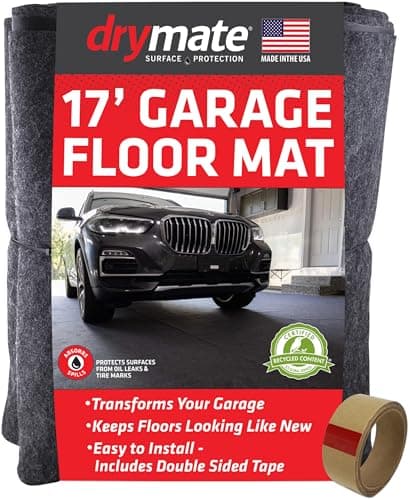
An absorbent mat with a waterproof backing that catches the salt slurry falling off the car instead of letting it soak into the slab. This is the product almost nobody thinks of and it protects the most expensive surface in the garage.

Check price on Amazon

#ad We hold no verified live price for this product, so we show none. How this site is funded.

Published specifications for the Drymate Garage Floor Containment Mat, with the source of each
SpecificationPublished valueWhere it is published
ConstructionAbsorbent surface layer over a waterproof backingDrymate published product information
SizesSold in vehicle-length and half-length sizesDrymate published product information
CarePublished as washableDrymate published product information
Absorbency figureNot published by the manufacturerDrymate published product information

What it does well

  • Stops salt slurry soaking into bare concrete, which is what spalls a slab
  • Rolls up and hoses off at the end of the season
  • No installation, no adhesive, no curing temperature to worry about

What it does not

  • It gets genuinely filthy and needs somewhere to dry
  • Full-length sizes are expensive
  • No published absorbency figure to compare against rivals

Skip this one if

You have a sealed or coated floor and a drain. Then the water is already handled.

How it scores, by criterion

Protects the slab9.0
Ease of use9.0
Cleaning6.5
Published data5.0
Price6.5
02 / Best on a budgetA garage floor with meltwater and salt residue under a parked car - a stand-in for the Drymate Under-Vehicle Half-Length Mat, not a photograph of this model

Drymate

8.0 / 10

Roughly $40-$80

Drymate Under-Vehicle Half-Length Mat

The half-length version, sat under the engine bay and front wheels where most of the slush and salt actually falls off. It costs roughly half as much and catches most of what matters.

Check price on Amazon

#ad We hold no verified live price for this product, so we show none. How this site is funded.

Published specifications for the Drymate Under-Vehicle Half-Length Mat, with the source of each
SpecificationPublished valueWhere it is published
ConstructionAbsorbent surface layer over a waterproof backingDrymate published product information
CoverageHalf vehicle lengthDrymate published product information
CarePublished as washableDrymate published product information

What it does well

  • Roughly half the price of a full-length mat
  • Covers the wheel-well and engine-bay area where most drip falls
  • Easier to handle and wash than a full-length mat

What it does not

  • Leaves the rear of the car unprotected
  • Edges can curl until it beds in
  • Still needs somewhere to dry

Skip this one if

Slush is falling off the whole underside of the car, not just the front.

How it scores, by criterion

Protects the slab7.5
Ease of use9.5
Cleaning7.5
Coverage6.5
Price8.5

How this was ranked

Every site in this category says it tested twenty of these. We have not tested any, and we say so. What we did instead: built the candidate set from what Amazon actually stocks, compiled the published specifications from each manufacturer’s own pages, did the arithmetic on running cost and on what the thing prevents, and read owner reviews for failure patterns rather than star averages. Every number on this page has a link to where it was published, so you can check the work.

Units we claim to have tested
0
Sponsored placements
0
Free products accepted
0

The full method, including what we refuse to claim

Questions people actually ask

Frequently asked

Do garage floor containment mats actually work?

For their actual purpose — keeping salt solution off the concrete — yes, because the mechanism is simple: an absorbent top layer holds the water and a waterproof backing stops it reaching the slab. What they do not do is dry the car, prevent rust on the vehicle, or hold an unlimited volume. In a heavy season they need hosing off partway through.

How do you clean a garage containment mat?

Drag it out on a mild day, hose it thoroughly on both sides, and let it dry fully before rolling it. The salt is the thing you are removing, so plain water and volume matter more than detergent. Do not roll it damp: a wet mat rolled and stored grows exactly the smell you would expect.

Will a containment mat stop my garage floor from spalling?

It removes the main cause on a domestic garage floor, which is salt solution dripping off a vehicle and soaking into the surface. It cannot reverse spalling that has already started, and it does not address water entering at the door line — a threshold seal handles that.

Is a containment mat better than sealing the concrete?

They solve different parts of the problem and they are not alternatives. A penetrating concrete sealer reduces how much solution the slab absorbs, and it is worth doing — but it must be applied to a clean, dry floor at a temperature the product specifies, which usually means planning it for autumn. The mat works immediately, needs no cure, and is removable. If you are reading this in December, buy the mat.

Sources

Read next