Heat tape for pipes, and the rules nobody reads
A heat cable is a cheap answer to an expensive problem. It is also the one product in this category with a published list of things you must not do with it, and that list is the reason it has a reputation.
Heads up: the buy links on this page are affiliate links. If you buy through one, we earn a commission at no extra cost to you. It does not change what we recommend or the order we rank things in - here is how we keep those separate.
What it is, in one paragraph
“Heat tape” is a resistance cable you run along a water pipe. It converts electricity to a small, steady amount of heat — the standard domestic product is 120 volts at 7 watts per foot — and a thermostat clamped to the pipe switches it on when the pipe gets cold. Frost King publishes the set points: the cable turns on below 38 F and off above 45 F, and the kits are stated to keep water flowing down to -40 F.
The name is a small lie that causes real problems. It is not tape. You do not wrap it around and around like tape, and on most kits you must not let it cross over itself at all. It is a cable that runs along the pipe, secured at intervals, and then gets covered with insulation.
Why this belongs on a garage site
Because the pipe that freezes is almost never the one in the heated part of the house. It is the hose bib on the garage wall, the run feeding a utility sink, the line crossing an unheated garage ceiling to the far side of the building. Those runs sit in a space that follows the outside temperature, and they are the ones with no warm air moving past them.
A frozen pipe is not primarily a water-supply inconvenience. Water expands as it freezes, the pressure has nowhere to go, and the pipe splits — often at a point away from the ice itself. You then have a split pipe that is plugged with ice and therefore not leaking. It leaks when it thaws, usually while nobody is standing there, into a garage with a sealed slab and things stored on it.
What running it costs
Six feet of cable at 7 watts per foot is 42 watts. Left on continuously for a full 24 hours that is about 1.0 kWh, or roughly 18 cents at the U.S. average residential rate of 18.34 cents per kWh (EIA, June 2026).
And it is not on continuously, because the thermostat only closes below 38 F. On a winter day that swings from 25 F at dawn to 40 F by afternoon, the cable is drawing for part of the day and nothing for the rest. Call it well under $20 for a whole season on a short run.
The kit itself was $25.99 for the 6 ft version at Ace Hardware when we checked on 2026-09-06. Against that: a split supply line discharging into a garage until somebody notices. This is one of the clearest cost cases on the site, and it does not need inflating.
The prohibitions, because this is the part that matters
Heat cable has a poor reputation in some quarters, and the reason is that it is installed wrongly a lot. Frost King publishes the restrictions plainly. On the automatic kits, the cable is not for:
| Do not use it on | Why it matters |
|---|---|
| PVC pipe | Explicitly prohibited. PVC softens well below the temperatures a constant-wattage cable can reach against it |
| Flexible hose | Explicitly prohibited - includes washing machine hoses and garden hose runs |
| Mobile home feed lines | Explicitly prohibited by the manufacturer |
| Inside walls, floors or ceilings | Buried cable cannot shed heat and cannot be inspected. This is the classic fire scenario |
| Itself - no overwrapping | Cable crossing over cable concentrates heat at the crossing point. The most common DIY mistake |
Two more that are not on the prohibited list but should be on yours. Use the clips or tape supplied with the kit, not something improvised — ordinary electrical tape and duct tape both fail in that environment. And plug it into a GFCI-protected outlet: this is a resistance heater lying against a wet pipe in a cold room, and a ground-fault device is the cheap part of that circuit.
Insulation over the top is not optional
This is the step people skip, and it halves the value of the whole job. A bare cable on a bare pipe heats the pipe and then heats the garage. Insulation over the cable keeps that heat against the pipe, which means the thermostat satisfies sooner, the cable runs less, and the pipe stays warmer on the coldest night when it matters most.
Pre-slit tubular polyethylene foam is the standard answer: closed cell foam, published in 3/8, 1/2, 5/8 and 1 inch wall thicknesses, sized to fit half-inch through two-inch copper. It is pre-slit so it goes onto an installed pipe without disconnecting anything, and it cuts with scissors. Frost King does not publish an R-value for it, so wall thickness is the only figure you can compare on — buy the thickest that will still close around the pipe with the cable underneath it.
One sequencing note: cable first, against the pipe, then insulation over both. Insulation under the cable would be exactly backwards.
What to do instead, where you can
Heat cable is the answer for a pipe that must stay in a cold space. It is not the answer for every cold pipe, and a site that only sold you cable would be leaving out the cheaper fixes.
Drain the outside line. A hose bib fed from an isolating valve inside can be shut off and drained in November. No water, no freeze, no electricity. This is free and it is better than any cable.
Close the gap the cold is coming through. A garage that leaks air around the door is a garage that tracks the outside temperature closely. Sealing the door raises the floor temperature of the whole space, and it is the change that makes every other item in this hub work better.
Insulate even without a cable. Foam sleeve on its own buys you hours, not immunity — but hours are often the whole difference on a single cold night, and it costs a few dollars a length.
Buying it: the two decisions
Length. Measure the run and buy the kit that covers it. Frost King publishes seven lengths, from 3 to 30 feet, all at the same 7 watts per foot. Buying long and coiling the excess is precisely the overwrapping the maker forbids, so buy the length you need rather than the length that was on the shelf.
Thermostat or not. The automatic kits have one built in. Bulk cable sold by the foot often does not, and running unswitched cable from October to April is how a cheap purchase becomes an expensive one. A separate thermostat with the same published set points — on below 38 F, off above 45 F — solves that, and is redundant on any kit that already includes one.
What to buy, given all that
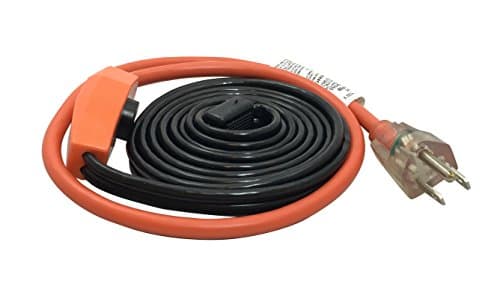
Frost King
Frost King Automatic Electric Heat Cable Kit
$25.99 for the 6 ft kit at Ace Hardware, checked 2026-09-06; longer kits cost more
The standard domestic answer, and the published numbers are the reason to trust it: 120 V at 7 watts per foot, a built-in thermostat that closes below 38 F and opens above 45 F, and a stated ability to keep water moving down to -40 F.
Skip it if: The pipe is PVC, a flexible hose, or buried in a wall. The maker prohibits all three, and those prohibitions are not advisory.
#ad Price as of October 18, 2026, from Amazon. Prices change. How this site is funded.
Frost King
Frost King Pre-Slit Tubular Polyethylene Foam Pipe Insulation
The cheapest item on this page by a wide margin, sold by the length
Not glamorous, and not optional. Insulation over the cable is what turns a heat cable from a device that warms your garage into a device that warms your pipe, and it is the cheapest component of the whole job by a wide margin.
Skip it if: Nothing here, honestly. If the pipe is exposed, it wants covering.
#ad We hold no verified live price for this product, so we show none. How this site is funded.
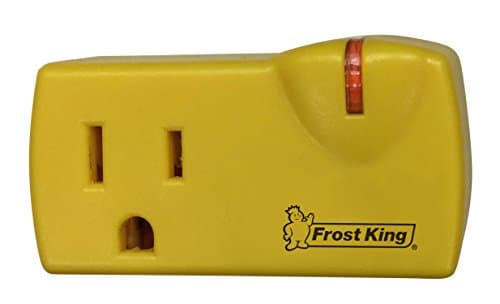
Frost King
Frost King Thermostat for Heat Cable Kits
An accessory purchase on top of the cable - check the current price
Only relevant if you have bought cable without a thermostat, which is easy to do when you buy by the spool rather than by the kit. It switches on below 38 F and off above 45 F, the same set points as the built-in unit.
Skip it if: Your kit already has one built in. The automatic kits above do, and a second thermostat adds nothing.
#ad Price as of October 18, 2026, from Amazon. Prices change. How this site is funded.
How this was ranked
Every site in this category says it tested twenty of these. We have not tested any, and we say so. What we did instead: built the candidate set from what Amazon actually stocks, compiled the published specifications from each manufacturer’s own pages, did the arithmetic on running cost and on what the thing prevents, and read owner reviews for failure patterns rather than star averages. Every number on this page has a link to where it was published, so you can check the work.
- Units we claim to have tested
- 0
- Sponsored placements
- 0
- Free products accepted
- 0
Frequently asked
How does heat tape for pipes know when to turn on?
A thermostat clamped to the pipe. On the Frost King automatic kits it closes the circuit when the pipe is below 38 F and opens it above 45 F, so the cable is not drawing power through mild weather. That switching is the difference between a few dollars a winter and a continuously running heater.
How much electricity does pipe heat cable use?
Seven watts per foot at 120 V on the standard domestic kits. A six foot run is 42 W, which is about 1 kWh and roughly 18 cents if it ran for a solid 24 hours at the U.S. average rate of 18.34 cents per kWh. Because the thermostat only closes below 38 F, real-world use is a fraction of that.
Can heat tape be used on PVC pipe?
Not the automatic kits discussed here — the manufacturer prohibits PVC explicitly, along with flexible hose, mobile home feed lines, and any installation inside a wall, floor or ceiling. If your run is plastic, check the specific product: these kits are published for Schedule 40 plastic with an outside diameter between 3/8 in and 1-1/2 in, which is a narrower permission than “plastic pipe” generally.
Do I need to insulate over heat tape?
Yes, and it is the step most often skipped. Without insulation the cable warms the pipe and then warms the room. With it, the heat stays against the pipe, the thermostat satisfies sooner and the cable runs less. Cable against the pipe first, insulation over both, never the other way round.
Can heat tape cause a fire?
Badly installed cable can, which is where the product’s reputation comes from. The published prohibitions exist for that reason: no overwrapping the cable on itself, nothing buried in a wall or floor, no PVC, no flexible hose. Use the fixings supplied, follow the length rule rather than coiling the excess, and put it on a GFCI-protected outlet.
How long does pipe heat cable last?
Manufacturers do not generally publish a service life, and we are not going to invent one. What we can say is what to check each fall before the cold arrives: the jacket for cracks or abrasion, the plug and its indicator light, and that the cable has not been crushed where the insulation was pushed over it. Anything damaged gets replaced rather than taped.
Sources
- Ice melt on pavers, brick, asphalt and decking
- The best garage door seals for cold weather
- The best budget garage heaters, priced by the hour
- The best garage dehumidifier when the garage is actually cold
- The cheapest garage heater to run, computed
- Garage winterizing
- How we pick, and what we refuse to claim