Why the timer is the purchase, not the accessory
Most people who plug in a block heater plug it in when they get home and unplug it when they leave. That is twelve or fourteen hours of heating for a job that does not need it, every night, all winter.
The heater does not warm the engine to a higher temperature because it ran longer. It reaches a plateau and then holds there, paying to hold it. Everything after that plateau is electricity spent warming your driveway.
A timer costs less than a tank of fuel and removes the wasted hours without you having to remember anything. That is the whole argument, and the arithmetic below is why it is not a small one.
What the wasted hours cost
The formula is simple: watts ÷ 1000 × hours × rate. At the U.S. average residential rate of 18.34 cents per kWh (EIA, Electric Power Monthly, June 2026):
A 1,000 W heater, 12 hours a night: 12 kWh = $2.20. The same heater on a 4-hour timer: 4 kWh = $0.73. You save about $1.47 a night.
Over 100 cold nights that is roughly $147, against a timer that costs under twenty-five dollars. It pays for itself inside about three weeks.
Smaller heaters save proportionally less. The magnetic pad we cover on the block heater versus battery blanket page publishes 200 W, where the same twelve-hour habit costs 44 cents a night and the four-hour version costs 15 cents.
The wattage is the input that matters, and it is printed on your heater or its cord. The rate is yours to substitute. The arithmetic is ours; the 18.34 cent figure is the EIA's.
How we judged these
We have not run these timers through a winter on a test bench. We ranked them on what their makers publish, and on how well that fits a device that is going to sit outdoors, in the cold, doing one job.
1. The electrical rating against your heater. This is the safety-relevant one. A block heater is a resistive load, and the rating you care about is the timer's resistive rating in amps and watts. All three here publish it.
2. How many on/off windows, and how fine. A block heater needs exactly one window a day. More is harmless; the granularity matters more, and every timer here works in 30-minute steps.
3. What the maker publishes about weather. Not just "weatherproof" on the box, but the conditions: how it has to be mounted, what outlet it needs, and how long it is rated to stay out there.
4. What happens after a power cut. A mechanical dial keeps its pins. A digital timer can lose its program, and a timer that silently forgot to turn on is worse than no timer at all.
What each maker publishes
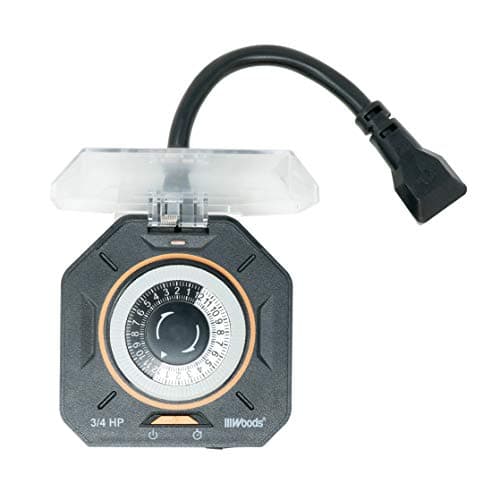
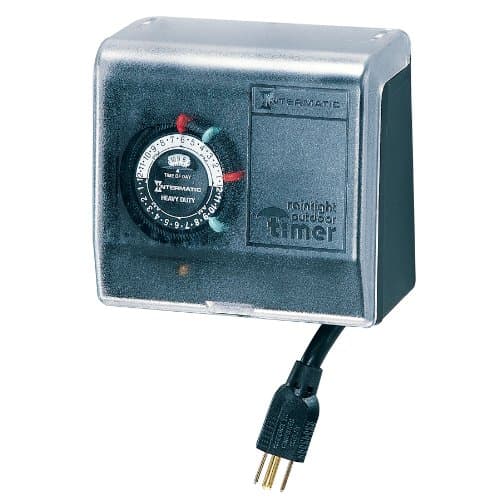
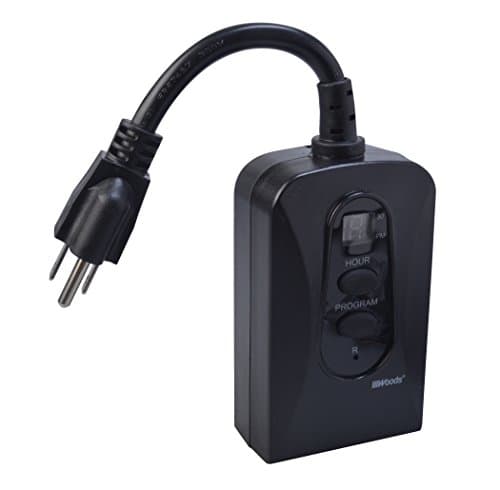
Published specifications for the three outdoor timers | Woods 50016WD digital | Woods 50124WD mechanical | Intermatic P1101 |
|---|
| Resistive rating | 15 A / 1875 W | 15 A / 1875 W | Up to 15 A, 120 VAC |
|---|
| On/off settings per day | 1 | Up to 24 | 2 on / 2 off |
|---|
| Granularity | 30 minutes | 30 minutes | 30 minutes |
|---|
| Type | Digital | Mechanical dial | Mechanical trippers |
|---|
| Weather | Raintight mounted vertically, receptacle down | Weatherproof housing | Built-in outdoor enclosure |
|---|
| Operating temperature | Not published | Not published | Not published |
|---|
| Cord | 6 in | 12 in | Not published |
|---|
Look at the bottom-but-one row. Three timers, all sold for outdoor use, one of them named after block heaters — and none of them publishes an operating temperature range. For a device whose entire purpose is to hang on a post at 10 F and switch a load at 5 a.m., that is the specification we most wanted and could not find on any of them.
We are not going to invent one. What we can say is that a mechanical dial has fewer things in it to mind the cold than an LCD and a microcontroller, and that is part of why the mechanical option is ranked as highly as it is.
The sentence in the manual nobody mentions
Woods’ own instruction sheet for the 50016 carries a line worth reading before you buy: “Do not install or use this product for more than a 90 day period per year.”
A block heater season in a cold state is longer than 90 days. That does not make the timer useless — it makes it a seasonal item with a stated service life, and it tells you two practical things. Bring it indoors when the season ends rather than leaving it on the post through spring rain and summer sun. And treat it as a consumable that you expect to replace, rather than infrastructure.
The same sheet publishes the two conditions people ignore: it is raintight only when mounted vertically with the receptacle facing downward, and it wants a three-conductor GFCI protected outlet. Hanging one sideways off a fence rail, plugged into an old two-prong garage outlet with an adapter, is outside everything the maker published.
Skip this
Do not put a battery maintainer on the timer
This is the most common way people misuse one. The logic seems sound: if timing the block heater saves money, timing the maintainer must save more.
It does not, and it defeats the device. A modern maintainer is designed to stay connected and to run its own cycle — it charges, it stops, it monitors, and it tops up only when the battery actually needs it. The NOCO GENIUS1 we rank on the maintainer page draws a published 15 W maximum, which is about three cents a night. There is nothing meaningful to save, and cutting its power at intervals stops it doing the monitoring you bought it for.
Put the heater on the timer. Leave the maintainer plugged in and connected properly.
How long should the heater actually run?
We are not going to give you a number that applies to every car, because it depends on the heater, the engine and the night. What we can give you is where to find yours and how to think about it.
Check the vehicle manual first. Manufacturers that fit block heaters usually publish guidance on how long to plug in, and that guidance beats anything a website tells you.
Then use the arithmetic above. Whatever window you choose, the saving is the hours you removed times the heater's wattage times your rate. Moving from twelve hours to four saves two-thirds of the bill, and going from four to two saves half of what is left — the returns shrink as you go.
Set the off time, not just the on time. The timer should end its window when you actually leave, not an hour later. That single detail is where a chunk of the saving lives, and it is the part people get wrong when they set a timer for “overnight”.
Load, cords and the boring safety part
A block heater is a resistive load, so the arithmetic is honest: watts divided by volts gives amps. A 1,000 W heater on a 120 V circuit draws a little over 8 A, comfortably inside the 15 A resistive rating all three of these timers publish. A 1,500 W heater on the same circuit is 12.5 A, still inside it but close enough that the rest of the chain matters.
That chain is where people get into trouble. The timer is rated; the thin indoor extension cord someone found in a drawer is not. If you need to reach the car, use a cord rated for outdoor use and for the load, keep the connection off the ground and out of the slush, and plug the whole thing into a GFCI outlet as the manual requires.
And check what else is on the circuit. A garage circuit already carrying a space heater has very little headroom left for anything else.
What we would buy
For most people: the Woods digital block heater timer. It is sold for this job, the rating covers any car block heater, and one on/off cycle a day is genuinely all this requires. Set it to end when you leave.
If you want to spend less, or you get power cuts: the Woods mechanical. Same resistive rating, more windows than you need, a longer cord, and nothing to reprogram when the power blinks. The trade is fiddling with pins in the cold.
If the outlet is fully exposed: the Intermatic, for its enclosure rather than its timing. It costs more than the other two together, which is only worth it when the weather really is landing on the timer.
And do the cheaper thing first. If the car is hard to start rather than slow to warm, the problem is usually the battery rather than the engine, and no timer fixes that.