The fitment, which is friendlier than most
Two things make buying liners for an Outback easier than for a lot of crossovers.
The first is that the trims do not split the fitment. Husky publishes its WeatherBeater floor liners for the 2020-2025 Outback across the range — Base, Premium, Limited, Limited XT, Onyx Edition, Onyx Edition XT, Touring and Touring XT — and adds the Wilderness for 2022-2025. There is no equivalent of the hybrid trap that splits the RAV4 range.
The second is that the parts are shared with the Legacy. The same Husky WeatherBeater part numbers are published for the 2020-2025 Legacy and the 2020-2025 Outback, which is a useful thing to know when you are staring at a listing that names the wrong car: the sedan and the wagon use the same front footwell.
What you do have to get right is the generation. The Outback was redesigned for 2020, and liners are published separately either side of that line.
Published Husky Outback fitment, as stated on its listings| Part | Published coverage | Rows |
|---|
| WeatherBeater 95541 | 2020-2025 Subaru Legacy and 2020-2025 Subaru Outback | Front and 2nd row, 3-piece |
|---|
| WeatherBeater 15951 | 2020-2025 Subaru Legacy and 2020-2025 Subaru Outback | Front row, 1-piece |
|---|
| WeatherBeater cargo liner 2854 | 2020-2025 Subaru Outback | Cargo area, 1-piece |
|---|
Note that the front-row part is published as a one-piece set rather than two separate mats, which is worth knowing if you were expecting a driver mat you could lift out on its own. Fitment data changes as makers add applications, so treat the table as a guide and read the fitment line on the listing you are buying from.
How we judged these
1. Published fitment for your generation. On an Outback that is the whole fitment question, because the trims and the Wilderness are already covered.
2. Edge height. A raised lip keeps slush in a tray instead of letting it find the carpet. On a car people buy precisely because it goes out in bad weather, this is the specification that earns its money.
3. Retention. Every modern Subaru has hooks in the driver's footwell and the mat has to engage them. That is a safety requirement rather than a preference.
4. What it costs to keep clean. The liner that gets rinsed is the one you can pull out with one hand and hose in the driveway.
Why this is a rust purchase
Road salt arrives in the footwell as a solution on your boots, not as crystals. It soaks into the carpet padding, which is designed to absorb, and then sits against the floor pan.
Salt is hygroscopic: it pulls moisture out of the air and keeps the surface damp long after the weather has dried. So a footwell that got wet in December is still working on the metal in March.
On a unibody wagon, a rusted floor pan is structural repair rather than a part you unbolt. A set of liners is a two-figure purchase that keeps the brine in a tray you tip out. That is the entire case, and it is the same reason rinsing the underbody matters on the outside of the car.
Liner, flat mat, or trim-to-fit?
Molded liners are cut for the exact footwell, with walls that hold what melts off your boots. They cost the most and they are the right answer on a car that sees salted roads all winter.
Flat all-weather mats cover the floor without the walls. They are cheaper, lighter and quicker to shake out, and on a car that mostly sees rain they are enough.
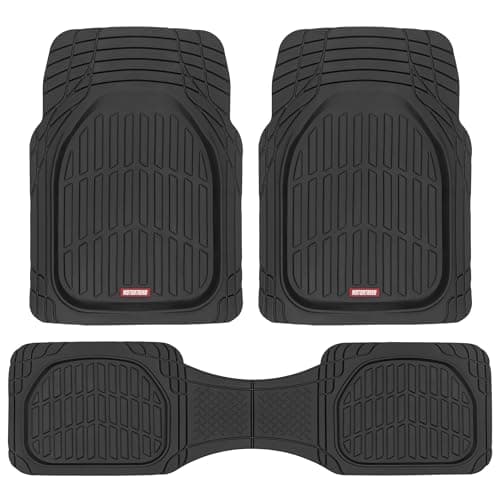
Trim-to-fit mats are the budget tier: a universal shape with a deep dish edge that you cut down yourself. The Motor Trend set we rank third publishes its dimensions — 27 by 20 inches at the front, 51 by 14 inches across the rear — which is the useful thing about buying universal: you can measure your footwell before you order rather than hoping.
The honest split: liners if you keep the car and drive it in winter, flat mats if the climate is mild, trim-to-fit if the car is older than the liners are worth.
Skip this
Skip universal mats in the driver's footwell
This is the one place we would not put a trim-to-fit mat, on any Subaru. The driver's side has retention hooks for a reason: an unsecured mat can creep forward under heel pressure and interfere with the pedals.
If you are buying universal mats anyway — and on an older Outback that is a perfectly rational choice — cut the driver's mat so the retention hole still lines up with the post, seat it on the post, and check it cannot slide when you push it with a boot.
Never lay any mat on top of the factory one. Stacked mats slide on each other, and no retention system is designed for two layers.
The part Outback owners actually forget
The cargo floor. An Outback gets bought for dogs, skis, bikes and firewood, and every one of those arrives wet in winter. The cargo carpet has the same padding as the footwells and sits over the same steel, with a spare wheel well underneath it collecting whatever gets through.
Husky publishes a cargo liner for the 2020-2025 Outback as a separate part from the floor set, and that is the pattern across this category: the cargo liner is a second purchase people skip. We rank cargo liners separately, including the trap where the tray is cut for one position of an adjustable cargo floor.
What we would buy
For a 2020-onward Outback in a salted state: molded liners, front and second row. The front pair does the daily work; the rear matters as soon as passengers get in with snowy boots.
For fit without the top price: the contoured Husky liners, published across the Outback range including the Wilderness, and shared with the Legacy if that is what you actually drive.
For an older Outback, or a second car: the trim-to-fit deep dish mats. Measure the footwell against the published dimensions, cut carefully, and keep the driver's mat on its retention post.
Then do the cargo area and, when the salt starts, actually empty the mats. A liner holding an inch of brine for a month is a reservoir, not protection.