Check which Model Y you have first
This is the fitment trap on this car and it is newer than most of the advice you will find. The Model Y has been in production since 2020, and it was substantially revised for the 2025 model year — new front and rear ends, and a reworked interior. Liners are cut to a scanned interior, so a part listed for 2021-2024 is not automatically the part for a 2025-onward car.
WeatherTech publishes fitment per model year on its Model Y FloorLiner page, which is the right way to check: select your year rather than buying from a listing that says “Model Y” and nothing else. If you bought the car used and are not certain of the model year, the door-jamb sticker settles it — not the year you took delivery.
The second thing to check is seating. Model Ys have been sold with a third row in some markets and configurations, and a set cut for a five-seat car does not cover a seven-seat one. Read the row count on the listing as carefully as the year.
What you are actually protecting on this car
Here the Model Y differs from a conventional crossover in a way worth understanding, because it changes what the mats are for.
The corrosion argument we make on the main floor mat roundup is about salt solution soaking through carpet into the padding and sitting against a steel floor pan for weeks. That argument applies to any car with carpeted footwells, and the Model Y has them.
What is different is everything around them. This car has a front trunk and a deep rear well under the cargo floor, and both are exactly where wet boots, snowy bags and salted groceries end up. They are separate liners, sold separately, and they are the ones people skip. On a car with this much enclosed storage, skipping them leaves most of the wet surfaces uncovered.
What the liners are worth
The visible problem is a dirty footwell. The expensive problem is underneath it: carpet padding is designed to absorb, which in winter means it holds brine against the floor structure for weeks at a time, in a place nobody inspects and no underbody wash reaches.
A set of molded liners is a two-figure to low-three-figure purchase that keeps that in a tray you tip out in the driveway. Against the cost of body repair on a unibody car, the arithmetic is not close — and on a vehicle of this value the resale argument is real too, because a clean interior is one of the few things a buyer can actually assess.
The honest limit: mats do nothing for the salt on the outside of the car, which is the more expensive half. Rinsing the underside on mild days does more for the vehicle overall and costs almost nothing.
Liner or flat mat, for this car
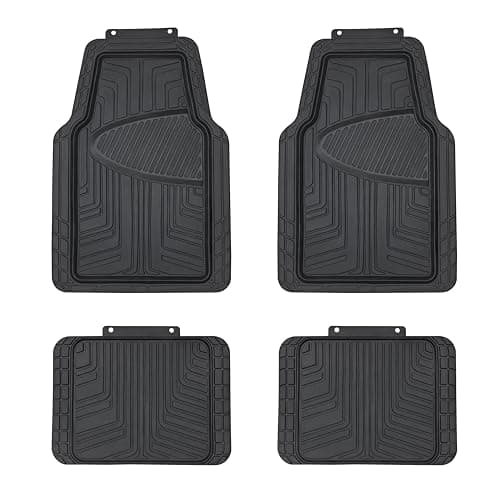
A liner is molded to the footwell with raised walls, so meltwater is contained instead of running to the edges. A flat mat is a tray with a low lip, cheaper and easier to hose off.
Our general guidance holds here: liners if you park outside in a salted region, mats if you are mostly protecting against mess. The Model Y-specific nudge toward liners is the footwell shape — a flat floor with a relatively high transmission-tunnel-free profile means water that gets past a low-lipped mat has a clear run across the floor rather than being caught by contours.
Skip this
Skip stacking anything on the factory mat
The same rule as every other car, and it is a safety rule rather than a tidiness one. A mat laid on top of another mat cannot engage the floor retention points and the stack can slide forward into the pedals as a unit. That is the scenario NHTSA’s floor mat guidance exists to address.
Remove the original mat and secure the replacement properly. If a liner will not sit on the retention points, it is the wrong fitment — not something to work around with a rubber pad underneath.
The related trap on this car specifically: trim-to-fit universal mats cut roughly to shape. Fine in the rear footwells where nothing is at stake beyond carpet. Not in the driver’s footwell.
Living with them through a winter
Empty them. A liner holding an inch of brine is not protecting the carpet — it is a reservoir sitting on top of it, and the seal around its edge was never designed to be watertight from below. Tip them out when you think of it, which in practice means when you next park somewhere you can.
Rinse rather than scrub, and keep them out of direct heat while drying. The method that does not cloud the surface is here.
Check underneath in March. If the carpet under the driver’s liner is damp at the end of winter, water is getting in around the edge rather than being caught by it. Better to find that out before another season than after one.
And if anything is sliding, that is fixable and it is a safety issue rather than an annoyance.