Dealer mats or aftermarket liners?
This is a decision people make at a desk with a pen in their hand, under time pressure, with no way to compare. Here is what each side publishes, before you sign.
Heads up: the buy links on this page are affiliate links. If you buy through one, we earn a commission at no extra cost to you. It does not change what we recommend or the order we rank things in - here is how we keep those separate.
Where this decision actually happens
Almost nobody researches this one properly, because of when it comes up: you are at the dealership, the car is bought, and accessories are being added to a number that already has four zeros in it. The all-weather liners are a few hundred dollars, they are on the same invoice, and the aftermarket alternative is a browser tab you have not opened.
So here is the comparison in advance. Both sides are legitimate; they differ in three things that are worth knowing before the pen moves: warranty, who guarantees the fit, and what happens to the retention system.
The warranty difference, which is the real one
This is where the two paths genuinely diverge, and it is published on both sides.
Dealer-fitted genuine accessories ride on the vehicle warranty. Toyota, for example, publishes that genuine parts purchased and installed by an authorized dealer are warranted for 12 months regardless of mileage, or the remainder of the New Vehicle Limited Warranty, whichever gives more coverage. Buy the same part over the counter and fit it yourself and the labor cover goes away.
Aftermarket liners carry the maker's own warranty instead, and in this category those are often longer. Husky publishes a lifetime guarantee on its liners; the practical difference is that the claim goes to the manufacturer rather than to the service desk you bought the car from.
Neither is better in the abstract. A twelve-month warranty you can walk into a dealership with is worth something; a lifetime warranty you have to mail a photograph for is worth something else.
| Dealer / genuine accessory | Aftermarket liner | |
|---|---|---|
| Warranty | 12 months regardless of mileage when dealer-installed, or balance of the new vehicle warranty (Toyota's published terms) | Manufacturer's own - Husky publishes a lifetime guarantee |
| Who guarantees fit | The vehicle manufacturer, for that exact model | The liner maker, from its own laser-measured fitment data |
| Retention | Designed around the factory hooks from the start | Published to use the factory retention posts |
| Where you buy | On the vehicle invoice, or the parts counter | Direct or online, at your own pace |
| Price position | Usually the most expensive of the three routes | Mid; universal trim-to-fit is cheapest |
| If it is wrong | Back to the dealer | Return through the retailer or maker |
Fit: closer than the argument suggests
The usual claim for dealer mats is that they are designed for the car. True - and so are the serious aftermarket liners, which are cut from the maker's own scan of that specific vehicle and published per model year and configuration.
Where the aftermarket actually trips up is the fitment traps we keep documenting: a range that excludes the hybrid, a truck part cut for one cab style and no fold-flat storage, or a cargo tray cut for one position of an adjustable floor. Buy from the dealer and those traps disappear, because the part is looked up against your VIN.
That is the honest case for paying the dealer price: you are buying the lookup as much as the rubber.
What the premium usually buys
Across this category the pattern is consistent: dealer all-weather liners sit at the top of the price range, the molded aftermarket liners sit below them, and trim-to-fit universal sets sit well below both.
What the top of that range buys you is the VIN lookup, a warranty you can walk in with, and the badge. What it does not buy you is more rubber or a deeper tray - the aftermarket liners are published with the same raised-lip construction and the same use of the factory retention posts.
So the question is not "which is better made". It is whether the lookup and the dealer warranty are worth the difference to you, on a part you are going to hose out in a driveway.
Skip this
Do not let anyone stack mats on the factory carpet set
Whichever route you take, the new mats replace the originals - they do not go on top. This is the one place where a bad decision has a safety consequence rather than a cosmetic one: stacked mats slide on each other, and no retention system is designed for two layers.
Check the driver's mat engages the factory posts before you drive away, whether the dealer fitted it or you did. If a universal mat is going in that footwell, cut it so the retention hole still lines up and seat it on the post.
Three cases, three answers
Buying new, keeping the car, and the mats are being rolled into the finance: take the dealer set if the price gap is small. The lookup is done, the warranty is simple, and the cost is buried in a payment you were making anyway.
Buying used, or adding mats later: aftermarket, every time. You have time to read the fitment line, the choice is wider, and the brands compare closely on what matters.
Older car, or a lease you are handing back: trim-to-fit. Protect the carpet for a fraction of the money and do not think about it again.
In all three cases the thing being protected is the same: the carpet padding, and the floor pan underneath it that road salt quietly works on all winter.
What to buy, given all that
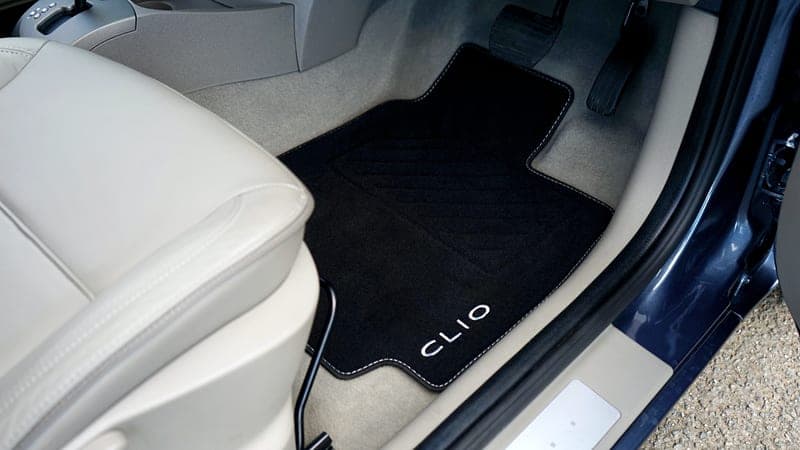
WeatherTech
WeatherTech FloorLiner
Roughly $120-$200 a row
A laser-measured, vehicle-specific liner with walls that run up the sides of the footwell. The walls are what you are paying for: they hold slush and salt solution where a flat mat lets it run off onto the carpet edges.
Skip it if: Your budget is the reason you are here. This is three to four times the price of a universal rubber mat that catches most of the same water.
#ad We hold no verified live price for this product, so we show none. How this site is funded.
Husky Liners
Husky Liners X-act Contour Floor Liners
Roughly $110-$180 a row
The main rival to the WeatherTech liner, and softer underfoot. The trade is straightforward: a more pliable compound is quieter and warmer to stand on, and slightly less rigid when you lift a full liner out of the car.
Skip it if: You want the most rigid tray possible for lifting out full of slush.
#ad We hold no verified live price for this product, so we show none. How this site is funded.
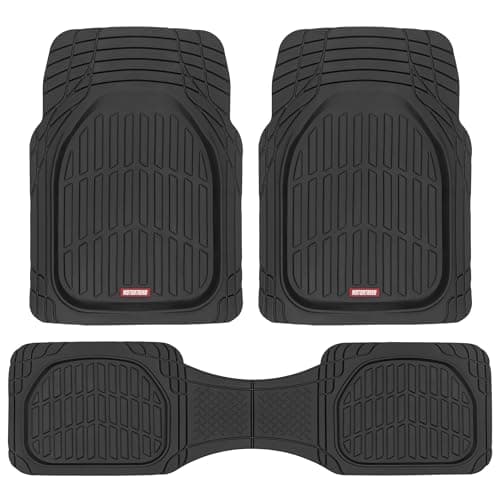
Motor Trend
Motor Trend FlexTough Deep Dish Floor Mats
The cheapest way to cover four footwells
The trim-to-fit answer, and the only one on most vehicle pages that carries a live price rather than a fitment lookup. Deep dish edges do more than a flat mat, and the compromise is that you are cutting a universal shape to a footwell it was not molded for.
Skip it if: You want the driver's footwell done properly. A universal mat rarely engages the factory retention posts, and that is the one place it matters.
#ad Price as of October 18, 2026, from Amazon. Prices change. How this site is funded.
How this was ranked
Every site in this category says it tested twenty of these. We have not tested any, and we say so. What we did instead: built the candidate set from what Amazon actually stocks, compiled the published specifications from each manufacturer’s own pages, did the arithmetic on running cost and on what the thing prevents, and read owner reviews for failure patterns rather than star averages. Every number on this page has a link to where it was published, so you can check the work.
- Units we claim to have tested
- 0
- Sponsored placements
- 0
- Free products accepted
- 0
Frequently asked
Are dealer all-weather floor mats better than WeatherTech?
Not inherently. Both are cut for the specific vehicle and both use the factory retention posts. The dealer set buys you a VIN-accurate lookup and a warranty you can walk into the dealership with; the aftermarket set is usually cheaper and often carries a longer manufacturer warranty.
What warranty do OEM floor mats come with?
It follows the vehicle accessory terms. Toyota publishes that genuine parts purchased and installed by an authorized dealer are warranted for 12 months regardless of mileage, or the remainder of the New Vehicle Limited Warranty, whichever is greater - and that over-the-counter purchases do not include the labor cover.
Is it cheaper to buy floor mats from the dealer or aftermarket?
Aftermarket is generally cheaper, and universal trim-to-fit sets are cheaper still. The dealer premium buys the fitment lookup and the warranty path rather than more material.
Do aftermarket liners use the factory floor mat clips?
The serious ones are published to use the factory retention posts, which is the specification that matters on the driver's side. Universal trim-to-fit mats often do not, which is why we would not put one in the driver's footwell without cutting it to engage the post.
Should I buy floor mats when I buy the car?
If the gap to the aftermarket price is small and the mats go onto the same invoice, it is a reasonable convenience. If the gap is large, buy aftermarket later - you will have time to check the fitment line for your exact model and powertrain, which is where most mistakes in this category happen.
Do OEM mats avoid the hybrid and trim fitment traps?
Yes, because the part is looked up against your vehicle rather than a model-year range. That is the strongest practical argument for the dealer route, given how often aftermarket ranges exclude a hybrid, a cab style or a particular cargo-floor position.