WeatherTech FloorLiner or FloorLiner HP?
Same brand, same laser-measured fit, two different polymers. For a winter footwell carrying salt, grit and wet boots, the newer and softer one is not the answer - and WeatherTech's own comparison is the reason why.
Heads up: the buy links on this page are affiliate links. If you buy through one, we earn a commission at no extra cost to you. It does not change what we recommend or the order we rank things in - here is how we keep those separate.
The answer first
For a winter car in a salted state, buy the standard FloorLiner. The HP is the better product for a quiet luxury interior and the worse one for wet boots.
WeatherTech’s own published comparison settles it in one sentence: the standard liner’s rigid construction “makes it highly resistant to deformation over time, even under heavy usage. The FloorLiner HP, while still durable, has a softer material that may show more wear in high-traffic areas.” A winter driver’s footwell is the definition of a high-traffic area.
Who each is for:
Standard FloorLiner — a truck, an SUV, a work vehicle, or any car that gets boots, grit and brine in the footwell. The rigid tray holds its shape and its walls.
FloorLiner HP — a car with a delicate carpeted interior, or one with no factory retention hooks, where a softer, more flexible liner that grips rather than clips is genuinely the better engineering answer.
What WeatherTech publishes about the difference
The two liners share the thing people buy WeatherTech for: both are published as laser-measured for an exact fit to the vehicle. What differs is the polymer, and everything else follows from that.
| FloorLiner (standard) | FloorLiner HP | |
|---|---|---|
| Material | High-density tri-extruded (HDTE) thermoplastic | Thermoplastic elastomer (TPE) |
| Properties | "Rigid, durable, and offers a semi-hard structure" | "Softer, more flexible, 100% recyclable, latex-free" |
| Published best for | "Heavy-duty use, excellent water resistance" | "Luxury vehicles, comfort, eco-conscious buyers" |
| Installation | "More rigid, snaps into place" - suits vehicles with factory retention hooks | "Stays in place without factory retention hooks" due to a grippy underside |
| Shape retention | "Highly resistant to deformation over time, even under heavy usage" | "May show more wear in high-traffic areas" |
| Underfoot feel | Firm, structured surface | Softer, slightly cushioned |
| Appearance | "Rugged, utilitarian" | "Sleeker, more refined" |
| Fit method | Laser-measured for an exact fit | Laser-measured for an exact fit |
| Price | The lower of the two | "Slightly higher price" |
Why rigidity is the winter specification
Everything a floor liner is for in winter comes down to one job: holding a volume of salted meltwater away from the carpet until you tip it out. That is a structural task, not a comfort one.
The walls are the product. A liner is a tray, and what separates it from a mat is that the sides stand up and contain liquid. A rigid HDTE wall holds its height whether it is January or its fourth January. A softer elastomer wall is more inclined to relax, roll outward or take a set under a heel that lands in the same spot every day.
Deformation is the failure mode that matters. This is why WeatherTech’s own “highly resistant to deformation over time” line is the sentence to read twice. A liner whose shape has relaxed no longer sits where it was laser-measured to sit, and a liner that no longer sits properly is a pedal-interference risk as well as a water-containment failure.
And the brine is the reason any of it matters. Salt solution in carpet padding is where floor pans rust from the inside out, which is the mechanism the whole worth-it question turns on. A liner that holds its tray shape prevents that. A liner that has gone soft at the edges only mostly prevents it.
Where the HP genuinely wins, and it is not a small case
It would be lazy to write the HP off, because WeatherTech publishes a real engineering advantage for it: it “offers a snug fit even in vehicles without factory retention hooks due to its grippy underside.”
That matters more than it sounds. The standard liner is published as working best in vehicles with factory retention hooks, because a rigid tray needs something to anchor to. If your car has no hooks, the rigid liner is relying on its own weight and friction against carpet — and a liner that can slide is the one failure in this category with a safety consequence rather than a cosmetic one.
So the decision tree has two questions, not one:
Does your car have factory retention hooks? If yes, the standard liner, and the winter argument is settled. If no, the HP’s grip is doing work the rigid liner cannot, and that can outweigh the wear difference.
Is it a curved footwell? WeatherTech publishes the HP as “ideal for cars with curved footwells,” because a flexible liner can follow a shape a semi-hard one has to approximate.
That reading is ours, from WeatherTech’s published retention and material notes.
What neither of them changes
Fitment is still per vehicle, and still the thing that goes wrong. Both ranges are laser-measured, which means both are sold against a specific year, make, model and often trim. That is why nothing WeatherTech on this site carries a single fixed product link: you have to buy your own vehicle’s part. The traps are real and documented — several liner ranges exclude the RAV4 Hybrid, for instance, and cab and cargo-floor variants catch out truck buyers. Use the vehicle lookup, not the thumbnail.
Neither is a cheap purchase. Both sit at the top of this category, and the honest comparison is not HP against standard but either of them against a $25 universal set. We do that arithmetic in full on the three-way comparison, and the short version is that the cheap set does most of the job if you are willing to fit it properly and accept a worse shape.
Neither replaces emptying them. A tray full of brine that never gets tipped out is a tray that has moved the problem from the carpet to the seam under the liner. The cleaning routine is about ten minutes a month and it is the part that decides whether either of these was worth the money.
The figure neither of them publishes
For a winter buyer there is a specification missing from both product pages, and it is the one that would actually settle this: neither liner publishes a cold-flexibility figure.
That matters because an all-weather liner spends its hardest nights at temperatures where polymers stiffen. A liner that is pleasantly firm at 70 F and brittle at 5 F is a liner that cracks at the fold when you pull it out to tip the brine away — which is, in practice, how most of these die. It is also the moment a hard-edged tray is most likely to mark a sill.
On the face of it the softer TPE should be the better cold performer, because elastomers generally retain flexibility further down the scale than a rigid thermoplastic does. But WeatherTech publishes no number for either material, so that is a reasonable inference rather than a fact, and we are not going to dress it up as one. The same gap exists across the whole category — no maker on this site publishes a cold-flex rating for a floor liner.
The practical workaround costs nothing: in deep cold, run the defroster for a minute before you yank a frozen liner out, and lift it by the edge rather than folding it in half. That applies to whichever one you buy.
What “laser-measured” buys you, and what it does not
Both ranges are published as laser-measured for an exact fit, and that phrase is doing more work than people realize. It is why these cost what they cost, and it is also the source of the only real risk in buying one.
What it buys: a tray whose walls climb the exact contour of your footwell, which is the difference between containing a liter of salted slush and spreading it. A universal mat cannot do that because it is cut to a generic profile; a trimmed universal mat cannot either, because you are approximating by hand what a scan did precisely.
What it does not buy: any tolerance for buying the wrong part. An exact fit for a 2023 model is not an exact fit for a 2024 one if the floor pan changed, and liner ranges routinely exclude hybrid variants, specific cab configurations and cars with a raised cargo floor. The fitment lookup is not an upsell, it is the product.
The HP adds one published claim the standard liner does not: it is stated as 100 percent recyclable and latex-free. If that matters to you it is a genuine differentiator, and it is independent of everything else on this page.
Skip this
Do not buy the HP because it is newer
The HP is the more recent product and it is marketed on comfort, aesthetics and recyclability. Those are real benefits, and none of them is a winter benefit.
WeatherTech itself positions the standard liner as the answer for “work trucks, off-road vehicles, and heavy-duty SUVs” and the HP for cars like a BMW X5 or a Mercedes E-Class, where it “provides a more luxurious and comfortable feel.” If your question is what survives a winter of salted boots, you are the first customer, not the second.
The exception is the retention-hook case above. That one is engineering rather than marketing, and it can genuinely flip the answer.
WeatherTech names the vehicles, which is unusually helpful
Most makers leave positioning implicit. WeatherTech does not: its published comparison gives worked examples on both sides, and they are the clearest statement of intent you will find.
For the standard FloorLiner it names trucks — the Ford Ranger, the RAM 1500, the Toyota Hilux — and says the rigid material “holds up well against dirt, gravel, and heavy boots.” Dirt, gravel and heavy boots is a fair description of a footwell in February.
For the FloorLiner HP it names a BMW X5 and a Mercedes-Benz E-Class, and says the HP “provides a more luxurious and comfortable feel.” Nothing in that sentence is about brine.
One more decision worth folding in while you are here, because it affects the bill more than the choice between these two: buy the front row first. The driver’s footwell takes the overwhelming majority of the water because the driver gets in every single time, and a full three-row set triples the spend to protect footwells that may never get wet. Check the rear carpet in March and add rows where there is evidence.
Who should buy which
Truck, SUV, work vehicle, or any car in a salted state: the standard FloorLiner. Rigid HDTE, snaps to the factory hooks, published as highly resistant to deformation under heavy use.
No factory retention hooks, or a deeply curved footwell: the HP. Its grippy underside is solving a problem the rigid liner cannot, and a liner that stays put beats a liner that lasts longer but slides.
A quiet commuter car with a nice interior and dry feet: the HP, comfortably. You are buying the softer feel and the finish, which is exactly what it is for.
On a budget, in a salted state: neither. A trim-to-fit universal set at a fraction of the price, cut carefully and secured to the factory retention points, keeps the brine off the carpet — which is the whole job. Mats versus liners is the page for that decision.
What to buy, given all that
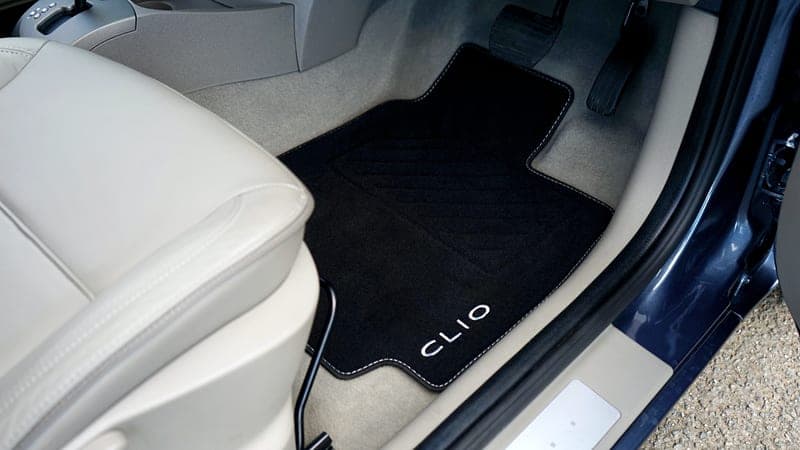
WeatherTech
WeatherTech FloorLiner
Roughly $120-$200 a row
A laser-measured, vehicle-specific liner with walls that run up the sides of the footwell. The walls are what you are paying for: they hold slush and salt solution where a flat mat lets it run off onto the carpet edges.
Skip it if: Your budget is the reason you are here. This is three to four times the price of a universal rubber mat that catches most of the same water.
#ad We hold no verified live price for this product, so we show none. How this site is funded.
Husky Liners
Husky Liners X-act Contour Floor Liners
Roughly $110-$180 a row
The main rival to the WeatherTech liner, and softer underfoot. The trade is straightforward: a more pliable compound is quieter and warmer to stand on, and slightly less rigid when you lift a full liner out of the car.
Skip it if: You want the most rigid tray possible for lifting out full of slush.
#ad We hold no verified live price for this product, so we show none. How this site is funded.
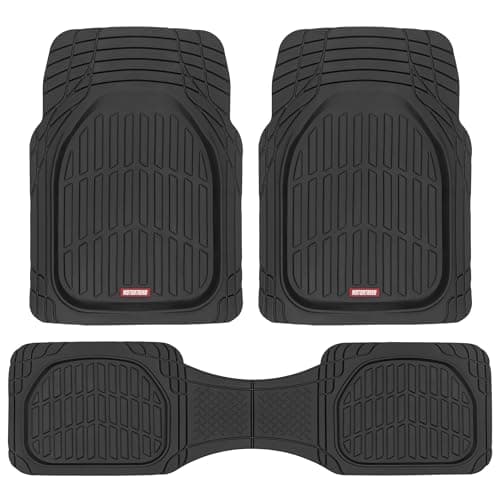
Motor Trend
Motor Trend FlexTough Deep Dish Floor Mats
The cheapest way to cover four footwells
The trim-to-fit answer, and the only one on most vehicle pages that carries a live price rather than a fitment lookup. Deep dish edges do more than a flat mat, and the compromise is that you are cutting a universal shape to a footwell it was not molded for.
Skip it if: You want the driver's footwell done properly. A universal mat rarely engages the factory retention posts, and that is the one place it matters.
#ad Price as of October 18, 2026, from Amazon. Prices change. How this site is funded.
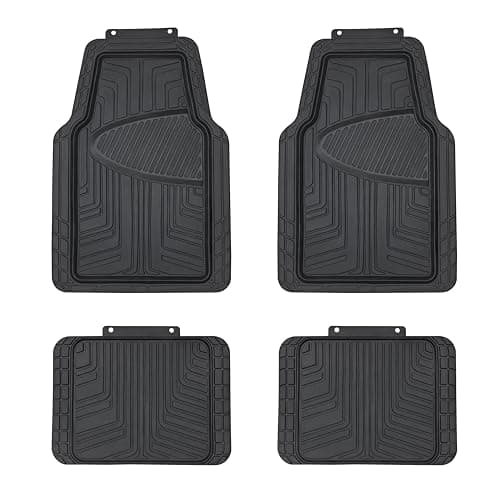
Amazon Basics
Amazon Basics 4-Piece All-Season Floor Mats
Roughly $20-$30 a set
The cheapest way to get something washable under all four sets of boots. It is a flat trim-to-fit mat, so it holds less water than a molded liner and it will never fit like one - but the salt ends up on the mat instead of the carpet, which is the entire job.
Skip it if: You want the driver's footwell done properly. A universal mat trimmed with scissors does not engage the factory retention posts, and that is the one footwell where it matters.
#ad Price as of October 18, 2026, from Amazon. Prices change. How this site is funded.
How this was ranked
Every site in this category says it tested twenty of these. We have not tested any, and we say so. What we did instead: built the candidate set from what Amazon actually stocks, compiled the published specifications from each manufacturer’s own pages, did the arithmetic on running cost and on what the thing prevents, and read owner reviews for failure patterns rather than star averages. Every number on this page has a link to where it was published, so you can check the work.
- Units we claim to have tested
- 0
- Sponsored placements
- 0
- Free products accepted
- 0
Frequently asked
What is the difference between WeatherTech FloorLiner and FloorLiner HP?
The polymer. WeatherTech publishes the standard FloorLiner as high-density tri-extruded (HDTE) thermoplastic — rigid, semi-hard, best for heavy-duty use — and the FloorLiner HP as a thermoplastic elastomer (TPE) that is softer, more flexible, 100 percent recyclable and latex-free. The standard snaps into factory retention hooks; the HP stays put without them thanks to a grippy underside.
Is the FloorLiner HP better than the standard FloorLiner?
It depends what you are protecting against. WeatherTech publishes that the standard liner is “highly resistant to deformation over time, even under heavy usage,” while the HP “has a softer material that may show more wear in high-traffic areas.” For a winter footwell with salt, grit and boots, that makes the standard liner the better buy. For a luxury interior or a car with no retention hooks, the HP is the better fit.
Which WeatherTech liner is better for winter?
The standard FloorLiner. A winter liner is a tray whose job is to hold salted meltwater away from the carpet, and that is a structural task — the rigid HDTE walls hold their height and shape. WeatherTech’s own published positioning puts the standard liner in work trucks and heavy-duty SUVs, and the HP in luxury cars.
Does the FloorLiner HP need retention hooks?
No, and that is its real advantage. WeatherTech publishes that the HP “offers a snug fit even in vehicles without factory retention hooks due to its grippy underside,” while the standard liner is published as working best in vehicles that have them. If your car has no hooks, the HP is solving a genuine problem rather than a cosmetic one.
Is the FloorLiner HP more expensive?
WeatherTech publishes it as carrying a “slightly higher price” than the standard liner. Both are at the top of this category, and the more consequential comparison for most budgets is either of them against a trim-to-fit universal set at a fraction of the cost.
Are both WeatherTech liners custom fit?
Yes — both ranges are published as laser-measured for an exact fit, which also means both are sold per year, make, model and often trim. That is where the real buying risk sits: liner ranges frequently exclude hybrid variants or specific cab and cargo-floor configurations, so use the vehicle lookup rather than a picture.
Sources
- WeatherTech - published FloorLiner versus FloorLiner HP comparison (HDTE thermoplastic versus thermoplastic elastomer, rigidity, retention, recyclability, wear)
- WeatherTech floor mats and liners - published product information
- WeatherTech All-Weather Floor Mats - published product information
- Husky Liners - published product information
- NHTSA - floor mat and pedal entrapment safety guidance